Wednesday, September 28th 2022

Intel Raptor Lake Processor with 34 P-Cores Spotted
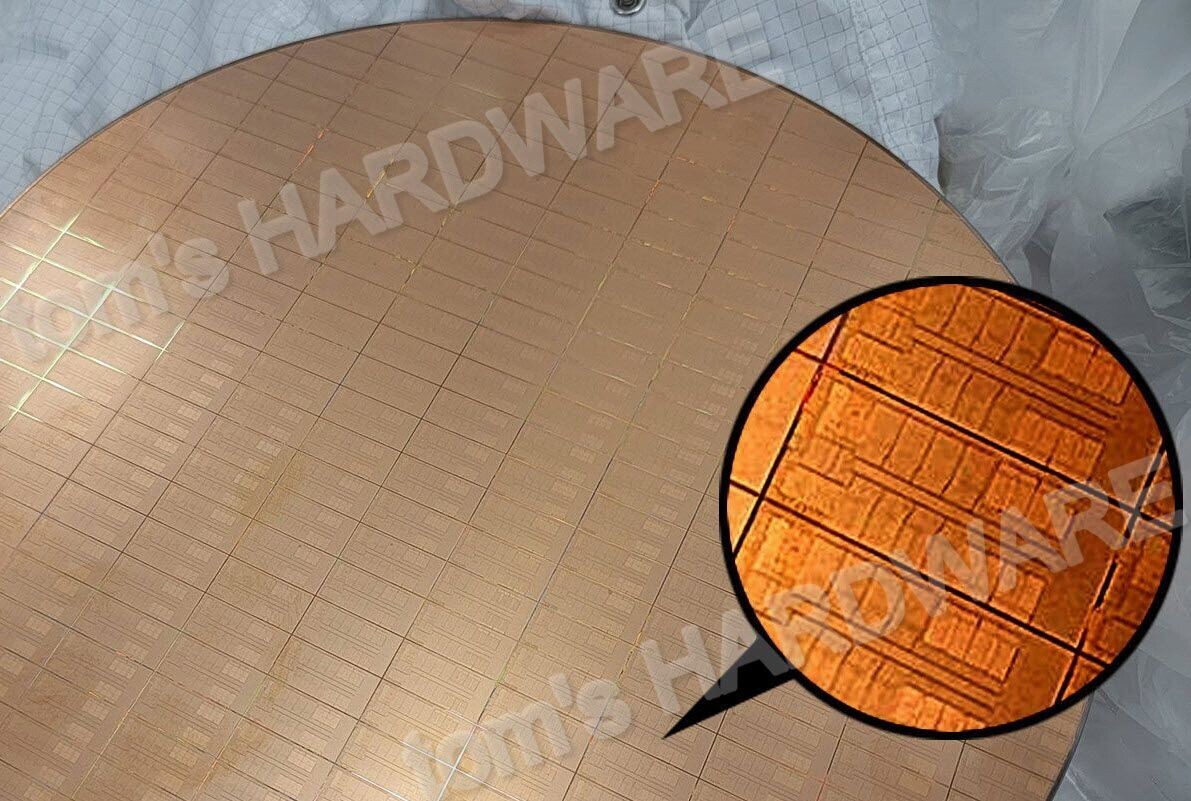
Yesterday Intel announced its 13th generation Raptor Lake processor lineup. The top-of-the-line model, Core i9-13900KS, features eight P-cores and 16 E-cores for a total of 24 cores in the SoC. However, that may not represent the maximum for Raptor Lake, as there appears to be another segment equipped with a Raptor Lake processor with 34 cores. According to findings of Tom's Hardware, the Intel Innovation event in San Jose had a surprise for everyone, as there was a booth to display Raptor Lake silicon wafers. After closer examination, the wafer had cutouts for dies that contained as many as 34 cores.
With all cores being the same size, it is assumed that those are P-cores interconnected on a mesh, unlike the traditional ring bus that the rest of Raptor Lake processors use. On the back of the wafer was a label stating, "Raptor Lake-S, 34 core". This suggests that the CPU is perhaps a part of the HEDT offerings that Intel will soon update with the 13th generation designs and that the company showcased a production wafer for those SKUs. We expect to hear more about this unknown 34-core configuration sometime in the future as the new Intel Core generation begins its rollout.


Source:
Tom's Hardware
With all cores being the same size, it is assumed that those are P-cores interconnected on a mesh, unlike the traditional ring bus that the rest of Raptor Lake processors use. On the back of the wafer was a label stating, "Raptor Lake-S, 34 core". This suggests that the CPU is perhaps a part of the HEDT offerings that Intel will soon update with the 13th generation designs and that the company showcased a production wafer for those SKUs. We expect to hear more about this unknown 34-core configuration sometime in the future as the new Intel Core generation begins its rollout.


57 Comments on Intel Raptor Lake Processor with 34 P-Cores Spotted
As you can see in "slide2" image, after you get past the 8th thread on 12900K where it starts to use hyper threading, the 7950x starts beating the snot out of it. Then the 7950x gets to it's 15th/16th thread and stops leaving it in the dust as it has to start using HT. At the 24th thread, the 12900k runs out of E cores and the 7950x continues its lead.
Looking just at 12900K results: if I normalize the 8T performance to 100%, next 8 threads (E, not HT) add 45% more, and then next 8 threads (HT) add another 37%.
Looking just at 7950X results: if I normalize the 8T performance to 100%, next 8 threads (not HT) add 80% more, and then next 8 threads (HT) add another 41%.
+45% seems little for E-cores but even on AMD it doesn't scale to +100%, there must be some contention elsewhere in both systems (cache, RAM, boost limits, I don't know).
+37 is quite close to +41%, indicating a similar efficency of HT. Very good actually, and if there was some contention before, there's more now. From what I've read and understood, the effect of HT is the greatest if the two threads are doing very different things, thus competing less for the same execution units. But in MT benchmarks, all threads are given exactly the same code to crunch, so it's a bad case for HT to show its strength.
But there's a but. MT benchmarks just record the total performance of all running threads. If one runs slower than the other on the same core, it won't show anywhere. So these results don't either confirm or deny what I stated before: that both threads on the same core run equally fast (and each is about 30-35% slower than a thread with no HT).