News Posts matching #HEDT

Return to Keyword Browsing

Intel "Nova Lake-S" Tested with AVX-512 and APX Enabled

Intel's upcoming "Nova Lake-S" series of desktop processors is set to bring some exciting changes. As previous rumors suggested, the company is incorporating the AVX-512 and APX instruction sets into this new processor lineup. Late last year, Intel published its 60th Architecture Instruction Set Extensions and Future Features manual, indicating that ultra-fast vector processing with 512-bit width is returning to desktops after years of absence from this sector. Thanks to @InstLatX64 on X, we have learned that the company is testing two SKUs—a 24-core model running at 3.4 GHz and a 28-core model running at 3.2 GHz—both featuring AVX-512 and APX instruction support. This further supports the claim that Intel's desktop processors are returning to their full potential.

Powered by "Coyote Cove" P-Cores and "Arctic Wolf" E-Cores, both models will support AVX-512 and APX, aligning software optimization and support with the HEDT and Xeon server segments that already use these vector and advanced accelerators. Initially, Intel chose to disable AVX-512 for the "Alder Lake" and "Raptor Lake" client-oriented CPU lineups, meaning only server-grade Xeon CPUs benefited from the accelerated 512-bit data paths. This decision was due to differences in P-Core and E-Core designs, which complicated software optimization on the consumer side. However, with "Nova Lake," these features are finally making a comeback.

Intel Readies Two 22-Core "Nova Lake-S" SKUs with 108 MB bLLC Cache for Gaming

According to well-known Intel leaker Jaykihn, Intel is preparing two "Nova Lake-S" CPU models with a 22-core configuration, enhanced by the big Last Level Cache (bLLC). These processors are part of the Core Ultra 5 400S family, and Intel is developing two mid-range configurations, each with 22 cores. Both models will feature 6 "Coyote Cove" P-Cores, 12 "Arctic Wolf" E-Cores, and 4 LPE-Cores. This design includes a single compute die aimed at mid-range gaming rigs. Alongside the 22 cores, Intel plans to add an extra 108 MB of bLLC cache to boost gaming performance, similar to AMD's approach with its Ryzen X3D gaming CPUs, which currently lead in gaming performance. Intel aims to match raw CPU compute power with newer CPU cores and use bLLC to improve latency-sensitive tasks like gaming. The only difference between the two new models is that one is an unlocked 125 W TDP version, part of the "K" overclockable family, while the other is a 65 W base TDP model.

Recently, it has been observed that Intel's upcoming Z9x0 platform for "Nova Lake-S" will support up to 52 cores in a single LGA-1954 socket. Some early rumors suggest a PL2 power draw of 474 W, which is a significant increase over previous designs. This is understandable, considering that the design brings workstation-like core counts into the consumer sector for the first time. Regarding the socket, Intel's LGA-1954 has been pictured with a 2-lever independent loading mechanism (ILM), similar to what Intel's HEDT sector uses. This is typically reserved for larger CPU packages, and with the pin count now nearing 2,000 socket pins, it is a necessary choice for Intel. Importantly, the first "Nova Lake-S" CPU SKUs are scheduled for release in just a few months, likely leading to more rumors as we approach the final launch.

AMD Ryzen Threadripper TR6 "Mustang Peak" Arrives with "Zen 6" and PCIe 6.0

AMD, through its official documentation portal, has confirmed the arrival of the next-generation Ryzen Threadripper TR6 "Mustang Peak" platform, along with some intriguing details about the upcoming CPU lineup. Based on the "Zen 6" CPU architecture, AMD is incorporating the latest I/O standards for these workstation powerhouses, including PCIe 6.0 and DDR5. As the "Zen 6" CPU cores are manufactured on TSMC's 2 nm semiconductor node, we expect AMD to increase the core count over its previous "Zen 5" Ryzen Threadripper workstation platform and deliver a significant performance boost due to advancements in node and microarchitecture. While specific details like TDP, clock speed, core counts, and segmentation are still lacking, we have learned that AMD is retiring its TR5 socket in favor of the new TR6 socket that will accommodate the platform.

With the introduction of PCIe 6.0, which doubles the bandwidth of PCIe 5.0 per lane configuration, AMD needs to add more pins to handle the increased bandwidth. Additionally, with varying core counts and clock speeds, the CPU socket likely requires more electrical capacity to support the new platform, necessitating an overhaul. If readers recall, the previous TR5 socket used 4,844 pins. For the TR6 update, it is possible that the pin count could exceed that number.

ID-Cooling Expands Into PC Chassis, Displays Air Coolers, AIOs and Fans at Computex 2026

ID-Cooling came to Computex 2026 with an extensive lineup that includes for the first time PC cases alongside the usual cooling lineup. The cases are designed to match ID-Cooling's own cooler aesthetic, with front panels sharing the same design as the components inside and coming pre-installed with their latest fans. The Flow 500 Wood White was catching our attention with whitewashed wooden front panel accents that look noticeably more premium than the typical mesh-and-glass mid-tower. The Flow 500 series covers wood and non-wood variants with vertical and horizontal ventilation, a detachable front grille 360 mm radiator support and a front USB-C port. The View 500 series goes panoramic with a 270-degree glass design, up to nine fans and 360 mm radiator support, while the View 510 steps up to ten fans, dual 360 mm radiator support, and eight expansion slots. The Ware series (300, 310, 510, each with and without ARGB) rounds out the case lineup.

On the AIO side, the flagship is the DL360 Curve, a 360 mm unit with a 6.67-inch curved 2400×1080 display, 2900 RPM pump, and fans spinning up to 2500 RPM.

V-Color Brings Cutting-Edge Memory to Computex 2026: 4R DIMM, EXPO-ULL, Memory with LED Displays, and More

V-Color brought a slew of new memory products to Computex 2026. We begin our tour with the V-Color Xfinity+ OLED Manta, a high-end DDR5 memory module with an OLED matrix display on the module, besides an ARGB diffuser. This display puts out real-time stats such as module voltage, temperature, speeds, timings, etc., along with animations showing whether EXPO or XMP is activated. We're not sure if an onboard circuit drives this display, or whether it's connected to software. The DIMM comes in speeds of up to DDR5-8600, and densities of up to 32 GB per module.

Next up, is the company's DDR5 4R UDIMMs (quad-rank). The first module shown offers 128 GB of density with DDR5-8800 CL62 @ 1.4 V, along with ECC support. The second module shown offers 256 GB from a single module, with speeds of DDR5-7600 and CL62 @ 1.25 V, along with ECC support. The 256 GB 4R DIMM is probably for the HEDT crowd, because a single stick would max out the memory limit of a Core Ultra Series 2 "Arrow Lake-S" processor.

Intel Announces Xeon 600 Workstation Processors Implementing "Redwood Cove" P-cores

Intel launches the new Xeon 600 series "Granite Rapids-WS" processors targeting workstations and HEDTs (high-end desktops). These had been announced in February. These processors mainly target AI development, where you take advantage of Intel AMX (FP16) accelerators, and a fully-fledged AVX-512 instruction set, along with a large PCIe I/O. The key talking point with this processor is its Compute complex. The processor comes with up to 86 "Redwood Cove" P-cores. These are the same P-cores powering Core Ultra "Meteor Lake" processors, and feature Hyper-Threading, besides a full-fat AVX-512 pipeline. The top-speed SKU hence comes with an 86-core/172-thread configuration, with a maximum Turbo Boost frequency of 4.80 GHz. Intel claims that the core-configuration offers a 61% multithreaded performance gain over the previous generation.

The Intel Xeon 600 series is built in the LGA4710 package, and supports Intel W890 chipset. It is configured with an 8-channel DDR5 memory interface (16 sub-channels), supporting up to 4 TB of ECC DDR5 memory, with speeds of up to DDR5-8000 being supported. The processor's PCIe root complex puts out 128 PCI-Express Gen 5 lanes. Intel is also offering CPU overclocking features with these processors. There are as many as 11 processor models, with core-counts ranging from the top 86-core/172-thread down to 12-core/24-thread, all models come with 8-channel ECC DDR5 memory and PCI-Express 5.0 x128. All processor models support Intel vPro remote manageability feature-set.

Fully Unleashed "Nova Lake-S" 52-core HEDT CPUs Only Supported by Certain Motherboards?

Earlier last week, more details emerged regarding Intel's rumored top-level 52-core "Nova Lake-S" processor model. According to recent leaks, this flagship Core Ultra Series 4 design is expected to feature a 16 P-core, 32 E-core, and 4 low-power island E-core configuration, paired with big last-level cache (bLLC). An unprecedented 700 W power consumption figure (under full load) was floated by kopite7kimi, with Jaykihn weighing in about the "NVL-S" series' TJMax (Thermal Junction Maximum) not being offset. Also, they mentioned that "thermal throttling cannot be disabled." Days later (on February 13), Jaykihn issued another "preliminary" prediction: "only some (motherboards) will support the full-power 52-core (52C) platform. Other boards will limit the performance and power of the 52C platform." When poring over this information, VideoCardz connected dots between the very best "Core Ultra Series 4" dual-tile options to a speculative and new "Core X" HEDT product lineup.

In theory, the highest level models could bear "Core X9" designations; akin to the recently launched flagship "Panther Lake-H" chip (Core Ultra X9 388H). Normally, Intel's workstation-focused Xeon processor families have occupied the HEDT segment. As a fallback hypothesis, VideoCardz envisions the "X" marking being applied exclusively to bLLC-augmented variants—likely specifying advertising elevated gaming performance; similar to AMD's "X3D" naming scheme. In their past weekend report, the popular online publication has dismissed rumors about Team Blue nixing the single-tile (with bLLC) side of the "Nova Lake-S" series. Instead, VideoCardz envisions two "mainstream" single-tile SKUs arriving—later in the year—pipped to take on equivalents within Team Red's Ryzen 7 and 9 desktop processor tiers. Two larger siblings, in premium dual-time form (with bLLC), are anticipated as forming a new HEDT line.

AMD Ryzen Threadripper Pro 9995WX OC Draws 1,300 W Under Direct-Die Watercooling

AMD Ryzen Threadripper Pro 9995WX HEDT processor with 96 cores and 192 threads comes with a default TDP of 350 W. However, heavy overclocking can bring the CPU to 1,300 W and requires a custom integrated heat spreader (IHS) that serves as a direct-die waterblock. In the latest endeavor by Geekerwan, the enthusiast created a custom fin structure inside the Ryzen Threadripper Pro 9995WX IHS that serves as a direct-die waterblock to achieve an impressive overclock of 5.325 GHz, drawing an astonishing 1,340 W during load, with the entire system drawing around 1,700 W. According to Geekerwan, he contacted ASUS China regional manager Tony Yu to experiment with different IHS designs before "ruining" the IHS of a $12,000 HEDT CPU. He then proceeded with trying a straight fin structure common in commercial waterblocks, but also conducted computer simulations that showed a curved, wavy S-shaped fin structure is the most efficient in capturing heat, as the coolant flows over a longer distance with minimal obstruction, resulting in 20% better cooling than the straight fin structure.

The IHS of the AMD Ryzen Threadripper Pro 9995WX processor is 4.1 mm thick, which left Geekerwan with about 2.0 mm of fin depth and about 2.1 mm for the structural integrity of the IHS, which is subject to a lot of water pressure. After a heavy 19-hour session of CNC milling, the result is a CPU that ran between 30-50°C, which is an amazing temperature under Cinebench 2026 load. The system also placed 7th in Cinebench R23, just behind an LN2-cooled AMD Ryzen Threadripper Pro 7995WX running at 6.2 GHz. Impressive heat dissipation and the massive 5.325 GHz clock on a 96-core system are also made possible with an industrial chiller, two Bosch water pumps from cars, and a 37-gallon water tank. You can check out the entire process below.

OCCT Tool Gets Intel Xeon 600 "Granite Rapids-WS" Overclocking Support

OCBASE has updated its OCCT tool to include overclocking support for Intel's latest Xeon 600 "Granite Rapids-WS" workstation processors, designed for precise tuning of Intel's best HEDT offering. While OCCT is traditionally known for hardware stability testing, OCBASE aims to transform it into a universal platform that combines fine-tuning, including overclocking, with stability testing in a single application. The company has worked with Intel to create a special skin for the OCCT tool, featuring an Intel-like blue and white theme. Besides the visual makeover, lots of under the hood changes follow.

For instance, Intel's flagship Xeon 698X, with 86 cores and 172 threads and 336 MB of L3 cache, can be overclocked from the application UI. The processor operates at a 2.0 GHz base clock and can boost up to 4.8 GHz with Turbo Boost Max 3.0 or 4.6 GHz with Turbo Boost 2.0. Intel confirms that the 698X is fully unlocked, which is unusual for the Xeon processor family. With OCCT, users can now make per-core clock adjustments and live parameter edits while running continuous stress tests. Currently in a closed beta program, the public release is expected within weeks and will include Linux compatibility.

ASUS Apparently Unveiled Next-gen W890 Pro WS EBB Motherboard at CES

Days after the conclusion of CES 2026, ASUS has presented a brand-new workstation motherboard design on social media. Today's mid-morning teaser claims that company representatives had already introduced their behemoth EBB format product in Las Vegas—furthermore, they describe their next-gen board as being "built for pros who demand serious performance and rock-solid stability." An included photo shows a demonstration sample sitting on top of a black plinth, emblazoned with the ASUS logo and a customary "in search of incredible" slogan. TechPowerUp and several other PC hardware media outlets did not manage to inspect this particular unit during visits to the Taiwanese brand's showroom space. The ASUS social media account hinted that "the future of workstations" is arriving soon, and included a cryptic link to their ExpertCenter Pro ET900N G3 workstation product page. It should be noted that this specific system is powered by NVIDIA's GB300 "Grace Blackwell" ultra desktop superchip.

It is possible that an Intel-based ExpertCenter workstation variant will emerge in the near future. The teased new-gen W890 Pro WS mainboard could succeed the company's current Pro WS W790E-SAGE SE design. The lone ASUS preview shot shows an LGA 4710 socket. This format will host Team Blue's upcoming Xeon "Granite Rapids-WS" HEDT processor family. Coincidentally, the supposed 86-core flagship "Xeon 698X" SKU has made an appearance this week. Forthcoming compatible motherboards are expected to utilize the W890 workstation platform chipset. The gigantic new ASUS Pro WS layout sports eight DDR5 DIMM slots, seven PCIe x16 slots, and four Gen 5 x4 slots. Various large heatsinks and two active cooling fans temper crucial elements on this feature-rich board. Naturally, pricing information is not available at this point in time. Given that the Pro WS W790E model goes for $1600+, we expect its successor to launch with a price tag closer to $2000.

DDR3 Platforms Make a Comeback Amid Severe Memory Shortages

The year is 2007 2026 and DDR3 memory platforms are becoming popular. Amid a severe memory shortage, technology nearly two decades old is rising in demand as consumers struggle to find modern memory at reasonable prices. According to a report from Chinese Board Channels, Chinese consumers are turning to Intel's old X99 HEDT platform as a way to obtain high memory capacity at a good price. Older Intel Xeon processors offer quad-channel memory, and Chinese aftermarket motherboards have adapted regular DDR3 and ECC DDR3 memory to work with the X99 chipset, which originally supports DDR4 memory, allowing the reuse of older, cheaper modules. With quad-channel support and up to 128 GB of capacity, this approach provides workstation-grade capacity at a fraction of the price. Additionally, we found listings of dual-socket X99 motherboards with LGA 2011-V3 sockets, which offer DDR3 capacity of up to 256 GB across eight total channels.
Board ChannelsThere is one major trend worth watching: DDR3 motherboard sales are growing quickly. This may be driven by a rebound in demand for lower priced builds. Bundles that pair DDR3 motherboards with 6th to 9th gen CPUs are selling well. Based on recent information from domestic motherboard brands, DDR3 motherboard volumes are rising fast, showing a rapid growth trend of roughly 2 to 3 times or more.

Flagship Intel Xeon 698X "Granite Rapids-WS" with 86 Cores and 336 MB L3 Cache Appears

Intel's flagship "Granite Rapids-WS" processor has appeared on Geekbench, confirming the specifications that will power Intel's HEDT platform for the upcoming year. The tested model is a Xeon 698X CPU, featuring 86 cores and 172 threads, with a base frequency of 2.0 GHz and a boost frequency of 4.6 GHz. With 86 cores, it is unclear whether this boost frequency applies to all cores or only select ones. Nonetheless, the CPU achieved a score of 2,532 points in the single-core test and 21,030 points in the multicore test on Geekbench v6.5, running on the Ubuntu 24.04.3 LTS operating system. This CPU SKU also includes an impressive 336 MB of L3 cache. Built on Intel's XCC server compute dies, the design likely involves a multi-chip-module SoC working together to achieve the high core count. These specifications are not yet public, so the exact die configuration will be revealed when the platform launches.

For the W890 workstation platform hosting these CPUs, Intel has chosen a socket E2 design with 4,710 LGA pins, capable of supporting TDP ratings up to 350 watts. Intel is adopting a two-tier approach with distinct "Expert" and "Mainstream" configurations. The Expert-class offers 112 PCIe lanes (96 PCIe 5.0 lanes plus 16 PCIe 4.0 lanes), while the Mainstream tier provides 80 PCIe 5.0 lanes. As for pricing, these CPUs are expected to be expensive. Earlier listings indicated that the lineup peaks at a price point of $8,300 for the flagship Xeon 698X SKU.

ASRock Expands Its AIO Liquid Cooler Range at CES 2026

ASRock, the global leading manufacturer of motherboards, graphics cards, mini PCs, power supplies, and gaming monitors, today officially unveiled its complete next-generation AIO liquid cooling lineup, marking a major step forward in the company's evolution into a comprehensive PC hardware solutions provider. Building on decades of proven engineering expertise in motherboards and graphics cards, ASRock now extends its design philosophy and thermal know-how into a full-spectrum AIO liquid cooler portfolio designed to support extreme enthusiast systems, professional workstations, gaming rigs, and mainstream PC builds alike.

Spanning the flagship Taichi series, professional-grade WS series, hardcore gaming-dedicated Phantom Gaming series, the durable Steel Legend series, and the mainstream-focused Challenger and Pro series, each lineup is purpose-built for its intended audience while remaining unified by ASRock's core DNA of performance, stability, and long-term reliability.

Intel Xeon 696X "Granite Rapids-WS" CPU Basic Specs Outed by Benchmark Entry

A list of unannounced Intel Xeon "Granite Rapids-WS" processors turned up online two weeks ago; as a result of momomo_us's detective work. Team Blue's supposed next wave of high-end desktop (HEDT) workstation CPUs are expected to be introduced at CES 2026, but unofficial details have already spread across PC hardware discussion communities. The mid-month leak provided an early look at eleven possible 600-series SKU candidates (supported by the W890 platform), complete with basic specifications—clock speeds and L3 cache capacities. A fresh discovery, again courtesy of momomo_us, grants further insight into the desktop family's sub-flagship chip: "696X."

Lately, a test system entry has turned up on the SiSoftware Official Benchmark Ranker database. The "Xeon 696X" model appears to feature 64 cores, and 128 threads. The lowest measured clock speed was 4.4 GHz, going up to 4.6 GHz (averaging at 4.51 GHz). A 2.4 GHz base clock was listed by momomo_us, a fortnight ago. A 350 W TDP rating was picked up by SiSoftware Sandra's suite. The latest leak reaffirms a presence of 336 MB L3 cache. A total of 128 MB L2 cache is shared across the processor's 64 cores (so 2 MB each). Intel's rumored forthcoming re-entry into HEDT territories could carry Xeon 6 family branding, albeit sporting an added "W"—denoting workstation applications.

Intel W890 Workstation Platform Details Leak Ahead of "Granite Rapids-WS" Launch

Intel's W890 workstation platform, the foundation for its upcoming "Granite Rapids-WS" HEDT workstation Xeon processors, has been leaked. The platform introduces a new Socket E2 design with 4,710 LGA pins built to support CPUs with TDP ratings reaching 350 watts. Intel is taking a two-tier approach with distinct "Expert" and "Mainstream" configurations: Expert-class implementations unlock 112 PCIe lanes (96 PCIe 5.0 lanes plus 16 PCIe 4.0 lanes), while the Mainstream tier delivers 80 PCIe 5.0 lanes. This will support a XCC-based "Granite Rapids-WS" processor with 86 cores and 172 threads, achieving single-core boost speeds near 4.8 GHz with 336 MB of L3 cache.

Memory capabilities mark a significant evolution from previous workstation platforms. The W890 chipset supports registered DDR5 modules, with RDIMMs validated for speeds up to 5,200 MT/s. In a quad-channel configuration with two DIMMs per channel, systems can address up to 2 TB of memory per processor socket. The connectivity suite includes a 2.5 Gigabit Ethernet controller, numerous USB 3.2 and USB 2.0 ports, multiple SATA III interfaces, and dual SlimSAS connectors that each provide PCIe 4.0 x4 bandwidth. Server-grade management infrastructure includes an ASPEED AST2600 BMC and a Nuvoton system supervisor, while power delivery provisions mandate a standard 24-pin ATX connector alongside support for up to four supplementary 8-pin CPU power headers.

Intel "Granite Rapids-WS" Workstation Xeon SKUs Appear With Up to 336 MB of Cache

Intel is gearing up for a return to the high-end desktop (HEDT) workstation market with the launch of the "Granite Rapids-WS" Xeon processors. A well-known hardware leaker, @momomo_us, has provided a list of potential SKUs, detailing their L3 cache capacities and clock speeds. At the top of this preliminary list is a SKU labeled as the "698X," featuring 336 MB of L3 cache and a clock speed of 2.0 GHz across all cores. The lower clock speed combined with naming conventions suggesting it's a top end SKU tier suggests this should be a higher-core SKU, though this is yet to be confirmed. The Granite Rapids-WS design is based on Intel's XCC server compute dies, incorporating two compute tiles that deliver up to 86 cores with two I/O tiles for connectivity, such as PCIe and memory controllers. To exceed 86 cores, Intel would likely need to adopt the larger UCC die and a bigger package.

The specifics of memory support for the workstation SKU are still uncertain. However, the server XCC family supports DDR5-6400 and can achieve higher effective speeds with MR-DIMMs. For workstations, Intel is likely to opt for an eight-channel memory configuration to balance capacity and board complexity, although a 12-channel memory setup is also possible. The Granite Rapids-WS processors are derived from Intel's server XCC dies, allowing for a quicker path to higher core counts in workstations. These "Granite Rapids" server dies are modified with a new socket and package to suit the specific needs of workstations. Intel manufactures the I/O die for Granite Rapids on the Intel 7 node, while the compute tiles are produced using Intel 3.

SilverStone Intros XE360PD Dual-Pump AIO CLC for 1P HEDTs and Workstations

SilverStone today introduced the XE360PD, a single-socket variant of the XE360PDD dual-block AIO CLC that the company originally launched for 2P servers and workstations. The XE360PD comes in a socket-agnostic form, you are required to separately purchase a retention module kit specific to your socket type. The XAC-MK-4189 is meant for Intel LGA4189, the XAC-MK-4710 for Intel Sockets LGA4677 and LGA4710; and the XAC-MK-SP5 for AMD Sockets SP5 and sTR5. Moving on to the cooler itself, and the SilverStone XE360PD comes with a large, 38 mm-thick 360 mm x 120 mm radiator with two integrated pumps located in the radiator, one of which tugs at coolant flow from the block, while the other pushes it back into the block after circulation through the radiator. The radiator channels and fins are made of aluminium.

The water block is made of nickel-plated copper all around. Each of the two pumps turns at speeds of up to 4,000 RPM, and takes in 3-pin DC input and 12 V. The rubber tube is 45 cm in length, and features Nylon sleeving. SilverStone includes three high-performance 120 mm fans with the cooler. These come with double ball bearings, take in 4-pin PWM input, and feature a liquid crystal polymer (LCP) based impeller. Each of the fans turns at speeds ranging between 800 and 3,000 RPM, pushing up to 95.1 CFM of airflow, at 5.2 mm H₂O static pressure, and a maximum noise output of 39.6 dBA. SilverStone didn't reveal pricing.

Intel "Granite Rapids-WS" Appears with 86 Cores and 172 Threads Built for HEDT

According to listing on OpenBenchmark.org, spotted by @momomo_us on X, appears to show a "Granite Rapids-WS" engineering sample running with 86 cores and 172 threads. The entry lists peak core speeds near 4.8 GHz, which likely reflects a turboboost on a few cores rather than a sustained all-core clock. Several important fields are empty in the submission, including power figures and other platform metrics, so the entry should be viewed as an early leak rather than a finished specification. The Granite Rapids-WS is a design built from Intel's XCC server compute dies, featuring two compute tiles that deliver 86 cores and two I/O tiles that handle connectivity, including PCIe and memory controllers. To go beyond 86, Intel would probably need to move to the larger UCC die and a bigger package.

Memory support for a workstation SKU remains unclear, although the server XCC family supports DDR5-6400 and can achieve higher effective speeds with MR-DIMMs. For a workstation, Intel is likely to choose an eight-channel memory configuration to balance capacity and board complexity. Thermal envelope and base clock frequencies are not reported, leaving questions about cooling and real-world expectations unanswered. If the entry is accurate, a Granite Rapids-WS part built from a server die could give Intel a quicker path to higher core counts for workstations. Intel has recently promoted Arrow Lake as a workstation option, while professional users have been left with a choice of an older workstation platform or AMD Threadripper, as Intel has recently scaled back its involvement in HEDT. For professionals and OEMs, the decisive factors will be validated core counts, power efficiency, memory and I/O capabilities, and how well software scales on the new hardware.

32 GB of RAM Could Become the New Standard for Gamers, According to Steam Survey

The Steam Hardware and Software Survey has delivered yet another update, showing us where the general PC gamer is headed. This time, the sector shows an interesting growth is system memory, particularly among users with 32 GB of RAM. While 16 GB of RAM is still the most common configuration, accounting for 41.88% of all surveyed systems, the next most common configuration is actually 32 GB, at 36.46%, with a growth of +1.31% in August compared to July. At this rate, if the growth continues, the 32 GB systems could be on a path to becoming a standard in gamers' choice in just a couple of months, meaning that more users than ever could be on 32 GB RAM systems. DDR5 memory is becoming cheaper, and OEMs are offering more memory configurations, all of which is making gamers opt for higher capacity, whether it's a prebuilt, DIY, or laptop system.

A few familiar forces drive that shift. Current generation platforms from both Intel and AMD utilize dual channel DDR5 configurations, so new builds moving forwards typically start at 32 GB from a pair of 16 GB modules, as densities were doubled from DDR4 to DDR5. Single channel memory from a single installed DIMM would typically be the only way to get just 16 GB of RAM in current generation desktops, since 8 GB modules are quite rare. Modern AAA games increasingly recommend 32 GB for the smoothest experience at high or ultra settings, and anyone who streams, records, or runs background tools alongside a game benefits from the extra headroom. Local AI is part of the equation for some users. Many hobbyist AI tasks rely on GPU VRAM, but certain CPU-based or very large-model setups can also increase system RAM requirements. High-end desktop configurations are a niche example, but show just how much memory some workloads can demand. Students, content creators, and professionals who use rendering, CAD, or EDA alongside gaming likewise favor bigger capacities. Finally, many gamers buy extra RAM to future-proof their systems so they can upgrade a GPU later without worrying about memory.

GIGABYTE Reveals AI TOP 500 TRX50 Desktop - Powered by Ryzen Threadripper PRO 7965WX

Gigabyte has low-key introduced an ultra-premium AI TOP 500 TRX50 Desktop; advertised as being: "purpose-built for local AI development, multimodal fine-tuning, and high-performance gaming, delivering workstation-grade performance and advanced AI capabilities in a streamlined, plug-and-play format." A firm price point and release date were not mentioned in last week's press material. This system easily outmuscles a flagship Intel "Arrow Lake-S" Core Ultra-powered sibling; the AI TOP 100 Z890. A 24-core AMD Ryzen Threadripper PRO 7965WX sits at the heart of the AI TOP 500 TRX50—an AORUS 360 AIO Liquid Cooler tempers this beast. Given that Team Red will be launching its next-gen Ryzen Threadripper PRO 9000 "Zen 5/Shimada Peak" processor family next month, Gigabyte's selection of older "Zen 4/Storm Peak" tech seems to be ill-timed. Fortunately, their TRX50 AI TOP motherboard can support the next wave of CPUs. VideoCardz believes that another variant—sporting a 32-core Threadripper PRO 7975WX CPU—will emerge at some point in the near future.

The AI TOP 500 and 100 pre-builds have something in common: both are specced with own-brand GeForce RTX 5090 WINDFORCE graphics cards. The Taiwanese firm's signature AI TOP Utility is described as: "a unified software suite that streamlines the entire AI development process. Users can explore models via RAG (Retrieval-Augmented Generation), build and manage custom datasets, fine-tune LLMs and LMMs up to 405B parameters, and monitor system performance through a real-time dashboard. It also supports multi-node clustering via Thunderbolt 5 and Dual 10G LAN, allowing users to scale computing resources as needed." The AI TOP 500 TRX50 can be equipped with up to a total of 768 GB (8 x 96 GB) DDR5 R-DIMM memory—"enabling smooth execution of complex AI tasks and large-scale datasets. Storage is managed by AI-ready SSDs, including a 1 TB AI TOP 100E cache drive with up to 150x TBW (total bytes written) compared to standard consumer SSDs—ensuring high durability under frequent read/write workloads." An ultra-fast AORUS Gen 4 7300 SSD 2 TB is also included in this package. Appropriately, an AI TOP-branded Ultra Durable 1600 W 80 Plus Platinum PSU (ATX 3.1) provides necessary juice.

V-Color at Computex 2025: Memory Modules with Displays are Here

V-Color brought an interesting innovation to Computex 2025—DDR5 memory modules with LCD matrix displays. The company showed off its upcoming XFinity Manta DDR5 modules that come with small integrated displays (around 1-inch diagonal), which put out real-time stats such as module voltage, temperature, clock speed, timings, module density, etc. Among the speed and density options we've seen are 24 GB DDR5-7800 CL38 @1.4 V, and 24 GB DDR5-8000 CL38 @ 1.35 V. There's also a 32 GB DDR5-6400 CL32 @ 1.4 V module, a 48 GB DDR5-6000 CL28 @ 1.4 V module, and a 48 GB DDR5-7200 CL36 @ 1.4 V. The 32 GB and 48 GB modules are likely dual-rank.

We also spotted a 64 GB (2x 32 GB) DDR5-8000 CL44 @ 1.4 V dual-channel kit. Given its high speed, it is either using high-density DRAM chips in a single-rank configuration, or a CKD. Another example of high density is an XPrism 32 GB DDR5-9600 CL48 1.4 V module, and an XSky ROG co-branded series 24 GB DDR5-8800 CL42 1.45 V module. Next up are things we weren't expecting—OC R-DIMMs with RGB!

AMD Announces Ryzen Threadripper PRO 9000 "Shimada Peak" HEDT Processors

AMD at Computex 2025 announced the Ryzen Threadripper PRO 9000 series processors targeting high-end desktops (HEDT) and workstations. These processors are codenamed "Shimada Peak," and are based on the "Zen 5" microarchitecture. "Shimada Peak" is a variation of the EPYC "Turin" MCM, designed for Socket TR5, with slightly modified I/O. The chip puts out up to 128 PCIe Gen 5 lanes but lacks CXL capability on these lanes, and the memory I/O is set to 8-channel DDR5 (16 sub-channels), down from 12-channel DDR5 on "Turin" (24 sub-channels).

The top SKU, the Ryzen Threadripper PRO 9995WX, comes with a 96-core/192-thread configuration, a 128-lane PCIe Gen 5 I/O, and an 8-channel DDR5 memory interface. The chip comes with a maximum boost frequency of 5.40 GHz, and a total of 384 MB of L3 cache (12x 32 MB). AMD claims a significant 10-20% gain in Cinebench 2024 nT performance over the previous generation 7995WX "Zen 4" processor, and nearly 220% gain over the Intel Xeon W9-3595X processor. Across a wide segment of media, design, architecture, science, and LLM inferencing use-cases, the 9995WX is shown posting performance leads ranging anywhere from 44% to 145% over the W9-3595X. The Threadripper PRO 9000 series will be an OEM-exclusive launch through workstation partners such as Lenovo.

"Official" AMD Ryzen Threadripper PRO "Shimada Peak" CPU Category Found by Data Miner

Mid-week, leakers produced an impressive list of unannounced next-gen AMD processor families—spanning across workstation, desktop, and laptop/notebook product lines. Additional data mining activities have outlined a possible "PRO model-only" release of Ryzen Threadripper Pro "Shimada Peak" 9000WX CPUs. AMD's upcoming Computex 2025 presentation plans could include an unveiling of their much-leaked Zen 5 workstation-grade processor family. Curiously, AMD's Technical Information Portal does not list a "Shimada Peak" High-End Desktop (HEDT) category—industry watchers expected to see a successor to the current-gen Ryzen Threadripper (non-PRO) 7000X "Storm Peak" series. In theory, next-gen HEDT models could be introduced at a later date. All leaked identifiers have featured "-5WX" affixes; denoting workstation deployments. Keen observers have not found products IPs ending with "-0X." InstLatX64's supplementary investigations seemed to confirm presences of the vast majority of recently disclosed next-wave product ranges—namely Ryzen 9000G "Gorgon Point" APUs and EPYC 4005 "Grado" CPUs. Another anomaly was discovered; the alleged Arm-based "Soundwave" SoC family was notably absent from Team Red's tech info repository.

AMD Ryzen Threadripper "Shimada Peak" 9000WX CPU Support Discovered in BIOS Update

AMD's next-gen Ryzen Threadripper High-End Desktop (HEDT) processor family remains under wraps, but the latest insider whispers indicate a potential official introduction at Computex 2025. So far, leaks have provided the majority of insights into Team Red's speculated "Shimada Peak" 9000WX series. Mid-way through this month, three more unannounced product identifiers appeared online—industry observers are still seeking out a futuristic 96-core "9995WX" model. AMD's teaser material—regarding Jack Huynh's upcoming keynote presentation—does not list anything bearing a Threadripper label. Fresh evidence—not from a shipping manifest—points to a possible upcoming inclusion. As disclosed by the PCGH.de crew; GIGABYTE has rolled out an F10a BIOS update for TRX50 AERO D motherboards—accompanying release notes mention intriguing "Next Gen CPU Support."

PCGH's investigative piece put a spotlight on an exciting specification point, but potential customers will probably be greeted by corresponding extreme "niche" pricing. The article elaborated on this fan-favorite technology: "workstation and high-end desktop processors from the AMD Ryzen Threadripper 9000 and Ryzen Threadripper Pro 9000 series—also known as 'Shimada Peak'—will feature multiple 3D V-Caches consisting of up to four stacks on as many chiplets, and could thus represent, for the first time, an option for gamers who benefit from as many processor cores and massive L3 cache as possible...(this CPU platform) will continue to be housed on the already established LGA4844 ('sTR5') socket and will most likely be compatible with the two chipsets: the TRX50 and WRX90. However, the much more interesting information is provided by the UEFI/BIOS itself, as this is where the use of the CPU's 3D V-Cache can now be configured. Configurations with 1, 2, or even 4 memory 'stacks' are available, as well as a corresponding auto-feature." GIGABYTE's "official" leak suggests the distribution of evaluation samples—naturally, review outlet test rig's would require support for "Shimada Peak" CPUs.

AMD Ryzen Threadripper "Shimada Peak" 9985WX 64-core CPU Discovered in Shipping Document

Going back to May 2023, an industry inside report suggested that AMD was planning a new generation Ryzen Threadripper High-End Desktop (HEDT) processor series. At the time, "Shimada Peak" was linked to a possible 2025 launch. Over the ensuing years, shipping manifests have revealed the transfer of various 9000 SKUs between Team Red facilities—starting with a mysterious 96-core prototype. Industry observers have been seeking out newer evidence of AMD's next-gen flagship "Zen 5" Threadripper chip; likely going under a "9995WX" moniker.

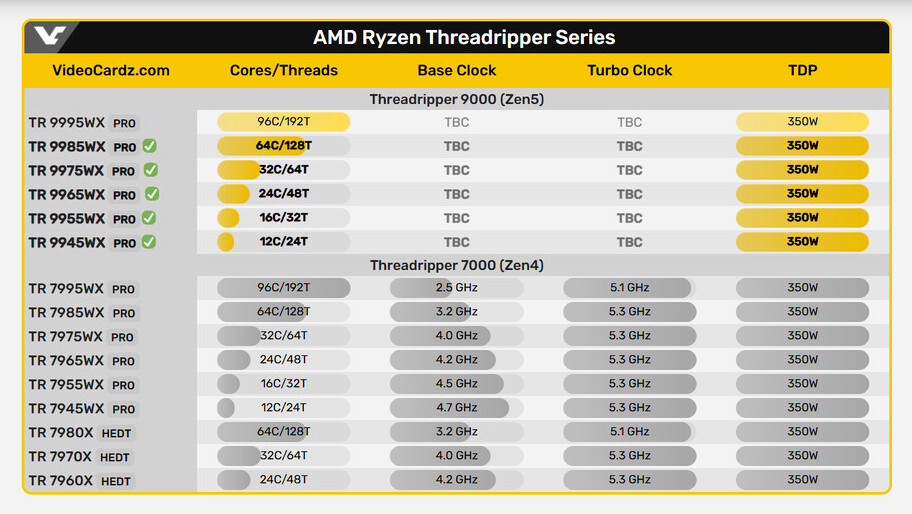
Late last week, a fresh leak unearthed a likely sub-flagship SKU: the 9985WX. This alleged 64-core SKU was spotted—by Everest (aka Olrak29)—alongside 9955WX (16-core) and 9945WX (12-core) siblings, in a shipping manifest. As reported on TechPowerUp on March 21, the same source uncovered two other entry-level models: the 9975WX (32-core) and 9965WX (24-core) parts. Unfortunately, Team Red's rumored monstrous 96-core 9995WX processor was not listed within fresh batches of shipping documents. Industry watchdogs expect AMD to repeat its product layout from past generations; spanning from entry-tier 12-core offerings up to the aforementioned 96-core range-topper. The latest leak suggests utilization of the SP6 socket type, and 350 W TDPs (across all product identifiers).
Return to Keyword Browsing
Nov 11th, 2026 03:34 CST change timezone

New Forum Posts

Popular Reviews

TPU on YouTube

Controversial News Posts