Monday, January 16th 2023

CAMM to Replace the Decades-old SO-DIMM Laptop Memory, JEDEC and Dell Argue
Laptop memory has been a controversial topic for many years. Its proprietary standard, SO-DIMM, has shown signs of aging as the decades-old JEDEC standard didn't adapt to other expanding capacities and speed trends. Today, JEDEC and Dell think that the future of laptop memory is in the new CAMM standard that both companies are working on. The introduction of CAMM comes from Dell, whose Senior Distinguished Engineer Tom Schnell is working on it. "We have unanimous approval of the 0.5 spec," said Mr. Schnell for PCWorld. One of the problems that SO-DIMM is facing is the capacity and speed issue, where the current DDR5 SO-DIMM memory stops at around 6400 MT/s. CAMM, on the other hand, starts from that speed and works its way up to offer higher capacities as well.
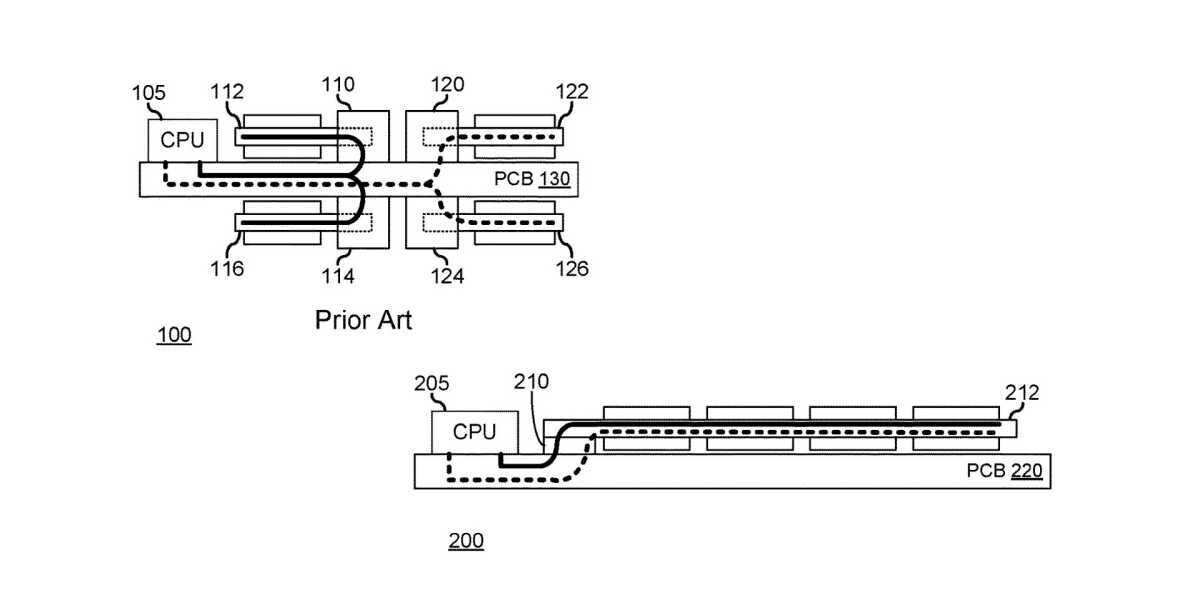
With Dell introducing CAMM in its laptops, it had no intentions of creating a proprietary solution but rather an expandable and upgradable memory platform with various benefits. With JEDEC's involvement in finalizing this, the CAMM standard is slowly on its way to becoming a viable option for different laptop manufacturers. Dell's Tom Schnell didn't reveal what companies are in the process of creating the final specification; however, we know that 32 of them are present, including Apple. If others join, the standard could take over future laptop designs and offer higher speeds and higher capacities, especially in the mobile workstation space where it matters. Below is an example of a CAMM memory module with a patent showing the SO-DIMM (upper left) versus CAMM (lower right) and CAMM's smaller trace path. With smaller tracing, the latency is also going down, so the new standard will bring additional efficiency. Additionally, devices that are based on LPDDR memory could have an upgrade path with the installment of CAMM.

Source:
PCWorld
With Dell introducing CAMM in its laptops, it had no intentions of creating a proprietary solution but rather an expandable and upgradable memory platform with various benefits. With JEDEC's involvement in finalizing this, the CAMM standard is slowly on its way to becoming a viable option for different laptop manufacturers. Dell's Tom Schnell didn't reveal what companies are in the process of creating the final specification; however, we know that 32 of them are present, including Apple. If others join, the standard could take over future laptop designs and offer higher speeds and higher capacities, especially in the mobile workstation space where it matters. Below is an example of a CAMM memory module with a patent showing the SO-DIMM (upper left) versus CAMM (lower right) and CAMM's smaller trace path. With smaller tracing, the latency is also going down, so the new standard will bring additional efficiency. Additionally, devices that are based on LPDDR memory could have an upgrade path with the installment of CAMM.

33 Comments on CAMM to Replace the Decades-old SO-DIMM Laptop Memory, JEDEC and Dell Argue
Are they for real or just trolling us, like nGreedia with that 5 slots GPU ??
everything will be glued so you don't have the right to repair. Remember what happened to NY right to repair?
Additionally, desktop trace lengths are actually shorter. It's why the DIMM slots are immediately adjacent to the CPU socket and prioritised for trace-routing on the PCB. With a laptop motherboard there is far more contention for CPU>SoDIMM PCB trace routing and the physical layout of the board often has the SoDIMM slots off-center and offset from the CPU to accomodate other logic for which there simply isn't room to put anywhere else.
Choosing between NVMe storage or RAM expansion will be a big move in thin and light workstation laptops, even prosumer or content creators.
- If you're a gamer, you care about speed - and CAMM promises to offer the trace length and pin count advantages of soldered, but with the flexibility of user-replaceable RAM.
- If you're a productivity user, you care about capacity and CAMM promises to offer the capacity advantages of four-SODIMM systems in less physical thickness than dual-SODIMM systems.
I see that as a win-win for end-users with no disadvantages. Like any new standard there will be an economies-of-scale thing where the large marketshare of SODIMMS means they are cheaper than the small marketshare of the new CAMM modules, but if the manufacturers adopt it because it's better and thinner, then it will eventually cost the same as SODIMMS because the BOM for both form factors is basically the same.I LOVE SODIMMS and actively avoid buying soldered-RAM laptops wherever possible, but it's an ancient standard that is starting to become incompatible with the goals of modern laptops manufacturers and their users.