Friday, July 7th 2023
Sabrent's Rocket X5 PCIe 5.0 NVMe SSD Shown Hitting 14 GB/s Read Speeds
The first batch of PCIe 5.0 NVMe SSDs didn't quite deliver on the promise of doubling performance from PCIe 4.0 NVMe SSDs, but now it appears that Sabrent has managed to work some magic with its upcoming Rocket X5 SSD. The SSD is still based on the same Phison E26 controller as all other current PCIe 5.0 NVMe drives and from what we know, the controller is paired to Micron's 232-layer B58R NAND, a combination that should be able to reach 2400 MT/s across eight channels. However, it's not the only drive with this combination of components, so it seems like the magic here might be in the firmware.
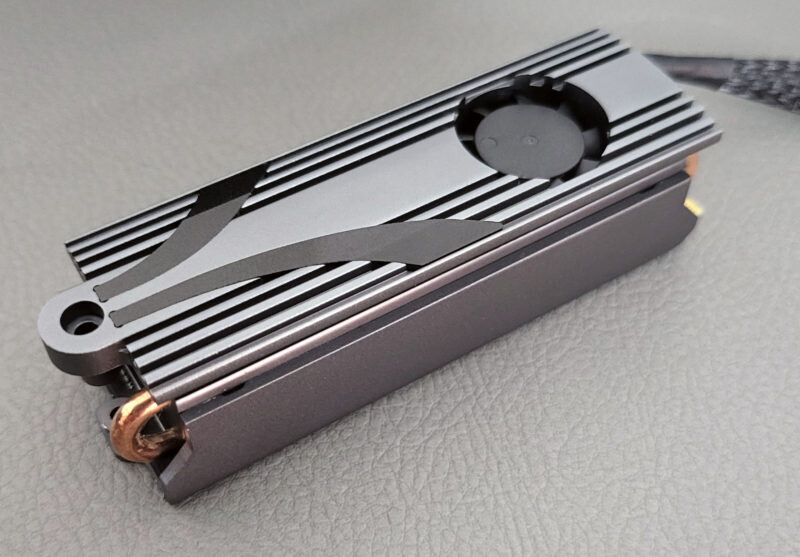
A 2 TB version of the Rocket X5 was tested in CrystalDiskMark 8.0.4 and reached a read speed of 14,179 MB/s or just over 14 GB/s, with write speeds trailing somewhat at 12,280 MB/s. The random 4K numbers are looking good too with 106 MB/s for reads and 448 MB/s for writes, a step up from the competition at least, if not a major one with regards to the read speed. The downside you ask? Sabrent has equipped the Rocket X5 with not only a heatsink and heatpipes, but also a tiny fan, which is likely to add some noise at some time in the future when the fan starts to give up. We obviously don't know the price of the Rocket X5 either, but Sabrent tends to have competitively priced products.

Source:
Serve the Home
A 2 TB version of the Rocket X5 was tested in CrystalDiskMark 8.0.4 and reached a read speed of 14,179 MB/s or just over 14 GB/s, with write speeds trailing somewhat at 12,280 MB/s. The random 4K numbers are looking good too with 106 MB/s for reads and 448 MB/s for writes, a step up from the competition at least, if not a major one with regards to the read speed. The downside you ask? Sabrent has equipped the Rocket X5 with not only a heatsink and heatpipes, but also a tiny fan, which is likely to add some noise at some time in the future when the fan starts to give up. We obviously don't know the price of the Rocket X5 either, but Sabrent tends to have competitively priced products.

40 Comments on Sabrent's Rocket X5 PCIe 5.0 NVMe SSD Shown Hitting 14 GB/s Read Speeds
www.amazon.ca/Intel-Optane-960GB-XPoint-959527/dp/B07JD9GZN7/ref=asc_df_B07JD9GZN7/?tag=googleshopc0c-20&linkCode=df0&hvadid=579033760296&hvpos=&hvnetw=g&hvrand=9187058505615494319&hvpone=&hvptwo=&hvqmt=&hvdev=c&hvdvcmdl=&hvlocint=&hvlocphy=9000811&hvtargid=pla-647953838834&psc=1
At this rate we may carch up to optane when PCI-E 8 drives come out with 500 layer nand and 70W idle power.
The only way you'd benefit is having two of these drives transferring large files between them.
Optane's starting point was better than NAND's starting point, but unlike NAND, Optane wasn't entering the market as a revolutionary new technology that was desperately needed. SSDs are good enough and there's little call for lower-latency storage, especially not at the prices Optane was selling for.
Given NAND SSDs are here to stay, the hope is (as you say) that the real world will adjust. Hopefully NAND-aware software, drivers, and OS evolve to the point where hardware tiers can be managed seamlessly from CPU to RAM to cache to <small 3D Xpoint buffer?> to pSLC cache to TLC/QLC NAND.
The CDM RRQD1 of 106 is still on an early drive that has not been fully optimized. The next update will be from Flash Memory Summit in a few weeks.
I'm surprised you compare NAND to Optane. E26 ships up to 4TB right now. How much does a Gen4 4TB Optane drive cost? It doesn't exist. How much does a 2TB Optane drive cost....It doesn't exist either.
Large capacity optane are enterprise drives, typically U.2.
ark.intel.com/content/www/us/en/ark/products/201840/intel-optane-ssd-dc-p5800x-series-3-2tb-2-5in-pcie-x4-3d-xpoint.html
There's other models too that you can't buy on the consumer market.
BTW, it costs $6,400 so it's not like most people will actually buy one for a consumer system.
www.wiredzone.com/shop/product/10022680-intel-ssdpf21q032tb-hard-drive-3-2tb-ssd-nvme-pcie-4-0-u-2-15mm-dc-p5800x-series-9158
Mostly I've seen them on EBAY, not many outlets seem to have much stock.
I'm not sure what the difference is between the different models. I think the 4xxx is gen 1 and the 5xxx is gen 2, but haven't looked into it too deeply.
ark.intel.com/content/www/us/en/ark/products/series/213706/intel-optane-dc-ssd-series.html
I think this is the full list.
I'd love one of these drives but as a student can't really afford the price lol.
Oh well, maybe when I'm a consultant. I doubt there'll be anything that comes close to these numbers for endurance even then.Do you post your test results anywhere?