Monday, February 10th 2025

Unofficial 12V-2x6V Power Connector Melts NVIDIA GeForce RTX 5090

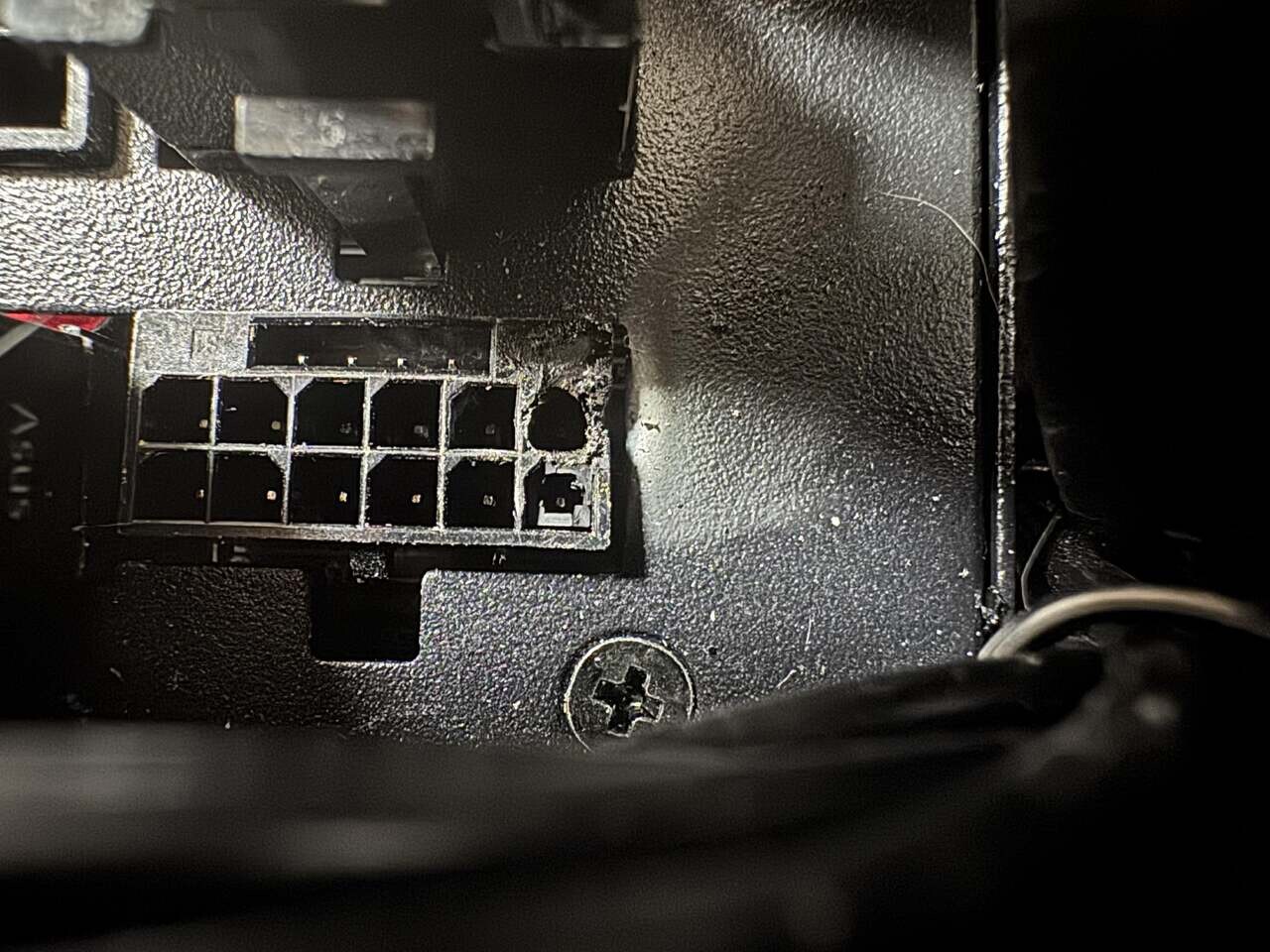
NVIDIA's high-TDP flagship GPU, the GeForce RTX 5090, appears to cause additional headaches for users, not including the high power bill. According to a Reddit user, we now have the first documented case of a melted power connector on NVIDIA's flagship GeForce RTX 5090 Founders Edition, reigniting concerns over high-wattage GPU safety from the last generation. While playing Battlefield 5, Reddit user ivan6953 detected a burning odor and immediately shut down their system, only to discover severe damage to both the RTX 5090's 12V-2×6 connector and their ASUS ROG Loki SFX-L PSU. The user had employed a Moddiy 12VHPWR cable, marketed as ATX 3.0/PCIe 5.0-compliant and rated for RTX 5090's 600 watts of power. Despite claims of secure installation—audible clicks at both ends—the cable melted at 500-520 W load, charring connectors on the GPU and PSU.

Notably, the same cable had powered an RTX 4090 FE for two years without issue. NVIDIA's RTX 5090 FE ships with a redesigned adapter featuring a longer, more flexible cable and an angled connector to reduce strain in compact builds. NVIDIA asserts that no incidents have occurred with its bundled adapter, emphasizing compliance with the updated 12V-2×6 standard, which shortens sensing pins to prevent power flow if connections loosen. Hence, an older connector can not provide 100% secure usage despite the user thinking that the sensing pins are touching properly.
A second case reported by Spanish YouTuber Toro Tocho involved a melted PSU-side connector, though the GPU remained undamaged. This resulted from worn connectors or improper seating despite user assurances of correct installation. RTX 5090 owners should avoid third-party adapters and rely solely on NVIDIA's included cable or PSU-native connectors. Regular inspections for discoloration, wear, or bending near connectors are also advised, particularly for systems with high power consumption. While NVIDIA investigates, the takeaway is clear: cutting corners on power delivery risks costly hardware failures. The RTX 5090's melting woes appear isolated to unofficial accessories—a small solace for early adopters navigating the pitfalls of the high-TDP GPU era.

Sources: Reddit, via VideoCardz
Add your own comment

105 Comments on Unofficial 12V-2x6V Power Connector Melts NVIDIA GeForce RTX 5090

#76
Crackong
user556If the plug works correctly then 12 pins is fine. It's been fine for the 6-pin and 8-pin GPU plugs. 8 pins for the CPU power plugs are doing just fine too.
According to spec, for 8-pin, the 3 live wires only share maximum load of 13A (150W)
Even 1x 18AWG wire could handle that load.
And there are three wires in a 8-pin plug to spread the load.
So it is "safe" even in a case of "one wire carries all the load"

But Nvidia's 12pin isn't.
The spec was 50A and putting 50A in "one wire carries all the load" situation would blow the whole thing up.
Posted on Reply
#77
dragontamer5788
CrackongThey uses 110V/220V, that's different.
I don't think you understand my point.

Go to Home Depot and feel 12 AWG or 16 AWG wire. Its thick, inflexible, bulky and hard to work with. By the time you're talking about 6 AWG wire that's needed to carry 50 Amps safely, its a specialty wire that I don't think you'd see in any common situation.

You might see 6AWG on central home air conditioners or maybe generators. Its very rarely used given how big, and expensive, the copper is.

----------

At these wattages, its clear that larger wires like 6AWG or even 4x 8-pin connectors are too bulky for computer usage. But 12vhpwr adapter might be too small.
Posted on Reply
#78
Crackong
dragontamer5788I don't think you understand my point.

Go to Home Depot and feel 12 AWG or 16 AWG wire. Its thick, inflexible, bulky and hard to work with. By the time you're talking about 6 AWG wire that's needed to carry 50 Amps safely, its a specialty wire that I don't think you'd see in any common situation.

You might see 6AWG on central home air conditioners or maybe generators. Its very rarely used given how big, and expensive, the copper is.

----------

At these wattages, its clear that larger wires like 6AWG or even 4x 8-pin connectors are too bulky for computer usage. But 12vhpwr adapter might be too small.
Average quality 12vhpwr cable uses 16 AWG wires, and I think they are quite flexible, the bulkiness comes from the fact that it is 12 wires clamped together.

I think a simple scale up of a 6-pin with 10 AWG wires, or 8-pin with 12AWG wires should be Okay.
They have 80-90 total amps capacity in terms of safety, and okay flexibility.
And one wire could at least withstand 20+Amps...

A simple amazon search gives me roughly the same price for 12 AWG and 16 AWG wires, hence cost isn't the problem.
10 AWG costs twice than 16 AWG but is also uses 1/2 number of wires so they costs roughly the same.

One more observation.
Noticed that both the burn and der8auser's hottest wire all come from the nearest pin from PCB

That pin has the shortest 90 degree bridge behind the connector, hence least amount of resistance.


Posted on Reply
#79
user556
CrackongAccording to spec, for 8-pin, the 3 live wires only share maximum load of 13A (150W)
Even 1x 18AWG wire could handle that load.
But it would be a hot wire, and the pin wouldn't be lasting either. Besides, the CPU plugs can go way higher than that. They're rated up to 32 Amps in total.

The nitpicking over slight length differences is just that, nitpicking. The huge measured differences in current and thermals can't be from minor length differences.

It's clearly a faulty connection, and that fault can only be from the plug - The 12VHPWR cable plug. Which is now rectified with the newer 12V-2x6 cable plug.
Posted on Reply
#80
Chomiq
AusWolfOr maybe we shouldn't have 600 W GPUs? I know, heresy, but what if...? :rolleyes:


Yeah, stretching the power limits, connector limits and such isn't the way to progress. We need more performance for less power without any tricks like MFG.
Posted on Reply
#81
londiste
user556That's the plug's fault, not the card.
The discussion at hand about monitoring each wire seems to point at exactly the opposite. The cable and plug does not have problems when usage of it is even remotely in spec.
ChomiqYeah, stretching the power limits, connector limits and such isn't the way to progress. We need more performance for less power without any tricks like MFG.
That would basically be an 5080. There is no real path to more performance until TSMC has the new process available and/or Nvidia/AMD/Intel is willing to use it. Or, as an alternative, tricks like MFG...
CrackongAccording to spec, for 8-pin, the 3 live wires only share maximum load of 13A (150W)
Even 1x 18AWG wire could handle that load.
And there are three wires in a 8-pin plug to spread the load.
So it is "safe" even in a case of "one wire carries all the load"
Der8auer had 8-pin connectors on PSU side of things. 20A through one of those wires. I wonder if someone will do an actual test again in burning down a card or plugs :)
Posted on Reply
#82
AusWolf
CrackongAverage quality 12vhpwr cable uses 16 AWG wires, and I think they are quite flexible, the bulkiness comes from the fact that it is 12 wires clamped together.

I think a simple scale up of a 6-pin with 10 AWG wires, or 8-pin with 12AWG wires should be Okay.
They have 80-90 total amps capacity in terms of safety, and okay flexibility.
And one wire could at least withstand 20+Amps...

A simple amazon search gives me roughly the same price for 12 AWG and 16 AWG wires, hence cost isn't the problem.
10 AWG costs twice than 16 AWG but is also uses 1/2 number of wires so they costs roughly the same.

One more observation.
Noticed that both the burn and der8auser's hottest wire all come from the nearest pin from PCB

That pin has the shortest 90 degree bridge behind the connector, hence least amount of resistance.


I'm not an electrician, but based on my limited knowledge, this makes complete sense to me.
Posted on Reply
#83
londiste
CrackongAverage quality 12vhpwr cable uses 16 AWG wires, and I think they are quite flexible, the bulkiness comes from the fact that it is 12 wires clamped together.
Spec calls for 16AWG as minimum.
Posted on Reply
#84
user556
londisteThe discussion at hand about monitoring each wire seems to point at exactly the opposite. The cable and plug does not have problems when usage of it is even remotely in spec.
The total power is entirely in spec. Only there is an imbalance of currents between all the wires. Given that both ends, the power supply and the card, are a single conductors internally, there isn't any way for the card to be at fault.
Posted on Reply
#86
Crackong
londisteWhile Nvidia clearly messed up big with lack of monitoring, isn't the actual cause for something like this in either cable or the PSU? As repeatedly said and shown/explained in videos, at least on card side this all goes into one big blob of 12V. The only thing card can do in situation with per wire monitoring is raise alarm when one wire is overloaded and preferably shut the card down.
I think it is quite a simple idea here.
Since Nvidia defined it has to be a "big blob of 12V" electrically.
So the 12 wires in between are completely meaningless.
It should be just 2 wires, 1 live, 1 ground

They might as well just do this with a pair of giant 6 AWG wire:

Posted on Reply
#87
londiste
user556The total power is entirely in spec. Only there is an imbalance of currents between all the wires. Given that both ends, the power supply and the card, are a single conductors internally, there isn't any way for the card to be at fault.
That is what I meant. If either or both of the ends would not do a single conductor internally thing, there would not be a problem?
Basically, isn't that what Nvidia did initially with 3090s?
Posted on Reply
#88
AusWolf
CrackongI think it is quite a simple idea here.
Since Nvidia defined it has to be a "big blob of 12V" electrically.
So the 12 wires in between are completely meaningless.
It should be just 2 wires, 1 live, 1 ground

They might as well just do this with a pair of giant 6 AWG wire:

It still wouldn't help the issue with the connector that you mentioned in post #79.
Posted on Reply
#89
user556
londisteThat is what I meant. If either or both of the ends would not do a single conductor internally thing, there would not be a problem?
Doesn't really matter about what-ifs. The proof is here already. It can only be the cable plug at fault.
Posted on Reply
#90
Crackong
AusWolfIt still wouldn't help the issue with the connector that you mentioned in post #79.
It doesn't, I think the 12vhpwr solution is fundamentally flawed.
But at least the thick wires won't melt.
Posted on Reply
#91
Imouto
dragontamer5788At 8Amps expected load per wire, 0.5 Ohms == 4V drop.

Add a few 0s there. Its maybe 0.05Ohms or less. Making miniscule differences even a bigger deal.
A 0.3m 16AWC (1.3mm²) copper cable should be around 4mΩ * 2 (phase+ground). So: 50A * 0.008Ω = 0.4V if it was a single cable but it's 6 so in an ideal scenario of same resistances it would be: 50A * (0.008Ω / 6) = 0.066^Vdrop

Then you have to factor that resistance raises with temperature. If we go with der8auer's video temp delta of over 100ºC (holy actual guacamole...) the resistance of a cable could go over 10mΩ meaning the issue is even greater than and it's likely on the PSU (Corsair AX 1600i from 2018 before any of this 12VHPWR madness) side that doesn't do any load balancing. In fact you can tell from the thermal imaging that it's only drawing from just 4 wires divided into two plugs from the PSU side that's likely merged onto the 2 pins at the GPU end.
CrackongThat pin has the shortest 90 degree bridge behind the connector, hence least amount of resistance.


That sounded really stupid so I looked around for connector pictures and looks like Nvidia factored it in and made a slab for the connection to the PCB.

Posted on Reply
#92
AusWolf
ImoutoThat sounded really stupid so I looked around for connector pictures and looks like Nvidia factored it in and made a slab for the connection to the PCB.
Could you have different resistance at different sections of the slab?
Posted on Reply
#93
Crackong
ImoutoThat sounded really stupid so I looked around for connector pictures and looks like Nvidia factored it in and made a slab for the connection to the PCB.
If it is a slab of metal then it doesn't help.
Current flows through the path of least resistance.
The nearest pin still has the shortest distance from pcb
shortest distance = least resistance.


If they want to account for that they need a pcb like we got in the RAM sticks, with purposely routed traces in exact same lengths.
Posted on Reply
#94
AusWolf
CrackongIf it is a slab of metal then it doesn't help.
Current flows through the path of least resistance.
The nearest pin still has the shortest distance from pcb
shortest distance = least resistance.
That's what I thought, thanks. :)
Posted on Reply
#95
Imouto
AusWolfCould you have different resistance at different sections of the slab?
Engineering exists for a reason. That slab seems designed to have the same resistance for all the pins. If it wasn't it would have a different shape.
CrackongIf it is a slab of metal then it doesn't help.
Current flows through the path of least resistance.
The nearest pin still has the shortest distance from pcb
shortest distance = least resistance.
The parallel resistance formula still applies. The slab is wider on the furthest pins and that means less resistance. Again, I don't think Nvidia is stupid enough not to design it properly.
Posted on Reply
#96
AusWolf
ImoutoEngineering exists for a reason. That slab seems designed to have the same resistance for all the pins. If it wasn't it would have a different shape.

The parallel resistance formula still applies. The slab is wider on the furthest pins and that means less resistance. Again, I don't think Nvidia is stupid enough not to design it properly.
Yes, it "seems designed". But does it actually work?
Posted on Reply
#97
Crackong
ImoutoI don't think Nvidia is stupid enough not to design it properly.
I felt the same before I watched buildzoid's video and learnt that they put 6 live wires there for no reason.
Posted on Reply
#98
ninjafada
if they need that much power they should have use 24V instead of 12V or 48V like in the cybertruck
running high intensy is never the good choice
Posted on Reply
#99
Imouto
Dude, this is like 101 in the most basic electrician course. The resistance formula for any medium takes into account the distance and the cross section of said medium.

R = ρ × L / A

The area is as important as the length. If the length is doubled you only need to double the cross section to make up for it.
Posted on Reply
#100
ninjafada
yeah they need to improve the aera of connection too and those cylindric system are always a pain in the a***
perhaps one day we are gonna have plug with screw to tighten plugs
Posted on Reply
Add your own comment
Nov 22nd, 2026 01:16 PST change timezone

New Forum Posts

Popular Reviews

TPU on YouTube

Controversial News Posts