Monday, February 10th 2025

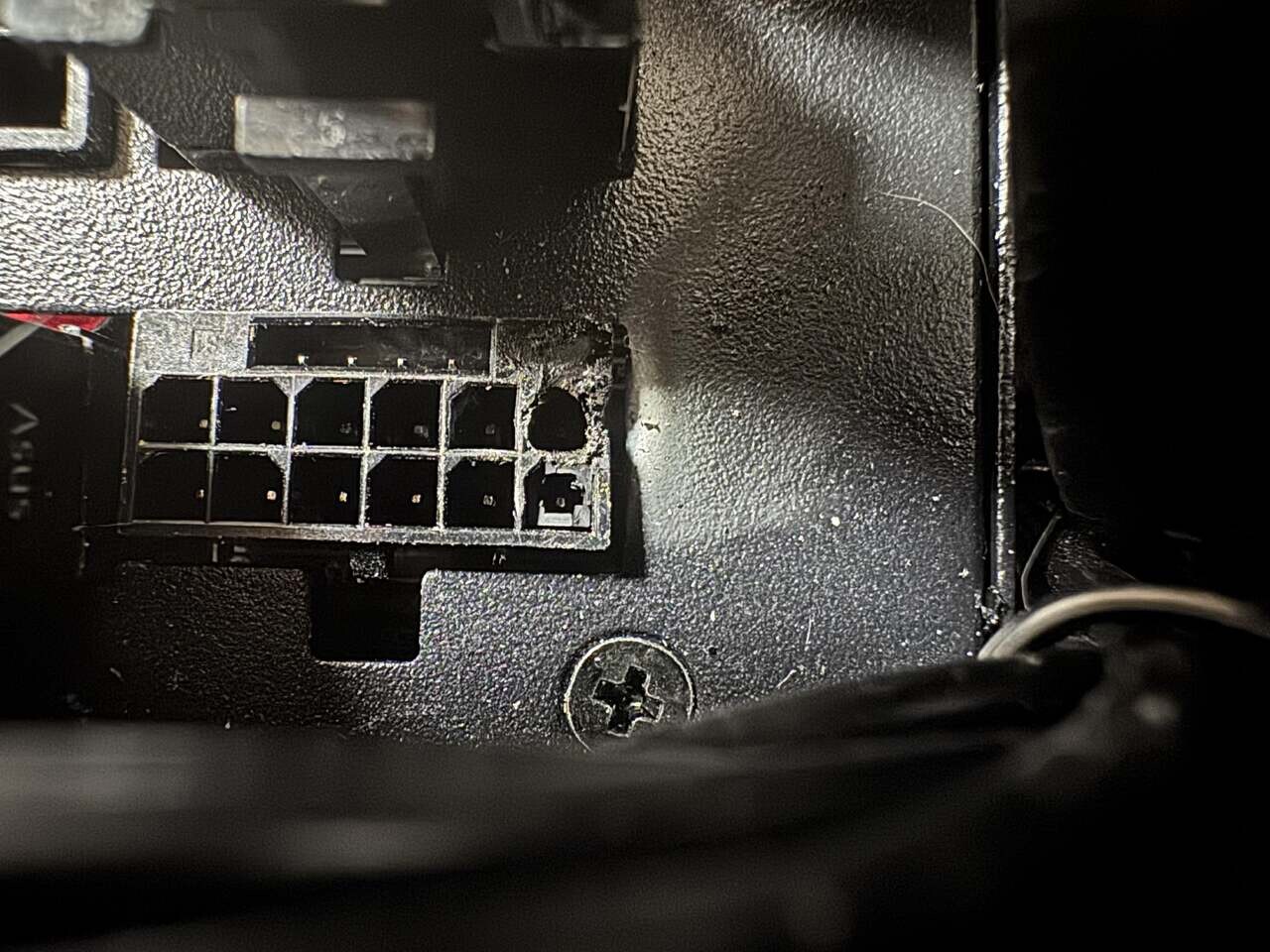
Unofficial 12V-2x6V Power Connector Melts NVIDIA GeForce RTX 5090
NVIDIA's high-TDP flagship GPU, the GeForce RTX 5090, appears to cause additional headaches for users, not including the high power bill. According to a Reddit user, we now have the first documented case of a melted power connector on NVIDIA's flagship GeForce RTX 5090 Founders Edition, reigniting concerns over high-wattage GPU safety from the last generation. While playing Battlefield 5, Reddit user ivan6953 detected a burning odor and immediately shut down their system, only to discover severe damage to both the RTX 5090's 12V-2×6 connector and their ASUS ROG Loki SFX-L PSU. The user had employed a Moddiy 12VHPWR cable, marketed as ATX 3.0/PCIe 5.0-compliant and rated for RTX 5090's 600 watts of power. Despite claims of secure installation—audible clicks at both ends—the cable melted at 500-520 W load, charring connectors on the GPU and PSU.
Notably, the same cable had powered an RTX 4090 FE for two years without issue. NVIDIA's RTX 5090 FE ships with a redesigned adapter featuring a longer, more flexible cable and an angled connector to reduce strain in compact builds. NVIDIA asserts that no incidents have occurred with its bundled adapter, emphasizing compliance with the updated 12V-2×6 standard, which shortens sensing pins to prevent power flow if connections loosen. Hence, an older connector can not provide 100% secure usage despite the user thinking that the sensing pins are touching properly.


 A second case reported by Spanish YouTuber Toro Tocho involved a melted PSU-side connector, though the GPU remained undamaged. This resulted from worn connectors or improper seating despite user assurances of correct installation. RTX 5090 owners should avoid third-party adapters and rely solely on NVIDIA's included cable or PSU-native connectors. Regular inspections for discoloration, wear, or bending near connectors are also advised, particularly for systems with high power consumption. While NVIDIA investigates, the takeaway is clear: cutting corners on power delivery risks costly hardware failures. The RTX 5090's melting woes appear isolated to unofficial accessories—a small solace for early adopters navigating the pitfalls of the high-TDP GPU era.
Sources:
Reddit, via VideoCardz
Notably, the same cable had powered an RTX 4090 FE for two years without issue. NVIDIA's RTX 5090 FE ships with a redesigned adapter featuring a longer, more flexible cable and an angled connector to reduce strain in compact builds. NVIDIA asserts that no incidents have occurred with its bundled adapter, emphasizing compliance with the updated 12V-2×6 standard, which shortens sensing pins to prevent power flow if connections loosen. Hence, an older connector can not provide 100% secure usage despite the user thinking that the sensing pins are touching properly.



105 Comments on Unofficial 12V-2x6V Power Connector Melts NVIDIA GeForce RTX 5090
knowledge.seasonic.com/article/79-comparison-atx-3-0-vs-atx-3-1-standards
As what these findings have shown me, I have ruled out buying an RTX 5090 Founders Edition for my next build and will look only at AIB cards if I want an RTX 5090.
Buildzoid made a follow-up video building on der8auer's video below:
This sadly shows that NV can sell whatever piece of junk, but as long as Jensen says "its way to be played" masses will blindly buy for whatever price.
What i find appalling watching Buildzoid video, that no one really seen this insanity from electrical perspective to point it out earlier??
Perhaps NV went with usual corporate "logic" and just fired old veteran engineers (because they are expense, workers are just evil that cost corporate money...) that build earlier power delivery circuits and replaced them with cheap graduates that didnt actually knew what they are doing (hey but they are half the price, yay!) plus they were pushed for savings, because apparently nv is such poor company that cannot afford to pay few cents on parts for cards that are overpriced and expensive...
Or maybe they just used same fake frames mentality they push with rendering, lets use just one wire and imagine/fake there are 6 :D Power DLSS 6 :D
Which all adds up to the cable, the plug in particular, being the only problem.
Honestly it was kind of inevitable that NVIDIA was going to go small for the FE's where possible, considering the prototype 40 series card GN acquired that was supposedly (and probably) a prototype for the 4090 was even thicker and bigger than the 4090 we actually got, it seems like NVIDIA was always trying to go smaller and smaller even before the 50 series.
How can be copper wire faulty? it either is conduit or isnt (if it would be under spec or too thin etc, it would burn), or you think that cable manufacturer(s) are that much incompetent that they somehow manage mix wires with significantly different specs, with such difference in resistance, that one cable would allow 2amps while next wire 20 and another 8?
Also he checked his cable/connector so the plug was correctly connected , IF it would be "user error" then some other wires would show 0 amps right? which didnt, so there was contact on pins (or perhaps with lousy contact such pins would heat more, maybe like what was seen on PSU side - however in such case, with lousy contact point with higher resistance, would current rather flow via more conductive paths , other wires, so the hotspot would actually cool down as current flow switches? Sadly it wasnt possible to tell from his video if those two hot wires were same as that 150C PSU connection . But the two hot wires clearly shows they were carrying too much amps
But otherwise yes, it was said before that plug design is problem (which is still nv fault)
Or what were you trying to say? its too late, and it was kinda hard to read that sentence
In the demonstrated video, it's clearly two of the six pins carrying the bulk of the power. The other four are bad connections.
With the melted cable, it would have been five bad pins with only one working fully. 500 Watts is too much for one pin.
However, these plugs should be able to handle not being fully seated without any undue loss of quality in the connection. And this has already been demonstrated as working fine using the 12V-2x6 plug.
Nvidia made all 6 wires as one set so most of the current flow through the one wire with least resistance....
It is actually melting the one wire with the perfect contact, not the other way around.The wires in between are separated.
And current flows through the path with least resistance.
Take the below picture as illustration
Those with ~1Ω are wires making normal contact.
3Ω is the one making bad contact
and the 0.5Ω is the one having the perfect contact
As both the card and the PSU treat the whole thing like one giant cable.
Most current flow through the path with least resistance.
So the 0.5Ω wire gets all the love and most of the current.
More current = more heat = melt.
Add a few 0s there. Its maybe 0.05Ohms or less. Making miniscule differences even a bigger deal.
And this explains why der8auer got 20+Amps in 2 wires and 5 Amps in others.
Very small difference due to soldering / clamp pressure / copper impurity makes huge difference in this case
Nvidia just forgo any control and let nature do its thing on balancing between the wires.
In particular, the molex pins are springs that apply consistent force upon the pin. Its not the plastic housing that makes it springy, its the pin itself that's the spring and grabbing onto the contact.
Since both the PSU and the 5090 both treated the thing as one big wire.
The most "reliable manufacturing" thing should be...exactly one big wire.
One 6 AWG wire with good insultation should do the job just fine.
Also, a 6AWG wire is ~5mm in diameter. Your typical wall wires in a house are 12AWG (2mm) in diameter. 6AWG is much bulkier, expensive. In fact, I've placed two circles next to this 12vhpwr drawing to give you an idea of just how big 6AWG wire is.
That's just the wire, not including the pins or connector needed to work with such a wire. Any electrician who has worked with this knows how hard it is to work with. Its not easy bending or moving copper cables that thick around.
5090 runs on 12V 50A, and the working temperature >60C.
So 1x 6AWG, or 2x 10AWG
Give it some safe room and the solution could be just scale up the original 6 pin design with 10 AWG wires and connectors