Tuesday, March 18th 2025

NVIDIA Announces DGX Spark and DGX Station Personal AI Computers
NVIDIA today unveiled NVIDIA DGX personal AI supercomputers powered by the NVIDIA Grace Blackwell platform. DGX Spark—formerly Project DIGITS—and DGX Station, a new high-performance NVIDIA Grace Blackwell desktop supercomputer powered by the NVIDIA Blackwell Ultra platform, enable AI developers, researchers, data scientists and students to prototype, fine-tune and inference large models on desktops. Users can run these models locally or deploy them on NVIDIA DGX Cloud or any other accelerated cloud or data center infrastructure.
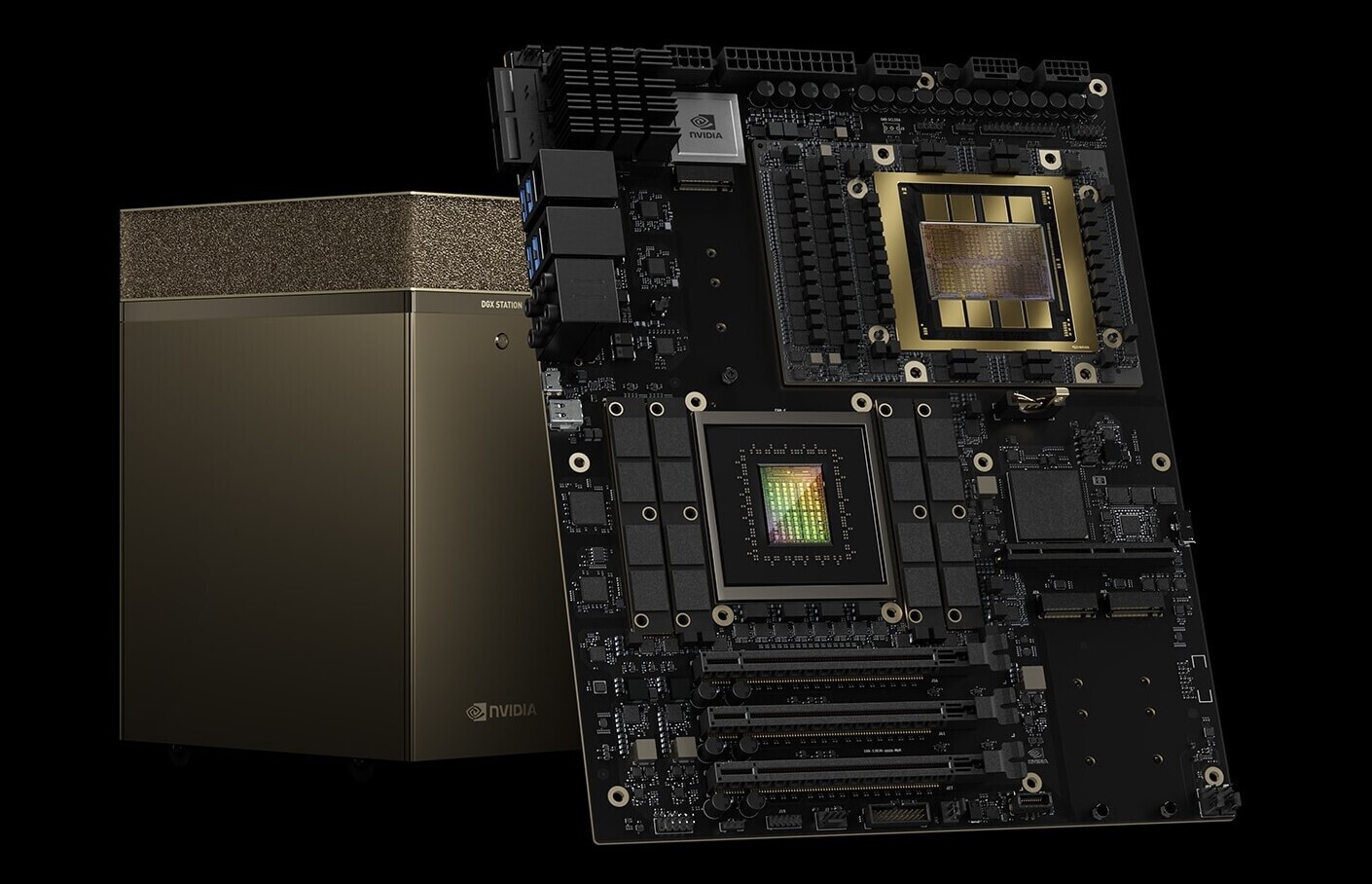
DGX Spark and DGX Station bring the power of the Grace Blackwell architecture, previously only available in the data center, to the desktop. Global system builders to develop DGX Spark and DGX Station include ASUS, Dell, HP Inc. and Lenovo.

DGX Spark is the world's smallest AI supercomputer, empowering millions of researchers, data scientists, robotics developers and students to push the boundaries of generative and physical AI with massive performance and capabilities.
At the heart of DGX Spark is the NVIDIA GB10 Grace Blackwell Superchip, optimized for a desktop form factor. GB10 features a powerful NVIDIA Blackwell GPU with fifth-generation Tensor Cores and FP4 support, delivering up to 1,000 trillion operations per second of AI compute for fine-tuning and inference with the latest AI reasoning models, including the NVIDIA Cosmos Reason world foundation model and NVIDIA GR00T N1 robot foundation model.
The GB10 Superchip uses NVIDIA NVLink -C2C interconnect technology to deliver a CPU+GPU-coherent memory model with 5x the bandwidth of fifth-generation PCIe. This lets the superchip access data between a GPU and CPU to optimize performance for memory-intensive AI developer workloads.
NVIDIA's full-stack AI platform enables DGX Spark users to seamlessly move their models from their desktops to DGX Cloud or any accelerated cloud or data center infrastructure—with virtually no code changes—making it easier than ever to prototype, fine-tune and iterate on their workflows.
Full Speed Ahead With DGX Station
NVIDIA DGX Station brings data-center-level performance to desktops for AI development. The first desktop system to be built with the NVIDIA GB300 Grace Blackwell Ultra Desktop Superchip, DGX Station features a massive 784 GB of coherent memory space to accelerate large-scale training and inferencing workloads. The GB300 Desktop Superchip features an NVIDIA Blackwell Ultra GPU with latest-generation Tensor Cores and FP4 precision—connected to a high-performance NVIDIA Grace CPU via NVLink-C2C—delivering best-in-class system communication and performance.
DGX Station also features the NVIDIA ConnectX -8 SuperNIC, optimized to supercharge hyperscale AI computing workloads. With support for networking at up to 800 Gb/s, the ConnectX-8 SuperNIC delivers extremely fast, efficient network connectivity, enabling high-speed connectivity of multiple DGX Stations for even larger workloads, and network-accelerated data transfers for AI workloads.
Combining these state-of-the-art DGX Station capabilities with the NVIDIA CUDA-X AI platform, teams can achieve exceptional desktop AI development performance.
In addition, users gain access to NVIDIA NIM microservices with the NVIDIA AI Enterprise software platform, which offers highly optimized, easy-to-deploy inference microservices backed by enterprise support.
Availability
Reservations for DGX Spark systems open today at nvidia.com.
DGX Station is expected to be available from manufacturing partners like ASUS, BOXX, Dell, HP, Lambda and Supermicro later this year.
Source:
NVIDIA
DGX Spark and DGX Station bring the power of the Grace Blackwell architecture, previously only available in the data center, to the desktop. Global system builders to develop DGX Spark and DGX Station include ASUS, Dell, HP Inc. and Lenovo.

"AI has transformed every layer of the computing stack. It stands to reason a new class of computers would emerge—designed for AI-native developers and to run AI-native applications," said Jensen Huang, founder and CEO of NVIDIA. "With these new DGX personal AI computers, AI can span from cloud services to desktop and edge applications."Igniting Innovation With DGX Spark
DGX Spark is the world's smallest AI supercomputer, empowering millions of researchers, data scientists, robotics developers and students to push the boundaries of generative and physical AI with massive performance and capabilities.
At the heart of DGX Spark is the NVIDIA GB10 Grace Blackwell Superchip, optimized for a desktop form factor. GB10 features a powerful NVIDIA Blackwell GPU with fifth-generation Tensor Cores and FP4 support, delivering up to 1,000 trillion operations per second of AI compute for fine-tuning and inference with the latest AI reasoning models, including the NVIDIA Cosmos Reason world foundation model and NVIDIA GR00T N1 robot foundation model.
The GB10 Superchip uses NVIDIA NVLink -C2C interconnect technology to deliver a CPU+GPU-coherent memory model with 5x the bandwidth of fifth-generation PCIe. This lets the superchip access data between a GPU and CPU to optimize performance for memory-intensive AI developer workloads.
NVIDIA's full-stack AI platform enables DGX Spark users to seamlessly move their models from their desktops to DGX Cloud or any accelerated cloud or data center infrastructure—with virtually no code changes—making it easier than ever to prototype, fine-tune and iterate on their workflows.
Full Speed Ahead With DGX Station
NVIDIA DGX Station brings data-center-level performance to desktops for AI development. The first desktop system to be built with the NVIDIA GB300 Grace Blackwell Ultra Desktop Superchip, DGX Station features a massive 784 GB of coherent memory space to accelerate large-scale training and inferencing workloads. The GB300 Desktop Superchip features an NVIDIA Blackwell Ultra GPU with latest-generation Tensor Cores and FP4 precision—connected to a high-performance NVIDIA Grace CPU via NVLink-C2C—delivering best-in-class system communication and performance.
DGX Station also features the NVIDIA ConnectX -8 SuperNIC, optimized to supercharge hyperscale AI computing workloads. With support for networking at up to 800 Gb/s, the ConnectX-8 SuperNIC delivers extremely fast, efficient network connectivity, enabling high-speed connectivity of multiple DGX Stations for even larger workloads, and network-accelerated data transfers for AI workloads.
Combining these state-of-the-art DGX Station capabilities with the NVIDIA CUDA-X AI platform, teams can achieve exceptional desktop AI development performance.
In addition, users gain access to NVIDIA NIM microservices with the NVIDIA AI Enterprise software platform, which offers highly optimized, easy-to-deploy inference microservices backed by enterprise support.
Availability
Reservations for DGX Spark systems open today at nvidia.com.
DGX Station is expected to be available from manufacturing partners like ASUS, BOXX, Dell, HP, Lambda and Supermicro later this year.

30 Comments on NVIDIA Announces DGX Spark and DGX Station Personal AI Computers
How easy/hard was it for you to get those up and running this time?
Also, which specific RDNA 2 GPU is that? Those results are totally usable, but not really that fast for such quant level (at least compared to other higher-end GPUs).
As for the GPU I was being intentionally obtuse, but let's just say it starts with a sixty-eight and ends with an "ecks tee" ;)
Nice to see that it was a painless setup!