Tuesday, March 18th 2025

NVIDIA Announces DGX Spark and DGX Station Personal AI Computers
NVIDIA today unveiled NVIDIA DGX personal AI supercomputers powered by the NVIDIA Grace Blackwell platform. DGX Spark—formerly Project DIGITS—and DGX Station, a new high-performance NVIDIA Grace Blackwell desktop supercomputer powered by the NVIDIA Blackwell Ultra platform, enable AI developers, researchers, data scientists and students to prototype, fine-tune and inference large models on desktops. Users can run these models locally or deploy them on NVIDIA DGX Cloud or any other accelerated cloud or data center infrastructure.
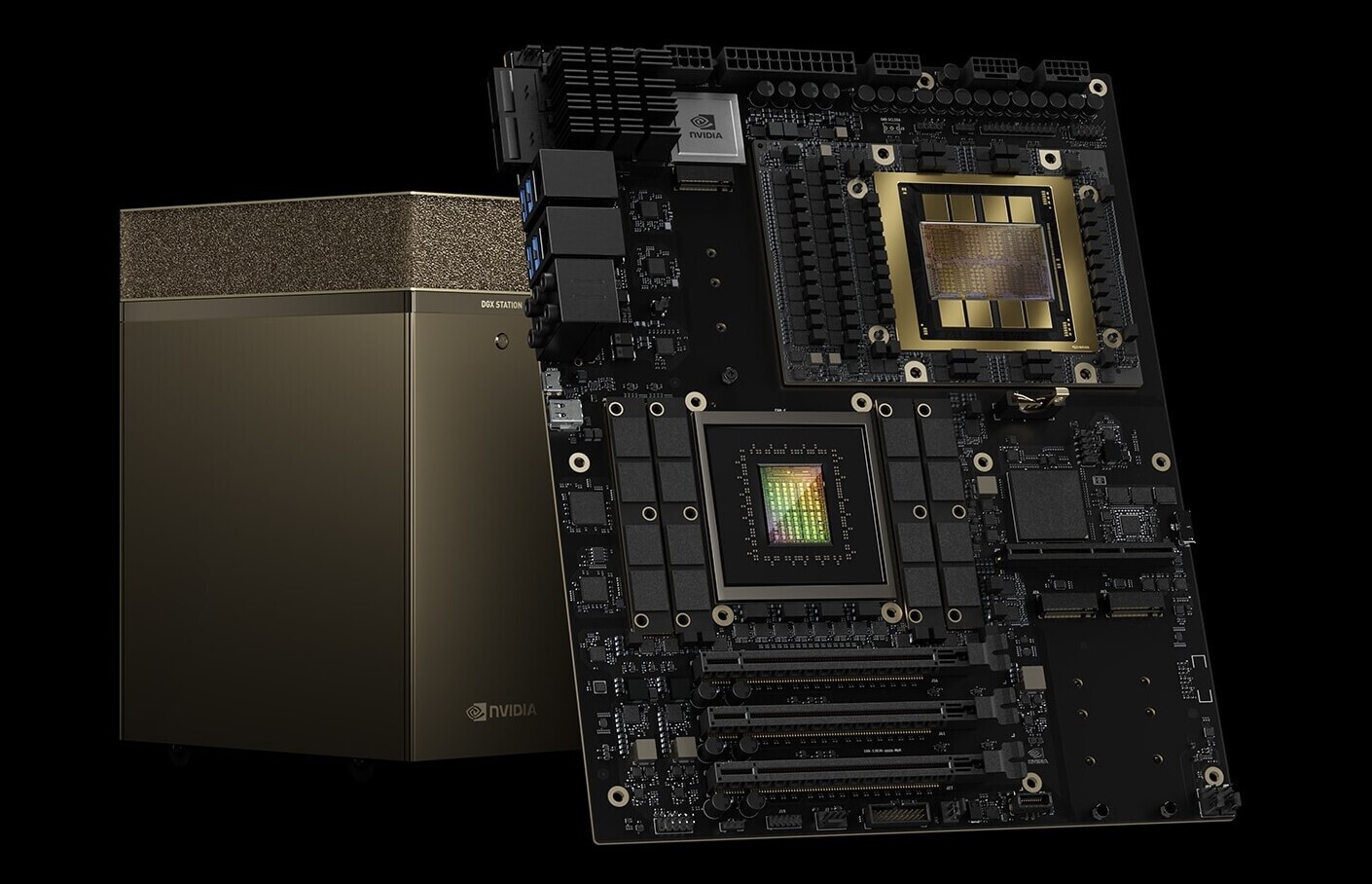
DGX Spark and DGX Station bring the power of the Grace Blackwell architecture, previously only available in the data center, to the desktop. Global system builders to develop DGX Spark and DGX Station include ASUS, Dell, HP Inc. and Lenovo.

DGX Spark is the world's smallest AI supercomputer, empowering millions of researchers, data scientists, robotics developers and students to push the boundaries of generative and physical AI with massive performance and capabilities.
At the heart of DGX Spark is the NVIDIA GB10 Grace Blackwell Superchip, optimized for a desktop form factor. GB10 features a powerful NVIDIA Blackwell GPU with fifth-generation Tensor Cores and FP4 support, delivering up to 1,000 trillion operations per second of AI compute for fine-tuning and inference with the latest AI reasoning models, including the NVIDIA Cosmos Reason world foundation model and NVIDIA GR00T N1 robot foundation model.
The GB10 Superchip uses NVIDIA NVLink -C2C interconnect technology to deliver a CPU+GPU-coherent memory model with 5x the bandwidth of fifth-generation PCIe. This lets the superchip access data between a GPU and CPU to optimize performance for memory-intensive AI developer workloads.
NVIDIA's full-stack AI platform enables DGX Spark users to seamlessly move their models from their desktops to DGX Cloud or any accelerated cloud or data center infrastructure—with virtually no code changes—making it easier than ever to prototype, fine-tune and iterate on their workflows.
Full Speed Ahead With DGX Station
NVIDIA DGX Station brings data-center-level performance to desktops for AI development. The first desktop system to be built with the NVIDIA GB300 Grace Blackwell Ultra Desktop Superchip, DGX Station features a massive 784 GB of coherent memory space to accelerate large-scale training and inferencing workloads. The GB300 Desktop Superchip features an NVIDIA Blackwell Ultra GPU with latest-generation Tensor Cores and FP4 precision—connected to a high-performance NVIDIA Grace CPU via NVLink-C2C—delivering best-in-class system communication and performance.
DGX Station also features the NVIDIA ConnectX -8 SuperNIC, optimized to supercharge hyperscale AI computing workloads. With support for networking at up to 800 Gb/s, the ConnectX-8 SuperNIC delivers extremely fast, efficient network connectivity, enabling high-speed connectivity of multiple DGX Stations for even larger workloads, and network-accelerated data transfers for AI workloads.
Combining these state-of-the-art DGX Station capabilities with the NVIDIA CUDA-X AI platform, teams can achieve exceptional desktop AI development performance.
In addition, users gain access to NVIDIA NIM microservices with the NVIDIA AI Enterprise software platform, which offers highly optimized, easy-to-deploy inference microservices backed by enterprise support.
Availability
Reservations for DGX Spark systems open today at nvidia.com.
DGX Station is expected to be available from manufacturing partners like ASUS, BOXX, Dell, HP, Lambda and Supermicro later this year.
Source:
NVIDIA
DGX Spark and DGX Station bring the power of the Grace Blackwell architecture, previously only available in the data center, to the desktop. Global system builders to develop DGX Spark and DGX Station include ASUS, Dell, HP Inc. and Lenovo.

"AI has transformed every layer of the computing stack. It stands to reason a new class of computers would emerge—designed for AI-native developers and to run AI-native applications," said Jensen Huang, founder and CEO of NVIDIA. "With these new DGX personal AI computers, AI can span from cloud services to desktop and edge applications."Igniting Innovation With DGX Spark
DGX Spark is the world's smallest AI supercomputer, empowering millions of researchers, data scientists, robotics developers and students to push the boundaries of generative and physical AI with massive performance and capabilities.
At the heart of DGX Spark is the NVIDIA GB10 Grace Blackwell Superchip, optimized for a desktop form factor. GB10 features a powerful NVIDIA Blackwell GPU with fifth-generation Tensor Cores and FP4 support, delivering up to 1,000 trillion operations per second of AI compute for fine-tuning and inference with the latest AI reasoning models, including the NVIDIA Cosmos Reason world foundation model and NVIDIA GR00T N1 robot foundation model.
The GB10 Superchip uses NVIDIA NVLink -C2C interconnect technology to deliver a CPU+GPU-coherent memory model with 5x the bandwidth of fifth-generation PCIe. This lets the superchip access data between a GPU and CPU to optimize performance for memory-intensive AI developer workloads.
NVIDIA's full-stack AI platform enables DGX Spark users to seamlessly move their models from their desktops to DGX Cloud or any accelerated cloud or data center infrastructure—with virtually no code changes—making it easier than ever to prototype, fine-tune and iterate on their workflows.
Full Speed Ahead With DGX Station
NVIDIA DGX Station brings data-center-level performance to desktops for AI development. The first desktop system to be built with the NVIDIA GB300 Grace Blackwell Ultra Desktop Superchip, DGX Station features a massive 784 GB of coherent memory space to accelerate large-scale training and inferencing workloads. The GB300 Desktop Superchip features an NVIDIA Blackwell Ultra GPU with latest-generation Tensor Cores and FP4 precision—connected to a high-performance NVIDIA Grace CPU via NVLink-C2C—delivering best-in-class system communication and performance.
DGX Station also features the NVIDIA ConnectX -8 SuperNIC, optimized to supercharge hyperscale AI computing workloads. With support for networking at up to 800 Gb/s, the ConnectX-8 SuperNIC delivers extremely fast, efficient network connectivity, enabling high-speed connectivity of multiple DGX Stations for even larger workloads, and network-accelerated data transfers for AI workloads.
Combining these state-of-the-art DGX Station capabilities with the NVIDIA CUDA-X AI platform, teams can achieve exceptional desktop AI development performance.
In addition, users gain access to NVIDIA NIM microservices with the NVIDIA AI Enterprise software platform, which offers highly optimized, easy-to-deploy inference microservices backed by enterprise support.
Availability
Reservations for DGX Spark systems open today at nvidia.com.
DGX Station is expected to be available from manufacturing partners like ASUS, BOXX, Dell, HP, Lambda and Supermicro later this year.

30 Comments on NVIDIA Announces DGX Spark and DGX Station Personal AI Computers
- Arm CPU, not x86 CPU, so playing (certain) games is going to be an issue
- Supposedly requires a specialized NVIDIA Arm OS
- Can't run serious models like the real DeepSeek-R1 quants, because can't fit even the smallest quant ("DeepSeek-R1-IQ1_S.gguf" is 133.56GB)
- The overpriced Framework Desktop using AMD Max+ 395 128GB is still 1000 $ cheaper for similar bandwidth (256 GB/s) and has all the advantages of x86 compatibility
- It's a given that it can't be used for training (maybe models in the millions of parameters, not billions), but even fine-tuning it isn't going to be great with the 273 GB/s memory bandwidth (maybe small models)
- Soon there are going to be many AMD Max+ 395 128GB x86 mini-PC devices at half the price with all the compatibility advantages that x86 brings
What would be really needed are 256GB RAM devices with, say, at least twice the memory bandwidth (>500GB/s) to be able to run serious LLM like the real DeepSeek-R1 (luckily as a MOE model, it runs faster than dense models at the same size).Maybe when AMD and NVIDIA designed the 128 GB RAM, 256-bit, quad-channel, SOCs (and to also catch up no APPLE's offerings), DeepSeek-R1 wasn't a thing (though maybe at that time there was Llama-3.1-405B, but as a dense model it would run much slower), but it is now.
Vera seems to be a custom core as well, unlike grace which was a neoverse design.Linux for sure. Even on windows Nvidia is recommending people to use WSL instead of trying to do things natively.Only saving point I see for spark is if you want to cluster multiple of those, given that it has connect-x. Not sure why one would spend that amount of money in such a setup, but it's an option.
But yeah, at this price point it may make more sense to go with a proper GPU setup.
There are no off-the-shelf wheels for pytorch or tensorflow, and that applies to most of the packages on pypi, as an example.CUDA makes thing way easier. ROCm is not that easy to deal with, and has major annoyances and lack of performance when it comes to the major frameworks/engines.
I am currently running an application I developed with c++/Cuda on g5 instances on aws under Ubuntu. I saw yesterday's announcement about Spark which uses an arm cpu. If I recompile my code, would it work on spark? What would be the performance of its GPU?
This sounds like a wonderful solution for me but I am not sure it would work.
Thank you
Previously they had some POWER offerings which had NVLink, but I guess we can agree that ARM was a way better ecosystem than POWER.
They don't really have many options regarding ISA. Grace also used an off-the-shelf core from Arm, whereas RISC-V has no design at the same scale.
Now that they went with a custom core design, they could've likely used RISC-V, but then the software ecosystem part comes into play, and that would also mean making the transition from Grace to Vera way harder.There is, a lot. Software support is really subpar, the performance is far from the theoretical performance the hardware can achieve, many operators are not properly supported.
Even at the enterprise level stuff can get really annoying. Here's a great post regarding such issues:
semianalysis.com/2024/12/22/mi300x-vs-h100-vs-h200-benchmark-part-1-training/It doesn't.After a hecking long time those got ported to ROCm.
Most of the other stuff never gets ROCm support, or takes a really long time to get support for.FA2 and 3, CTranslate2,
ktransformers*, and thunderkittens are some examples that I can think of right out of the bat.*seems like ktransformers just got ROCm support this week, albeit with limitations:
github.com/kvcache-ai/ktransformers/pull/178
github.com/kvcache-ai/ktransformers/blob/main/doc/en/ROCm.md
Nonetheless, even with some stuff working, performance is still really subpar:
LocalLLaMA/comments/1ghvwsj
Randomfoo2 has a great site were they keep track of some of those things:
llm-tracker.info/howto/AMD-GPUs
The ecosystem has been evolving at a really nice pace, for sure, but it's not fast enough to keep up with all the CUDA stuff going on, and requires way more tinkering to get things going.
One could argue: Why connect, say 2, of these units together, when one could get an APPLE Studio M4 Max with 256GB of unified memory at 410 GB/s for a similar price, actually cheaper (2*3000 $ vs 5600 $).
As I said, idk why one would like to spend that amount of money, but it is an option, and it does sound like a fun (albeit expensive) project to tinker with.
Edit:Let me add, why at least 256 GB RAM: According to this (which was posted after my post, but it's kinda common knowledge at this point), recommended DeepSeek-V3 / -R1 quants are 2.42bit (203GB) / 2.71bit (231GB) and above.
For training the communication cost is higher. But for just a pair of devices it wouldn't be that bad either. It starts to really become an issue when you have 4 or more devices, from my own experience.