Thursday, July 17th 2025

AMD Radeon AI PRO R9700 GPU Arrives on July 23rd
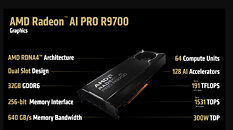
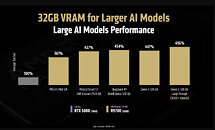
AMD confirmed today that its RDNA 4-based Radeon AI PRO R9700 GPU will reach retail on Wednesday, July 23. Built on the Navi 48 die with a full 32 GB of GDDR6 memory and supporting PCIe 5.0, the R9700 is specifically tuned for lower-precision calculations and demanding AI workloads. According to AMD, it delivers up to 496% faster inference on large transformer models compared to NVIDIA's desktop RTX 5080, while carrying roughly half the price of the forthcoming RTX PRO "Blackwell" series. At launch, the Radeon AI PRO R9700 will only be offered inside turnkey workstations from OEM partners such as Boxx and Velocity Micro. Enthusiasts who wish to install the card themselves can expect standalone boards from ASRock, PowerColor, and other add-in-board vendors later in the Q3. Early listings suggest a price of around $1,250, placing it above the $599 RX 9070 XT yet considerably below competing NVIDIA workstation GPUs. Retailers are already accepting pre-orders.
Designed for AI professionals who require more than what consumer-grade hardware can provide, the Radeon AI PRO R9700 excels at natural language processing, text-to-image generation, generative design, and other high-complexity tasks that rely on large models or memory-intensive pipelines. It's 32 GB of VRAM allows production-scale inference, local fine-tuning, and multi-modal workflows to run entirely on-premises, improving performance, reducing latency, and enhancing data security compared to cloud-based solutions. Full compatibility with AMD's open ROCm 6.3 platform provides developers with access to leading frameworks, including PyTorch, ONNX Runtime, and TensorFlow. This enables AI models to be built, tested, and deployed efficiently on local workstations. The card's compact dual-slot design and blower-style cooler ensure reliable front-to-back airflow in dense multi-GPU configurations, making it simple to expand memory capacity, deploy parallel inference pipelines, and sustain high-throughput AI infrastructure in enterprise environments.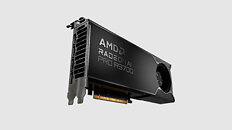
Sources:
AMD Blog, via VideoCardz
Designed for AI professionals who require more than what consumer-grade hardware can provide, the Radeon AI PRO R9700 excels at natural language processing, text-to-image generation, generative design, and other high-complexity tasks that rely on large models or memory-intensive pipelines. It's 32 GB of VRAM allows production-scale inference, local fine-tuning, and multi-modal workflows to run entirely on-premises, improving performance, reducing latency, and enhancing data security compared to cloud-based solutions. Full compatibility with AMD's open ROCm 6.3 platform provides developers with access to leading frameworks, including PyTorch, ONNX Runtime, and TensorFlow. This enables AI models to be built, tested, and deployed efficiently on local workstations. The card's compact dual-slot design and blower-style cooler ensure reliable front-to-back airflow in dense multi-GPU configurations, making it simple to expand memory capacity, deploy parallel inference pipelines, and sustain high-throughput AI infrastructure in enterprise environments.


93 Comments on AMD Radeon AI PRO R9700 GPU Arrives on July 23rd
lol
They are comparing their best vs their best.
You think it's unfair that they're comparing those GPUs therefore it must also be unfair that they're comparing their best CPU with Intel's best CPU. Which I am sure you realize is total nonsense.
If you think comparing the R9700 to a 5080 is wrong, fine, whatever, but pretending other random comparisons they made are unfair because "AMD bad" or whatever is just dumb.
The comparison is perfectly reasonable, R9700 has way more VRAM, there are uses cases where you are simply shit out of luck with a 5080 no matter how awesome and fast it is and you'd have to pay at least 2500$ for a 5090 to get the same 32GB or God knows how much for one of their pro cards with the same amount of VRAM. There really isn't any other product they could have compared it to that would have made more sense.Yeah right, because if you had the money to pay thousands for an Nvidia workstation card you'd be waiting to see how AMD's mid range offerings fair as if you'd expect them to be better in every way than Nvidia's best cards lol.
Again, this is the thought process of a fanboy, not a real consumer. A real consumer with this budget wouldn't be buying their workstation cards because he wouldn't have the money, hence comparing this to things like the 5080 makes sense.
If AMD's target market is just "people who need 32GB of VRAM but also will be bankrupted by spending an extra $1300 for an Nvidia card," again, they are completely dead in this market. That hasn't worked in the consumer space, and it most definitely isn't working in the workstation market.
If every consumer would always be willing to pay more because "an extra $$$ wouldn't bankrupt them", then Nvidia wouldn't sell cheaper pro cards, which they do, cheapest Blackwell card (24GB) is 1500$ in case you didn't know. So clearly there is a market for cheaper products in the segment, unless Nvidia is also selling products that are "dead" according your very high IQ take.
So it's obvious you have no idea what you are talking about.
Nowadays? The 1080ti is as relevant as vega64 for the stuff we're talking about: better used as a space heater.Well, you don't seen to be doing any argument in good faith, bring no evidence or proper arguments, and are just bashing a product that you have never used on tasks you clearly never worked with while praising another product for in the tasks that you clearly never used it for either.
So yeah, I feel like I get a pass to step down to your level on a pointless discussion :p
github.com/nvidia
Look at the commit history of ROCm. While I won’t say nobody wants anything to do with it…
Similar thing happens at Nvidia, where they have an extremely annoying setup for most of their projects with an internal perforce repo and the public github one that have to be kept in sync.
Also the situation has changed somewhat compared to the 7900XTX days.
AMD is performing very well in some workloads (Topaz AI, Unreal Engine, ON1 Resize, partially SPEC workstation etc.).
www.pugetsystems.com/labs/articles/nvidia-5060-ti-vs-amd-9060-xt-for-content-creation/
www.computerbase.de/artikel/grafikkarten/nvidia-geforce-rtx-5060-test.92811/seite-7
www.tomshardware.com/pc-components/gpus/amd-radeon-rx-9060-xt-16gb-review/6
More here @10:38.
But it's still a long road ahead of them: www.phoronix.com/review/radeon-rx-9060-xt-rocm
nVidia is extremely strong in rendering, but in everything else it's much closer than some would like to admit.
Yes, I know that it makes sense for workstation PC, but not for a gaming PC in 2025.