Thursday, July 17th 2025
AMD Radeon AI PRO R9700 GPU Arrives on July 23rd
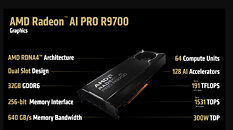
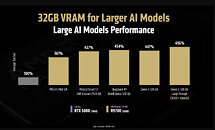
AMD confirmed today that its RDNA 4-based Radeon AI PRO R9700 GPU will reach retail on Wednesday, July 23. Built on the Navi 48 die with a full 32 GB of GDDR6 memory and supporting PCIe 5.0, the R9700 is specifically tuned for lower-precision calculations and demanding AI workloads. According to AMD, it delivers up to 496% faster inference on large transformer models compared to NVIDIA's desktop RTX 5080, while carrying roughly half the price of the forthcoming RTX PRO "Blackwell" series. At launch, the Radeon AI PRO R9700 will only be offered inside turnkey workstations from OEM partners such as Boxx and Velocity Micro. Enthusiasts who wish to install the card themselves can expect standalone boards from ASRock, PowerColor, and other add-in-board vendors later in the Q3. Early listings suggest a price of around $1,250, placing it above the $599 RX 9070 XT yet considerably below competing NVIDIA workstation GPUs. Retailers are already accepting pre-orders.
Designed for AI professionals who require more than what consumer-grade hardware can provide, the Radeon AI PRO R9700 excels at natural language processing, text-to-image generation, generative design, and other high-complexity tasks that rely on large models or memory-intensive pipelines. It's 32 GB of VRAM allows production-scale inference, local fine-tuning, and multi-modal workflows to run entirely on-premises, improving performance, reducing latency, and enhancing data security compared to cloud-based solutions. Full compatibility with AMD's open ROCm 6.3 platform provides developers with access to leading frameworks, including PyTorch, ONNX Runtime, and TensorFlow. This enables AI models to be built, tested, and deployed efficiently on local workstations. The card's compact dual-slot design and blower-style cooler ensure reliable front-to-back airflow in dense multi-GPU configurations, making it simple to expand memory capacity, deploy parallel inference pipelines, and sustain high-throughput AI infrastructure in enterprise environments.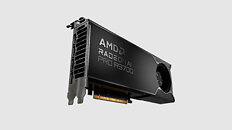
Sources:
AMD Blog, via VideoCardz
Designed for AI professionals who require more than what consumer-grade hardware can provide, the Radeon AI PRO R9700 excels at natural language processing, text-to-image generation, generative design, and other high-complexity tasks that rely on large models or memory-intensive pipelines. It's 32 GB of VRAM allows production-scale inference, local fine-tuning, and multi-modal workflows to run entirely on-premises, improving performance, reducing latency, and enhancing data security compared to cloud-based solutions. Full compatibility with AMD's open ROCm 6.3 platform provides developers with access to leading frameworks, including PyTorch, ONNX Runtime, and TensorFlow. This enables AI models to be built, tested, and deployed efficiently on local workstations. The card's compact dual-slot design and blower-style cooler ensure reliable front-to-back airflow in dense multi-GPU configurations, making it simple to expand memory capacity, deploy parallel inference pipelines, and sustain high-throughput AI infrastructure in enterprise environments.


93 Comments on AMD Radeon AI PRO R9700 GPU Arrives on July 23rd
Nvidia's strong point is that all its software is optimized for Nvidia, that's all. AMD engineers aren't stupid; it just takes a huge amount of work to ensure that the libraries are optimized for AMD as well. It won't be easy for them to compete, but I admire that they're doing their best in so few years
An instinct MI355x isn't worse than a b100 on the hardware front; it just doesn't have software optimized for it.
Lets not turn this into a moral argument when we're talking about megacorpos. Businesses are not obligated to risk R&D and all the costs associated with bringing new products to market, just to give it away for free. AMD is literally no better, look at the prices of their CPUs at both consumer and enterprise levels. The better product wins, and you pay more for it. The competition licenses your IP if they can, as with x86-64. That's just life.
The entire core of CUDA is super closed—drivers, runtime, toolchain, etc.
What are you talking about? Nvidia's margins lies there; it doesn't make better hardware than others, it just has a closed stack.
Of course, AMD is the same; they're mega-companies, not do-gooders, and they're right to do so. They exploit the high price if they can.
That doesn't mean you can say Nvidia's advantage is hardware, when in fact it's only due to closed software.
AMD has even more advanced nodes than Nvidia, it simply doesn't have software support because all companies choose Nvidia, as is only right.Wait... I replied that Nvidia's strong point is its closed-source software, not its hardware, as the other user said. Of course, there's nothing against it.
The risk is maybe one day some governerors impose restrictions or to open cuda for monopoly risk, and than the castle falls
github.com/CVCUDA/CV-CUDA
github.com/NVIDIA/ccclIt's literally both, but believe what you want to believe. Much of the reason their software stack is better and more developed, is because they brought hardware that can run that type of software to market before anyone else. They are now on 5th or so gen specialized hardware in certain cases, when the direct competition has just brought a kind of first gen to the market, or is still using a hybrid approach. Thus, they set the standards, and companies that wanted cutting edge bought NVIDIA, learned NVIDIA, and trained devs on NVIDIA stacks. Ignoring this or pretending it isn't so doesn't change reality.
But please, show me the "equivalent hardware" to NVLink?
AMD at the time of this comment has the best GPGPU regardings specs, but it does not have the software, so for this is a fraction of the power of nvidia b100.
That's all. Only CUDA software
AMD has plenty of proprietary or closed source software, let's not play this game, it's just none of it is as popular or profitable as CUDA.
Good day
Do you seriously think that these teams of people representing billions of dollars, whose careers hinge on making the right technical decisions haven't evaluated the alternatives? Aren't capable of making their own software/hardware? Haven't tried to?
Because ROCm will never be able to match CUDA if no one uses it. They'll always be a second choice, but you have to understand why! Not because AMD can't make a B100—in fact, the MI355X is even better on paper—but simply because the software stack isn't up to par and probably never will be because all the software is optimized only for NVIDIA.
MI355X-
"
Based on that spec alone, AMD will potentially deliver roughly the same AI computational horsepower with MI355X as Nvidia will have with Blackwell. AMD will also offer up to 288GB of HBM3E memory, however, which is 50% more than what Nvidia offers with Blackwell right now. Both Blackwell and MI355X will have 8 TB/s of bandwidth per GPU.
Of course, there's more to AI than just compute, memory capacity, and bandwidth. Scaling up to higher numbers of GPUs often becomes the limiting factor beyond a certain point, and we don't have any details on whether AMD is making any changes to the interconnects between GPUs. That's something Nvidia talked about quite a bit with it's Blackwell announcement, so it will be something to pay attention to when the products start shipping."
So again, you're still claiming that the AMD stack is competitive, just lacking software. But from what I can tell just from a minute of checking one reference that occured to me from memory, they have no answer to NVLink. There's likely many other specialised hardware solutions that don't have equivalents, and I mean equivalents, not "does the same thing but slower". I can't really be bothered to go and research them all, just needed one example to demonstrate that 'it's just software the hardware is the same' statement is misleading.
The fact they're usingand still at best reach 'parity', isn't a compliment to the architecture. Blackwell pushing the bar forwards again while reusing the same node as Ada, just goes to show the casual approach NVIDIA can take to maintain hardware/software dominance. They don't need cutting edge nodes or massive amounts of HBM just to reach 'equivalence' on paper.
I'll give you a clear example so I hope you understand:
If CUDA software were as "open" (duopoly thanks to ibm) as the x86 architecture has become, anyone could make GPUs that use CUDA, just like AMD makes CPUs that use x86, which was previously reserved for Intel. So don't think NVIDIA's monopoly will last long; it's very likely that some government will intervene.
They have their own technology, called Infinity Fabric Link. There's no point in getting too hung up on it; on the hardware front, AMD has it all.
www.digitimes.com/news/a20240702PD221/france-nvidia-antitrust-investigation-ai.html and many many more www.businessinsider.com/nvidia-secret-sauce-regulators-gpu-chips-jensen-huang-2024-7
Talking about absurd hypotheticals like "if CUDA was open" to prove some alternate reality point that can't be argued against, because it doesn't exist, is certainly one of the approaches of all time.
I agree, this is a pointless discussion.
Quit it.
Its nice to have cheap gpus with lots of vram for the workloads that need it, but this is not cheap. Cant see a pro splurging for this instead of the 5090 with those prices.
As usual people who would have no interest in these things anyway are complaining about pricing even though AMD is clearly offering something of much better value for specific purposes.
www.techpowerup.com/gpu-specs/radeon-9700-pro.c50
Pro models are always more expensive for a 'lesser' chip (due to software/support and some bells etc). It's a little disingenuous to compare gaming and 'pro' models of GPUs on price. Lets not blur the lines?