Thursday, July 17th 2025

AMD Radeon AI PRO R9700 GPU Arrives on July 23rd

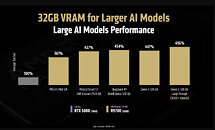
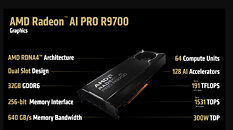
AMD confirmed today that its RDNA 4-based Radeon AI PRO R9700 GPU will reach retail on Wednesday, July 23. Built on the Navi 48 die with a full 32 GB of GDDR6 memory and supporting PCIe 5.0, the R9700 is specifically tuned for lower-precision calculations and demanding AI workloads. According to AMD, it delivers up to 496% faster inference on large transformer models compared to NVIDIA's desktop RTX 5080, while carrying roughly half the price of the forthcoming RTX PRO "Blackwell" series. At launch, the Radeon AI PRO R9700 will only be offered inside turnkey workstations from OEM partners such as Boxx and Velocity Micro. Enthusiasts who wish to install the card themselves can expect standalone boards from ASRock, PowerColor, and other add-in-board vendors later in the Q3. Early listings suggest a price of around $1,250, placing it above the $599 RX 9070 XT yet considerably below competing NVIDIA workstation GPUs. Retailers are already accepting pre-orders.

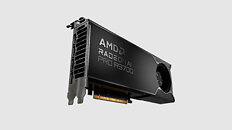
Designed for AI professionals who require more than what consumer-grade hardware can provide, the Radeon AI PRO R9700 excels at natural language processing, text-to-image generation, generative design, and other high-complexity tasks that rely on large models or memory-intensive pipelines. It's 32 GB of VRAM allows production-scale inference, local fine-tuning, and multi-modal workflows to run entirely on-premises, improving performance, reducing latency, and enhancing data security compared to cloud-based solutions. Full compatibility with AMD's open ROCm 6.3 platform provides developers with access to leading frameworks, including PyTorch, ONNX Runtime, and TensorFlow. This enables AI models to be built, tested, and deployed efficiently on local workstations. The card's compact dual-slot design and blower-style cooler ensure reliable front-to-back airflow in dense multi-GPU configurations, making it simple to expand memory capacity, deploy parallel inference pipelines, and sustain high-throughput AI infrastructure in enterprise environments.
Sources: AMD Blog, via VideoCardz
Add your own comment

93 Comments on AMD Radeon AI PRO R9700 GPU Arrives on July 23rd

#76
dgianstefani
TPU Proofreader
the54thvoidOnly a $625 uplift? Not bad. The RTX Pro 5000 is >$2000 more than a 5090 (which is faster).

Pro models are always more expensive for a 'lesser' chip (due to software/support and some bells etc). It's a little disingenuous to compare gaming and 'pro' models of GPUs on price. Lets not blur the lines?
I think that's the issue that some people had. The AMD marketing is comparing pro grade cards against consumer cards, which don't generally have more than 16 GB VRAM—like a 32 GB RTX 5080 wouldn't necessarily be any faster in general except in certain games at 4K—so don't have more. The second related thing is that they're directly comparing 16 GB cards to 32 GB cards in tasks that specifically require more than 16 GB VRAM, which is quite misleading. I do understand the pricing is similar, but...

Posted on Reply
#77
jnv11
dgianstefaniThe lack of CUDA makes AMD DGPUs DOA for most things workstation/scientific. Occasionally there's a metric where AMD is competitive for workstations, but it's the exception, not the rule.

This is regarding productivity OFC, not gaming, where RDNA 4 is reasonably competitive vs Blackwell.

Beyond just the hardware, developer and software support for NVIDIA's CUDA architecture is so many orders of magnitude ahead it's not even funny. AMD has made some steps in the right direction recently, but they have a lot of catching up to do and NVIDIA has insane momentum.


Or how AMD are currently comparing the $11700 96 core 9995WX against the $5890 60 core Xeon-3595X, instead of the $7999 64 core 9985WX.

Anything to show a bigger bar chart.
Nvidia recently shot itself in the foot by dropping 32-bit CUDA support in Blackwell and by making the “announcements” that it will be doing so a previously obscure knowledge base article and by removing the 32-bit CUDA compiler from the CUDA Toolkit. Lots of people who did not notice these things were surprised when the RTX 50 series failed to run 32-bit CUDA programs. Some developers like one BOINC project that I used to run (I forgot which one) intentionally released only a 32-bit CUDA version because the 32-bit version was faster than a 64-bit version. Perhaps the 32-bit version had smaller memory pointers so its code density would be greater, cutting performance-slowing cache thrashing. Unlike x86 where the additional CPU registers in 64-bit mode greatly boost performance by greatly reducing CPU register thrashing, CUDA does not have any similar bottlenecks to overcome on the GPU in 32-bit mode. 64-bit CUDA’s advantages are that the GPU and CPU can access more memory, and that the CPU side of the program can cut register thrashing if there are any CPU-heavy sections of the program. Lots of 32-bit CUDA, 32-bit OpenCL, and 32-bit PhysX programs (the latter which Nvidia supported via a software translation thunk that converted those to 32-bit CUDA) are now incompatible with the RTX 50 series GPUs. Had Nvidia made a bigger deal about 32-bit CUDA being deprecated with the intent to have it removed, perhaps developers could have known to develop 64-bit versions instead of 32-bit versions for future proofing instead of compatibility with older 32-bit machines, or have had a 64-bit port in the works during the XP to Vista transition.

Now is a great time for AMD to strike while Nvidia still has that bullet wound in its foot that can damage CUDA’s momentum. It could advertise that its OpenCL support is not self-nerfed so old 32-bit OpenCL code can continue to run as far as I am aware, and that AMD supports OpenCL 2.2 which Nvidia never supported outside of some token experimental efforts. (Intel also supports OpenCL 2.x in addition to 3.0.) Sure, AMD needs to release ROCm for consumer GPUs and OpenCL 3.0 support to fight the CUDA monopoly.

Nvidia chaired the group that standardized OpenCL, and used that to waste the OpenCL 2.x efforts by replacing it with OpenCL 3.0 which made OpenCL 2.x compliance optional. Nvidia only made token experimental efforts for OpenCL 2.x compliance for its GPUs that never went anywhere before OpenCL 3.0 was released probably to keep antitrust authorities off its back and to mislead competitors while it continued to maintain its CUDA monopoly that it legally earned due to being first in the market before OpenCL existed. Forcing everyone to restart their OpenCL after version 1.x efforts in this manner feels like a sneaky way for Nvidia to maintain the CUDA monopoly and makes me wonder if wasting everyone’s time with OpenCL 2.x until it pulled the rug under everyone with OpenCL 3.0 is an antitrust violation.
Posted on Reply
#78
JustBenching
the54thvoidOnly a $625 uplift? Not bad. The RTX Pro 5000 is >$2000 more than a 5090 (which is faster).

Pro models are always more expensive for a 'lesser' chip (due to software/support and some bells etc). It's a little disingenuous to compare gaming and 'pro' models of GPUs on price. Lets not blur the lines?
Oh I totally agree - putting more vram on a gpu makes it worth its weight in gold - but im wondering about the people not agreeing with that and made their position very vocal about nvidia upcharging 40$ for 8gb of vram, where are they now? If you find them, please notify me - im worried something happened to them :)
Posted on Reply
#79
the54thvoid
Super Moderator
<reply to post 77>

It doesn't warrant four pages of bickering though. It doesn't require reams of text and segways into other realms to beat people up about it.

People need to loosen up a little and go about their lives. Or, learn to craft discussion which doesn't require the 'last word'.
Posted on Reply
#80
Vya Domus
4 pages of people complaining about this comparison refusing to acknowledge that for this specific use case VRAM matters a lot, performance is limited by memory not compute at that level, comparing it to a 5090/Pro 4500 would seem absolutely ridiculous seeing as they are so much more expensive.

AMD is making a point by not comparing it to those models, you can get this much VRAM for the price of a regular card. Perhaps people should be mad at Nvidia for upcharging so much money for more VRAM on both regular and pro models but no, you should get mad at the company that's offering the cheaper alternative lol.
Posted on Reply
#81
dgianstefani
TPU Proofreader
Vya Domus"Anything to show a bigger bar chart"

lol

They are comparing their best vs their best.
Vya Domus4 pages of people complaining about this comparison refusing to acknowledge that for this specific use case VRAM matters a lot, performance is limited by memory not compute at that level, comparing it to a 5090/Pro 4500 would seem absolutely ridiculous seeing as they are so much more expensive.
So it's fine to compare $12,000 CPUs to $6000 ones, that's not "absolutely ridiculous", because it's the best vs the best.

But then in other direction it's fine to compare non-pro cards to pro cards with twice the VRAM, because suddenly you should only compare against hardware of a similar price point.

Both of these approaches are valid! But surely some consistency is good, within the same thread.

Let's test the Pro 9700 against a Blackwell RTX Pro card with 32 GB?
Posted on Reply
#83
Vya Domus
dgianstefaniSo it's fine to compare $12,000 CPUs to $6000 ones, that's not "absolutely ridiculous", because it's the best vs the best.

But then in other direction it's fine to compare non-pro cards to pro cards with twice the VRAM
Yep.

Because memory capacity matters a lot for these GPUs, these aren't the same types of products with the same limitations so consistency for what ? You can complain about it all you want, it's a legitimate selling point that AMD should make use of in their marketing. There is no rule that says you are barred from comparing products that aren't the exact same price or that you need to make sure both of them have "Pro" in their names, these are just a bunch of weird rules you came up with because AMD le bad and Nvidia le good.

I wonder if you'd be just as mad if for example Nvidia compared the 5090 with the 9070XT but we both know you would never complain about that.
Posted on Reply
#84
Red Hood
This card should be popular with the LLM crowd at that price of $1250

Apparently four of them can be used together in multi gpu config
Posted on Reply
#85
Denver
Very cheap compared to other professional tier cards. Unfortunately, the AI guys will absorb all the supply, this price tends to rise.
Posted on Reply
#86
Beermotor
dgianstefaniThe lack of CUDA makes AMD DGPUs DOA for most things workstation/scientific. Occasionally there's a metric where AMD is competitive for workstations, but it's the exception, not the rule.

This is regarding productivity OFC, not gaming, where RDNA 4 is reasonably competitive vs Blackwell.
I 100% agree with you on the bar chart thing and the whole benchmark orgy.

The elephant in the room with this particular card is the fact that the Linux Open Source AMD drivers will just see this as a Navi 48 GPU thereby effectively rendering* it a 32GB 9070XT. :D

*Yes that pun was slightly intended.
Posted on Reply
#87
JustBenching
Vya DomusI wonder if you'd be just as mad if for example Nvidia compared the 5090 with the 9070XT but we both know you would never complain about that.
Everyone with half a brain cell would consider this ludicrous and would laugh nvidia out of the room - then proceed to compare the 9700xt to the 5070ti.

The problem here is that amd is comparing 2 products that are not comparable, nobody that has workloads that need >16gb of vram was ever going to buy a 5080 in the first place, so the fact that the 9700 pro is faster in those workloads is useless for that target group. A more honest approach would be to compare it to the 5090 and show how much better value it brings to the table - since you can run the same stuff (albeit slower) for half the money. And that's the actual target group for this card, peeps that were looking at the 5090 cause they needed the vram, they can now have it for /2 of the price.
Posted on Reply
#88
Redwoodz
JustBenchingEveryone with half a brain cell would consider this ludicrous and would laugh nvidia out of the room - then proceed to compare the 9700xt to the 5070ti.

The problem here is that amd is comparing 2 products that are not comparable, nobody that has workloads that need >16gb of vram was ever going to buy a 5080 in the first place, so the fact that the 9700 pro is faster in those workloads is useless for that target group. A more honest approach would be to compare it to the 5090 and show how much better value it brings to the table - since you can run the same stuff (albeit slower) for half the money. And that's the actual target group for this card, peeps that were looking at the 5090 cause they needed the vram, they can now have it for /2 of the price.
Now add the factor of the motherboard. How many 5090's can you fit, and power? You can run 4 9700's.
Posted on Reply
#89
LabRat 891
BOXX is begining to advertise availibility.

I cannot find it in the customization menu now, but earlier this afternoon the R9700 was a $1049 add-on.
Posted on Reply
#90
jnv11
So far, I have found 3 different AIB partners that are offering Radeon AI PRO R9700 models as of this writing. I will also include an entry for a Made by AMD cards because MBA cards for the RX 9070 XT have been spotted being sold into the OEM prebuilt computer channel even though AMD decided not to compete in the retail card market. I don't know if AMD will pursue a similar strategy for the AI PRO R7900.

So far, all of the cards have the same dimensions within a millimeter, and all of them have the same clock speed specifications.

I have created this table of the differences of each model that I could find.

ManufacturerModelDisplayPortHDMIFan bearing typeThermal interface materialWeb page
AMDAMD Radeon™ AI PRO R97004 x 2.1b (Unknown max speed)0UnknownUnknownwww.amd.com/en/products/graphics/workstations/radeon-ai-pro/ai-9000-series/amd-radeon-ai-pro-r9700.html
ASRockAMD Radeon™ AI PRO R9700 Creator 32GB4 x 2.1b (Unknown max speed)0UnknownHoneywell PTM7950asrock.com/Graphics-Card/AMD/Radeon%20AI%20PRO%20R9700%20Creator%2032GB/
GigabyteRadeon™ AI PRO R9700 AI TOP 32G3 x 2.1a (Unknown max speed)1 x 2.1bDual ball bearingComposite metal grease for GPU + "server-grade thermal conductive gel" for VRAM and MOSFETswww.gigabyte.com/Graphics-Card/GV-R9700AI-TOP-32GD
PowerColorPowerColor Radeon™ AI PRO R97004 x 2.1b (Unknown max speed)0UnknownUnknownpowercolor.com/product-detail255.htm


From what I have read, DisplayPort 2.1a and 2.1b are identical and fully interchangeable on the GPU side. The difference is that 2.1b adds an active DisplayPort cable specification that is needed for longer DisplayPort cables.

I have listed the DisplayPorts as unknown max speed because AMD has in the past capped the DisplayPort speeds on consumer-level cards to UHBR13.5 while fully enabling DisplayPort 2.1a/b's maximum speed of UHBR20 on workstation-level cards.
Posted on Reply
#91
Othnark
With 2x9700s, rocM vLLM, and fairly large models with 100k+ contexts, my inference box has double the VRAM, higher throughput and none of the fire risk of a 5090 for roughly the same cost and power draw.

vLLM is able to keep the full tilt at 330w limit during prompt processing and generation using dense models, something Llama.cpp cannot do at this point as it has shite rocM implementation.

2850mhz memory is completely stable on both cards and gives a nice bump in performance, and like my 9070 XT in my gaming rig they jump straight to core at 3420mhz in lighter loads.

It's ~the same as 9070 XT in gaming, as expected, but keeps the VRAM cooler doing so.

DP is enough for 240hz on a 57" Samsung Odyssey G9, whatever standard that works out to.

Thing to keep in mind is that virtually no software leverages the matrix cores yet, RDNA 4 has a whole tier of performance being untouched by most non-gaming loads, it will age well as long as AMD keeps contributing to projects to get the CUDA interpreter working correctly.

The difference in inference between using matrix cores and not using them is a 4-12x speed boost depending on specific load. With them active it becomes the fastest AMD workstation card on the market, and 1/4 the price of its predacessor.

Not sure how people think that's a bad thing lol.
Posted on Reply
#92
Solid State Brain
Othnarksomething Llama.cpp cannot do at this point as it has shite rocM implementation.
Isn't the Vulkan backend the recommended choice for llama.cpp on AMD, nowadays?
Posted on Reply
#93
igormp
OthnarkWith 2x9700s, rocM vLLM, and fairly large models with 100k+ contexts, my inference box has double the VRAM, higher throughput and none of the fire risk of a 5090 for roughly the same cost and power draw.

vLLM is able to keep the full tilt at 330w limit during prompt processing and generation using dense models, something Llama.cpp cannot do at this point as it has shite rocM implementation.

2850mhz memory is completely stable on both cards and gives a nice bump in performance, and like my 9070 XT in my gaming rig they jump straight to core at 3420mhz in lighter loads.

It's ~the same as 9070 XT in gaming, as expected, but keeps the VRAM cooler doing so.

DP is enough for 240hz on a 57" Samsung Odyssey G9, whatever standard that works out to.

Thing to keep in mind is that virtually no software leverages the matrix cores yet, RDNA 4 has a whole tier of performance being untouched by most non-gaming loads, it will age well as long as AMD keeps contributing to projects to get the CUDA interpreter working correctly.

The difference in inference between using matrix cores and not using them is a 4-12x speed boost depending on specific load. With them active it becomes the fastest AMD workstation card on the market, and 1/4 the price of its predacessor.

Not sure how people think that's a bad thing lol.
For how much did you manage to get that pair for?
Posted on Reply
Add your own comment
Nov 14th, 2026 00:28 CST change timezone

New Forum Posts

Popular Reviews

TPU on YouTube

Controversial News Posts