Wednesday, August 13th 2025

Intel to Deliver More APO Game Optimizations Next Quarter
Intel announced today that it will accelerate the CPU fine-tuning for games with its Application Optimization (APO) by introducing a new set of improvements scheduled for release next quarter. An engineer on the team confirmed the company is still committed to the project, saying "Intel is vested in keeping and growing APO capabilities through future programs." The update aims to expand game and application support, refine runtime scheduling, and improve consistency in performance across systems. APO does more behind the scenes than thread assignment. It continuously monitors application behavior and dynamically steers resources, from deciding which performance cores run which threads to adjusting an application's internal threading, all aimed at improving responsiveness and frame rates for supported titles. Several core mechanisms are proprietary and will remain internal as Intel scales APO and folds it into future programs.
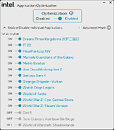
Intel plans to deliver the update through regular channels and to evolve the optional Application Optimizer interface that reveals which titles are tuned and allows users to opt out on a per-application basis. The interface is available through the Microsoft Store and not from Intel's download center. Users can disable APO globally or selectively disable specific games if the results are not as expected. The current APO stack targets modern Intel Core desktop and mobile processors with six or more performance cores. It requires BIOS enablement of Intel Dynamic Tuning Technology, a recent BIOS revision, and Windows 11. Advanced Mode unlocks wider compatibility for other 12th-generation and newer processors when Intel DTT version 11405 or later is present. Intel cautioned that real-world responsiveness may vary based on system configuration and graphics hardware. The company said ecosystem partners and select testers will receive early builds as the team focuses on stability, wider title coverage, improved telemetry, and clearer user controls. However, no exact release date was provided beyond the next quarter, which is expected to arrive soon.
Sources:
via Uniko's Hardware, r/Intel
Intel plans to deliver the update through regular channels and to evolve the optional Application Optimizer interface that reveals which titles are tuned and allows users to opt out on a per-application basis. The interface is available through the Microsoft Store and not from Intel's download center. Users can disable APO globally or selectively disable specific games if the results are not as expected. The current APO stack targets modern Intel Core desktop and mobile processors with six or more performance cores. It requires BIOS enablement of Intel Dynamic Tuning Technology, a recent BIOS revision, and Windows 11. Advanced Mode unlocks wider compatibility for other 12th-generation and newer processors when Intel DTT version 11405 or later is present. Intel cautioned that real-world responsiveness may vary based on system configuration and graphics hardware. The company said ecosystem partners and select testers will receive early builds as the team focuses on stability, wider title coverage, improved telemetry, and clearer user controls. However, no exact release date was provided beyond the next quarter, which is expected to arrive soon.


36 Comments on Intel to Deliver More APO Game Optimizations Next Quarter
On the other hand the cheap-ass Lenovo L15s with the i5-1340p get hot as hell and don't seem to have proper power state tuning, so the battery life on thosea are like 3 hrs on the SILENT mode which is laughable.
So, at least for laptops, it will depend if the OEM actually puts the time in and tunes the hardware a bit for their userbase. This sentiment is the same regardless of CPU brand since I have handle shitty 5800H and 6900HS laptops myself (particularly from Lenovo and ASUS).
www.cpubenchmark.net/compare/3549vs4999/Intel-i7-10510U-vs-Intel-i7-1260U
But yeah im sure its way slower than your previous laptop
I do not want software improved intel cpus. It feels like after years they did not even fix the P-core and E-core in any operating system.
The only way to do this is via microcode.
E-cores are good (and strong too) for users that can make use of them, even if it doesn't make sense to you.