Thursday, August 21st 2025

Microsoft's Advanced Shader Delivery Slashes First-Run Load Times by Up to 85%
Microsoft has announced Advanced Shader Delivery, a cloud-based system meant to dramatically cut first-time game load times by moving shader compilation off the player device. The feature will debut on the ROG Xbox Ally and ROG Xbox Ally X and will be distributed through the Xbox PC app. In testing with Obsidian Entertainment's Avowed, Microsoft says launch times dropped by as much as 85%, and devices spent less battery and CPU time compiling shaders. The company packages shader data into a State Object Database, or SODB, then uses cloud-based compilation to turn that data into a Precompiled Shader Database, or PSDB, which can be shipped alongside the game so a title finds ready-to-use shaders on first run.
Under the new workflow, the Xbox PC app detects a user's hardware and driver configuration and downloads the matching PSDB so the game can skip the lengthy compile step. If a system is unusual or running beta drivers, the device can still compile shaders locally. Microsoft will also refresh cached shader packages when drivers update. An AgilitySDK arriving in September will give developers and storefronts tools and APIs to adopt the format more widely. For now, the initial rollout requires no additional work from studios, and Microsoft plans to expand device and game support as the feature matures.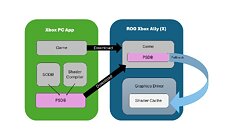
Source:
Microsoft
Under the new workflow, the Xbox PC app detects a user's hardware and driver configuration and downloads the matching PSDB so the game can skip the lengthy compile step. If a system is unusual or running beta drivers, the device can still compile shaders locally. Microsoft will also refresh cached shader packages when drivers update. An AgilitySDK arriving in September will give developers and storefronts tools and APIs to adopt the format more widely. For now, the initial rollout requires no additional work from studios, and Microsoft plans to expand device and game support as the feature matures.

60 Comments on Microsoft's Advanced Shader Delivery Slashes First-Run Load Times by Up to 85%
I couldn't personally care less about perceived relevancy when an alternative exists.Perhaps not for a majority of gaming, though Linux has taken many steps forward for games and thanks to the Steam Deck and Valve, it's a much more viable option than it was 6 years ago.
You can be anti-Linux all you like but the reality is Microsoft's OS has only gotten worse, and now they're panicking to catch up to a feature Steam OS had over 3 years ago. MS has 95% marketshare because people are forced to put up with BS, while such issues aren't happening with Linux.
At this point, Linux enthusiasts are just the equivalent of those doomsday cults that swear the Aztec calendar or whatever shows the apocalypse is going to be THIS YEAR! And then the world goes on, and they regroup, and then they realize that they misinterpreted the numbers and it's actually going to be NEXT YEAR! And then it repeats, ad infinitum.
Here's a question. What would make you change your mind about this? My answer is simple and easy: I'll change my mind about Linux's ability to replace Windows when I see Linux's gaming marketshare significantly increase and Windows' marketshare significantly decrease. Let's say Windows dropping below 85% and Linux reaching 10%. What would make you change your mind about Linux's potential?
www.techpowerup.com/239687/latest-steam-client-beta-introduces-shader-pre-caching-for-games
Maybe nobody noticed since OpenGL and Vulkan are relatively niche while they are the standard on Linux.
Also info for the people unable to recognize a trend unless it's explained to them like they are five.
www.gamingonlinux.com/steam-tracker/
That said, it's utterly appalling how this forum is totally clueless when it comes to Linux. Jay2cents level of cluelessness.
reiserfs in Suse.
ext2 and ext3 cried a lot to fix the file system.
ntfs kernel.org linux kernel, i do not talk about the operating system!, ruined one of my ntfs partitions. ntfs-3g with the fuse module is kinda mature. The linujx kenrel based read write ntfs driver module caused data corruption for myself. My motivation to use in kernel ntfs driver to get rid of the fuse translation kernel module and the external ntfs-3g module.
Seems i never retested the kernel ntfs module.
root 4718 0.0 0.0 231116 1968 ? Ss 20:12 0:00 /sbin/mount.ntfs-3g /dev/nvme0n1p4 /mnt/windows ...
when we talk about the gnu userspace with the linux kernel. Linux mint upgraded at least twice to not a useable state. REinstall was faster. GNu gentoo linux ships malfunctioning packages in year 2025 kinda often. E.g. no graphical userinterface because of broken linux-firmware package. Bugzilla bug was of course ignored which was older than my bugus update.
It'S not all sunshine. Every bad product get it'S beating regardless from who.
--
Back to the topic as others are going off topic also.
We should differentiate between linux from kernel.org and the userspace and the software.
-- last time i tried 2025 or 2024 steam, it downloaded all libaries as duplicates. Although I'm sure i have 80 percent or more precompiled for my architecture and optimised on my hardware already on my box. Steam is pure spacewaste. Regardless if windows 11 pro (the last of us part 1) or gnu gentoo linux + steam overlay(afaik )
-- microsoft has an easy life to compete against an unoptimised steam binary which what i remember downloads ubuntu binaries. Most likely it does this regardless which distro you are running. (i did not test of course any available distro and steam package for it)
The market share is also nonsense. We did not had in the past ANDROID - or mobile platform gamers, handhelds, gaming consoles, ... or any other means to play "computer" games.
I highly doubt the marketshare it is 95 percent. I hardly use steam. Past 19 years of gaming in gnu gentoo linux is in what statistic?
----
The overhead of the XBOX Gaming app is already considered? less dram? less cpu cycles? less disk space? Another bad implementation and bad fix for a problem.
It annoys me to see the xbox app on my refurbished lenovo w11 pro laptop which barely can even be used for gaming with the apu.
There are much more efficient and cost-effective ways to do always-online DRM than having to pay for an infra that always pulls new drivers and hardware configs to compile shaders and host and disseminate them to millions of player. Doing away with local compilation would be like shooting one’s foot with a bazooka.In the world where Heroic, Lutris, Bottles, Retroarches, bespoke Wine setups, and GoG offline installers exist.
Steam is the major player, sure, but it’s not the only platform. The same case as it is on Windows.This actually means Windows has less relative marketshare. The “steady” party would have filled enough of the void left by the withdrawing party equivalent to their existing weight.
The reasoning that Mac users would go for linux instead of Windows has its own faults (have you ever seen a typical mac user?)
Edit: Shouldn’t derail this thread with pointless flamewar, but I have to add: As much as it is the case with steam vs egs or uplay or whatever, platform use does not divide people to mutually exclusive groups. Many of the Deck owners (probably most) also use Windows.
Now, if you follow me, it means that Windows has doubled its userbase on Steam but Linux has ten times the userbase it had ten years ago.
But your post is probably the closest one to actually talk about the elephant in the room, namely why is this a problem in the first place? Having used the graphics APIs since the early 2000s (OpenGL extensively, but also Vulkan and a bit of DirectX), it puzzles me how this should be a problem at all. While I haven't played the latest top games of the past five years, this seem to be a problem which have increased over the past few years. Shader programs should be tiny, neat and efficient in order to perform well, they also have runtime parameters which makes them flexible, so you shouldn't need a whole lot of them. (And you can apply multiple sets of shaders to achieve different effects, so you don't need to have unique shaders for every type of object or every level.) Something tells me that games may be using very bloated (generated?) and possibly "duplicated" shaders. In other words, developers aren't using the shaders as intended. And I agree with your sentiment - there shouldn't be any need for this "feature". :rolleyes:
What are good examples of games doing this very badly?
This article is about precompiled shader cache. Clearing your (persistent) shader cache has been a common workaround/troubleshooting step for years, it's not news to anyone at this point, I don't think.
Only in the 2020s have I had to sit and wait 5-25+minutes at launch. Even back in the 00s with obscenely obsolete hardware, game loading did not take ages for 1 single process to complete.
It's 2025, even budget pre-builts have NVMe and quad-cores. What gives?!
Same way you can optimise a binary for Zen 1 era, and it works on Zen 1,2,3,4. Not maximum performance on the newer chips, but would work.
Lmao say you've never used Linux without saying you've never used Linux.
And it doesn't work only for fixed hardware. Dunno where the fuck that came from when the system has been working perfectly fine for even longer than the Steam Deck has existed.
Printing “hello world” can be done with a handful of instructions. Printing the Huffman tree representation of the same sentence requires much more.
I guess it may be possible to create mega shaders, but I think would be detrimental to performance. A variable, even if it receives dummy input when you don’t need it in a specific instance, still takes up memory and cycles.
Pre-compiling a shader happens once, executing it happens thousands/millions/trillions of times.
And let’s not forget that rendering has gotten way more complex than it was, and now we’re even doing gpgpu. Decades ago you could make a game with a handful of shader variations, today you get tons of permutations just from toggling a single option in your editor’s settings (something that is known to blow up shader count, apparently by design).
There is definitely some waste in this process. I wouldn’t be surprised if more than two thirds of the compiled shaders don’t get used during actual gameplay. Rendering only happens on a single quality settings, yet the game would have shaders specific to many more. Still, I’d rather the game process everything at once at launch than having to wait every time I toggle something in the settings. I hated testing quality settings in games that require restarts/reloads to apply them!