Thursday, August 21st 2025

Microsoft's Advanced Shader Delivery Slashes First-Run Load Times by Up to 85%
Microsoft has announced Advanced Shader Delivery, a cloud-based system meant to dramatically cut first-time game load times by moving shader compilation off the player device. The feature will debut on the ROG Xbox Ally and ROG Xbox Ally X and will be distributed through the Xbox PC app. In testing with Obsidian Entertainment's Avowed, Microsoft says launch times dropped by as much as 85%, and devices spent less battery and CPU time compiling shaders. The company packages shader data into a State Object Database, or SODB, then uses cloud-based compilation to turn that data into a Precompiled Shader Database, or PSDB, which can be shipped alongside the game so a title finds ready-to-use shaders on first run.
Under the new workflow, the Xbox PC app detects a user's hardware and driver configuration and downloads the matching PSDB so the game can skip the lengthy compile step. If a system is unusual or running beta drivers, the device can still compile shaders locally. Microsoft will also refresh cached shader packages when drivers update. An AgilitySDK arriving in September will give developers and storefronts tools and APIs to adopt the format more widely. For now, the initial rollout requires no additional work from studios, and Microsoft plans to expand device and game support as the feature matures.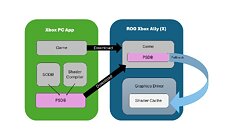
Source:
Microsoft
Under the new workflow, the Xbox PC app detects a user's hardware and driver configuration and downloads the matching PSDB so the game can skip the lengthy compile step. If a system is unusual or running beta drivers, the device can still compile shaders locally. Microsoft will also refresh cached shader packages when drivers update. An AgilitySDK arriving in September will give developers and storefronts tools and APIs to adopt the format more widely. For now, the initial rollout requires no additional work from studios, and Microsoft plans to expand device and game support as the feature matures.

60 Comments on Microsoft's Advanced Shader Delivery Slashes First-Run Load Times by Up to 85%
I am guessing this feature, requires steam client to be left running idle for a while, I might do that today, as it shows 0 bytes usage, s it hasnt downloaded anything on my system yet. Looks like its limited to Vulkan/Opengl though. They should probably add a download now button for it.
If these precompiled shader caches make it to Gamepass on Windows then it means Microsoft will start compiling for common GPUs, probably on the latest WHQL driver and host those too. I'm not expecting them to keep or care about shader cache for obscure GPUs on old drivers.
It's like an obsession.
(GP)GPUs are very good at math, but rather inefficient with heavy logic compared to CPUs, so a shader program should be as simple as possible, just a dense algorithm or two. A shader program can be just a handful lines of code, and if it happens to be hundreds of lines or more, then it's probably going to perform very badly.
This is at least the case for the most common shader types; vertex and fragment(pixel) shaders, the latter of which is executed for every sample for every pixel in a single frame, so typically millions of times per frame.
But I have a suspicion that many of these shaders are just exported by designers, not hand-written by expert coders. This may be okay for prototyping, but we should expect big development studios to do solid work. If they did, the first-time compilation of shaders should only take a few seconds or less. Composing an overengineered solution as a workaround for shoddy work is the wrong approach to this "problem". The real solution is to write shaders the way they are meant to work.x86 CPUs share a common ISA, but translate it into micro-operations which are specific for each architecture, so this isn't that different from what GPUs does. The key difference is that the CPUs translate this in real time in hardware, while the GPUs needs the driver to compile the IR or source before execution.