Thursday, August 21st 2025

Microsoft's Advanced Shader Delivery Slashes First-Run Load Times by Up to 85%
Microsoft has announced Advanced Shader Delivery, a cloud-based system meant to dramatically cut first-time game load times by moving shader compilation off the player device. The feature will debut on the ROG Xbox Ally and ROG Xbox Ally X and will be distributed through the Xbox PC app. In testing with Obsidian Entertainment's Avowed, Microsoft says launch times dropped by as much as 85%, and devices spent less battery and CPU time compiling shaders. The company packages shader data into a State Object Database, or SODB, then uses cloud-based compilation to turn that data into a Precompiled Shader Database, or PSDB, which can be shipped alongside the game so a title finds ready-to-use shaders on first run.
Under the new workflow, the Xbox PC app detects a user's hardware and driver configuration and downloads the matching PSDB so the game can skip the lengthy compile step. If a system is unusual or running beta drivers, the device can still compile shaders locally. Microsoft will also refresh cached shader packages when drivers update. An AgilitySDK arriving in September will give developers and storefronts tools and APIs to adopt the format more widely. For now, the initial rollout requires no additional work from studios, and Microsoft plans to expand device and game support as the feature matures.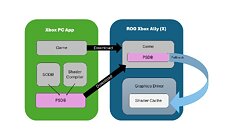
Source:
Microsoft
Under the new workflow, the Xbox PC app detects a user's hardware and driver configuration and downloads the matching PSDB so the game can skip the lengthy compile step. If a system is unusual or running beta drivers, the device can still compile shaders locally. Microsoft will also refresh cached shader packages when drivers update. An AgilitySDK arriving in September will give developers and storefronts tools and APIs to adopt the format more widely. For now, the initial rollout requires no additional work from studios, and Microsoft plans to expand device and game support as the feature matures.

60 Comments on Microsoft's Advanced Shader Delivery Slashes First-Run Load Times by Up to 85%
Do they want a round of applause for being this slow and late to the party or something? It's pathetic that it's taken Microsoft this long to support this feature for fixed-spec hardware.
Windows as a gaming OS is so utterly terrible, and yet gaming (specifically anti-cheat systems for online play) is one of the few reasons many people have left to stay on Windows, no matter how fast Microsoft poison the well with increasingly intrusive app advertising, data collection, removal of choices we've taken for granted for decades, and the incessant upsell to their cloud services embedded throughout the OS.
Instead of forcing good practices on developers MS chooses to create tech that will be locked to the Xbox App, I guess because they want to attract people to their ecosystem.
At least they realized that kernel level anti-cheats are a no-no and are in the process of disallowing their use.Steam Deck is a console that is locked down on a hardware level. Precompiling shaders for such device shouldn't be a problem (to be fair Xbox has solved this years ago since every console release already has precompiled shaders). What MS is doing here is trying to prepare something like this for various hardware builds, something that wasn't done before.
Even two people with identical hardware, driver, and OS versions can have different shader results based on user-configurable settings like ReBAR and Game Mode.
Still, if the bulk of it is re-usable for common GPU+Driver configurations, that's still an improvement.
At 90% gaming share, Windows is untouchable. At 85%, it looks strong but not invincible. At 80%, competitors start to emerge like cockroaches. At 75%, gamers start to leave Windows faster and faster. At 70% Windows quickly starts to drop to a lower steady-state share around 55-60% before dropping even more. You can change any of the numbers here but the trend is clear.
Microsoft keeps getting closer and closer to that threshold cliff, which continues to move closer to the present time thanks to Valve and other Linux partners' efforts in gaming. Microsoft's actions will look very short-sighted after the fact.
It has been like this since ever, it’s only became noticeable recently because shaders got more complex, and games started to explicitly state what they are doing instead of hiding it behind loading screens (for those that can’t get away with on-the-fly compilation).
If you take out the Steam Decks from the Linux marketshare, there's about as many people gaming on Linux as there are gaming on MacOS.
The best year for non-Windows gaming is this year. The next best year was last year. After that, it was 2023 and so on.
Conversely, I can't say that 2025 was the best year for Windows gaming (looking at you, Win 11 update problems).
"AI" answer how to do stop using cloud for calculation, potentially like compilation of shaders:
And of course, convenience of running games on Windows, but almost all of that convenience goes away when having to deal with forced updates breaking things, and bloatware in the form of ads and Microsoft pushing AI into everything. I'm not advocating for Linux either, but playing games on Linux has gotten a lot easier with Proton, and game launchers like Lutris or Heroic launcher.
Case in point, recent update bricking SSDs, or less disastrous but still very much an inconvenience, I recently myself had some trouble show up : notepad getting corrupted out of nowhere, have to perform an app repair every 2-3 reboot... task manager being unusable after a while, right clicking on items freezes it, has to be rebooted to finally work, no amount of sfc/scannow or dism-online got rid of that and still haven't found a permanent fix for it
It's less related to gaming but come on, ever seen this shit happen on linux ? Only Msoft is somehow capable of making these fuck ups despite being paid good money to make their OS.