Thursday, October 2nd 2025

Intel Allegedly in Talks with AMD for Potential Foundry Manufacturing Deal

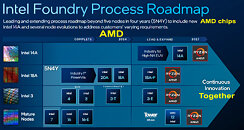
Latest rumors spin around Intel more than ever. According to Semafor, the company is in early talks with AMD—once its biggest rival in the PC and server chip wars—about making chips on Intel's production lines. As a CNBC report cited by TrendForce points out, if AMD were to use Intel for chip production, it would be a big win for Intel's foundry push. The report suggests such a deal would carry symbolic weight: AMD, a fierce competitor in x86 chips for PCs and servers, trusting manufacturing to its biggest rival. Right now, AMD relies heavily on TSMC for most of its chip production. The report didn't say how much manufacturing AMD would do with Intel, but Reuters noted in March that NVIDIA and Broadcom were testing Intel's most advanced node, 18A, while AMD was weighing whether the tech fits its needs.

AMD isn't the only company Intel is eyeing. We reported in late September that Intel reached out to Apple to explore potential investments and ways to work together more closely. The talks are described as early-stage and may not lead to a deal. Meanwhile, the Wall Street Journal reported that Intel also contacted TSMC—both a foundry rival and manufacturing partner—about potential investments or production partnerships. However, Focus Taiwan says TSMC clarified that no discussions about investments or partnerships have happened, despite rumors floating around that the struggling chipmaker is seeking TSMC's help.
Sources: TrednForce, Semafor, CNBC, Reuters, Bloomberg, Wall Street Journal, Focus Taiwan
Add your own comment

26 Comments on Intel Allegedly in Talks with AMD for Potential Foundry Manufacturing Deal

#1
usiname
Someone should reduce the use of copium
Posted on Reply
#2
Denver
I would never expect that, hell will freeze over... What kind of products would AMD manufacture in mature nodes, FPGAs?
Posted on Reply
#3
wNotyarD
Diverting from TSMC capacity can only bode well for AMD, but I do wonder how to impede design secrets from leaking from IFS to Intel CCG.
DenverI would never expect that, hell will freeze over... What kind of products would AMD manufacture in mature nodes, FPGAs?
Also possible. I think their latest Virtex products are made on 16nm.
Posted on Reply
#4
Hecate91
I don't see what chips Intel would produce for AMD other than perhaps chipsets, and Intel have admitted themselves they will be using TSMC.
Posted on Reply
#5
Shihab
Please no!
One of the reasons I went AMD was to stay as far as I can from Intel. Don’t make me start wasting my copium capacity on AArch64. -_-
Posted on Reply
#6
Mysteoa
With how Nvidia has a stake in Intel, what can AMD possibly produce at Intel fabs without the fear of IP leaks?
Posted on Reply
#7
Nomad76
News Editor
MysteoaWith how Nvidia has a stake in Intel, what can AMD possibly produce at Intel fabs without the fear of IP leaks?
Imagine how many secrets TSMC has ... :)
Posted on Reply
#8
windwhirl
DenverWhat kind of products would AMD manufacture in mature nodes, FPGAs?
Zen's IOD maybe. The IOD has always used a node that's one or two behind the one being used by the CCDs, so Intel might be able to do that if their 18A node works.

Unsure if this is a correct comparison (though it's definitely a bit brute and rough) but transistor density for 18A is 230+ million per square milimiter, roughly matching with TSMC's N3 nodes, so maybe it could work for the IOD. Zen 5 currently uses N6 for the IOD, with the CCDs using N4X or N3E for Zen 5c. So the IOD could be done in Intel's A18 node without feeling like a sidegrade... if Intel's node is good enough for yields and provided AMD wanted to try it.

Lots of ifs there but I don't think it's impossible. Just not easy at all, specially since we're probably quite far into the Zen6 product process, so AMD might already have a finished IOD design that's for TSMC. I doubt they'd want to make a new one to fit Intel's node right now.
Posted on Reply
#9
dyonoctis
MysteoaWith how Nvidia has a stake in Intel, what can AMD possibly produce at Intel fabs without the fear of IP leaks?
I mean, the few times that samsung fabbed Qualcomm Snapdragon didn't really helped their Exynos. I feel like people are overeacting about that whole IP leak thing.

Patent are also a thing, and might prevent the sales of any CPU or GPU using said IP.
Posted on Reply
#10
Darmok N Jalad
I would assume it’s not the high-performance components, since Intel can’t even get those to work for themselves, though how ironic would it be if AMD could get their chips to perform on an Intel node where Intel couldn’t? The lesser chipsets I would think were being made by GloFo, but maybe with AMDs increased market share, they just need more production capacity?
Posted on Reply
#11
Nomad76
News Editor
dyonoctisI mean, the few times that samsung fabbed Qualcomm Snapdragon didn't really helped their Exynos. I feel like people are overeacting about that whole IP leak thing.

Patent are also a thing, and might prevent the sales of any CPU or GPU using said IP.
Exactly my point with TSMC. IPs are important however that would not rule out Intel Fabs making AMD or anyone else's chips. Question is IF "true" -> THEN "what"
Posted on Reply
#12
GeoffreyA
Nomad76Imagine how many secrets TSMC has ... :)
Surely, the schematics are very low level, so it would be impractical to reverse engineer anything material?
Posted on Reply
#13
GodisanAtheist
Intel would be good for cranking out entry level GPUs, IODs, etc. the kind of thing you might be using older TSMC nodes for but for potentially even less money.

AMD always seems supply constrained and can't seem to feed OEMs etc the way Intel can, so using some of that fab capacity to increase output of entry level parts could be useful.
Posted on Reply
#14
TheinsanegamerN
Darmok N JaladI would assume it’s not the high-performance components, since Intel can’t even get those to work for themselves, though how ironic would it be if AMD could get their chips to perform on an Intel node where Intel couldn’t? The lesser chipsets I would think were being made by GloFo, but maybe with AMDs increased market share, they just need more production capacity?
AMD's contract with GloFo expires this year, so likely they are looking to move everything currently stuck on Glofo to something more modern, and Intel is likely to cut a deal just to get fab space used.
GodisanAtheistIntel would be good for cranking out entry level GPUs, IODs, etc. the kind of thing you might be using older TSMC nodes for but for potentially even less money.

AMD always seems supply constrained and can't seem to feed OEMs etc the way Intel can, so using some of that fab capacity to increase output of entry level parts could be useful.
I'm not sure intel's fab would be good for GPUs, considering Intel's own GPUs are not made on them.
Posted on Reply
#15
EsaT
windwhirlZen's IOD maybe. The IOD has always used a node that's one or two behind the one being used by the CCDs, so Intel might be able to do that if their 18A node works.
Motherboard chip"sets" would be another.
IIRC they're made on GloFo's quite old node.
Especially X-chipset serie boards are rather power hungry platform compared to Intels and could use update.
TheinsanegamerN...and Intel is likely to cut a deal just to get fab space used.
With about everyone flocking on TSMC Intel's foundry department really can't be that picky on pricing if they want to get production capacity into full use instead of having those expensive production lines semi-idle.
Posted on Reply
#16
Tomorrow
Nomad76Imagine how many secrets TSMC has ... :)
GeoffreyASurely, the schematics are very low level, so it would be impractical to reverse engineer anything material?
The difference is that TSMC is vendor agnostic. It is not producing TSMC branded CPU's and GPU's meant for the end user and thus directly competing with it's customers. Intel is. Intel has not even spun off fabs as a separate company which further erodes trust.
Not to mention that TSMC has made chips for decades and decades and how many cases of IP leaks have we had from them?

There are also other ways Intel could sabotage their competitors aside from IP theft if those competitors made chips in their fabs:
Oops this batch of wafers was contaminated and needs to be scrapped. Oops this batch of wafers has a manufacturing defect. Oops this node we customized for you has lower yields than the one we use for our own products. Oops this node has higher power usage than what we predicted.
Posted on Reply
#17
dyonoctis
TomorrowThere are also other ways Intel could sabotage their competitors aside from IP theft if those competitors made chips in their fabs:
Oops this batch of wafers was contaminated and needs to be scrapped. Oops this batch of wafers has a manufacturing defect. Oops this node we customized for you has lower yields than the one we use for our own products. Oops this node has higher power usage than what we predicted.
That would effectively kill IFS in the short term. You can't troll like that when external customers are mandatory for your survival, and your competition is a behemot that's the finest choice in the industry. unless the play is to cash out as much as you can before filling for bankruptcy, and having a bad reputation from conssumers and business customers alike that would make any revival close to impossible.
Posted on Reply
#18
R0H1T
I still think Intel's gonna spin off IFS although probably only if push comes to shove!
Posted on Reply
#19
igormp
DenverI would never expect that, hell will freeze over... What kind of products would AMD manufacture in mature nodes, FPGAs?
The topic mentions 18A, which is pretty bleeding edge and should be close to or even better than TSMC's 3nm.
Given that AMD has lots of products still in 4/5nm at TSMC, with some others on even older nodes, they could easily bring their monolithic mobile dies to Intel, or use Intel's older nodes for FPGA, networking (like their Pensando lineup), chipsets, IODs.
IO dies alone are a big thing. They have IODs for their consumer lineups, for Epyc/TR, as well as for their instinct products, which are stacked with the actual XCDs. The MI350 has a 3nm XCD on top of a 6nm IOD.
If Intel gives a good pricing, I can easily see AMD making use of their fabs for both some of these parts, as well as having Intel do the packaging since they have achieved some nice results with their interconnect and stacking features.
TomorrowThere are also other ways Intel could sabotage their competitors aside from IP theft if those competitors made chips in their fabs:
Oops this batch of wafers was contaminated and needs to be scrapped. Oops this batch of wafers has a manufacturing defect. Oops this node we customized for you has lower yields than the one we use for our own products. Oops this node has higher power usage than what we predicted.
Intel would be facing tons of lawsuits and would not get any trust, effectively killing their fabs.
Such defects also incur in discounts and whatnot, so Intel would only be losing money.
Posted on Reply
#20
Darmok N Jalad
TomorrowThe difference is that TSMC is vendor agnostic. It is not producing TSMC branded CPU's and GPU's meant for the end user and thus directly competing with it's customers. Intel is. Intel has not even spun off fabs as a separate company which further erodes trust.
Not to mention that TSMC has made chips for decades and decades and how many cases of IP leaks have we had from them?

There are also other ways Intel could sabotage their competitors aside from IP theft if those competitors made chips in their fabs:
Oops this batch of wafers was contaminated and needs to be scrapped. Oops this batch of wafers has a manufacturing defect. Oops this node we customized for you has lower yields than the one we use for our own products. Oops this node has higher power usage than what we predicted.
This assumes that the company that hired IFS has zero involvement once a contract is signed and the design is passed off. I suspect such contracts are way more of a partnership than a “hey build this and let me know” situation. I would suspect AMD, Apple, etc have engineers assigned to fab facilities to serve in a collaborative role and to ensure they are getting the desired results. It’s a contract, and contracts require proper oversight. Even if that isn’t the case, sabotaging your customers’ products is a sure way to lose all your customers. It’s the exact opposite of their goal of being the partner the customer can’t live without.
Posted on Reply
#21
claylomax
Oh man! What are AMD fanboys going to get now? VIA?
Posted on Reply
#22
DeathtoGnomes
... because making chips for a competitor is always a good idea.
Posted on Reply
#23
GodisanAtheist
TheinsanegamerNI'm not sure intel's fab would be good for GPUs, considering Intel's own GPUs are not made on them.
- That's fair, but I think Intel chose TSMC because Intel is starting so far behind that they cannot afford to have any handicaps on their GPU business.

For AMD cranking out high volume low end parts on a leaker and larger process isn't a big deal if they can get it for cheap (and ideally pass some of the savings to the consumer) and allocate their far more expensive TSMC wafers to their high performance/ high margin parts.

Imagine another 480/580 scenario where AMD was cranking out their basic stuff on GloFlo while their higher end stuff was fabbed on TSMC. All the shills will wring their hands over a little extra heat and little extra power, but at the end of the day if the trade off is plenty of performance for a nice (relatively) low price people will show up and buy.
Posted on Reply
#24
_roman_
Intel could make SSDs and chipsets. I think people do not care for data loss on storage. A decent playfield to gain share in the node business.

There is market for decent AMD Chipsets. Of course passive cooled chipsets.
Posted on Reply
#25
GeoffreyA
TomorrowThe difference is that TSMC is vendor agnostic. It is not producing TSMC branded CPU's and GPU's meant for the end user and thus directly competing with it's customers. Intel is. Intel has not even spun off fabs as a separate company which further erodes trust.
Not to mention that TSMC has made chips for decades and decades and how many cases of IP leaks have we had from them?
There's certainly a trust and reputation that TSMC has built and it isn't directly competing with its customers. My question, though, is genuinely curious about what can be gleaned from schematics sent to the fabs. Isn't it obfuscated by that point owing to the low level and the way libraries "print" out the plan, making it look different from the architectural view?
Posted on Reply
Add your own comment
Nov 28th, 2026 04:13 CST change timezone

New Forum Posts

Popular Reviews

TPU on YouTube

Controversial News Posts