Monday, October 6th 2025

OpenAI will Buy AMD GPUs, AMD Offers $30+ Billion in Stock to Sweeten the Deal
AMD (NASDAQ: AMD) and OpenAI today announced a 6 gigawatt agreement to power OpenAI's next-generation AI infrastructure across multiple generations of AMD Instinct GPUs. The first 1 gigawatt deployment of AMD Instinct MI450 GPUs is set to begin in the second half of 2026. AMD's strong leadership in high-performance computing systems and OpenAI's pioneering research and advancements in generative AI places the two companies at the forefront of this important and pivotal time for AI.
Under this definitive agreement, OpenAI will work with AMD as a core strategic compute partner to drive large-scale deployments of AMD technology starting with the AMD Instinct MI450 series and rack-scale AI solutions and extending to future generations. By sharing technical expertise to optimize their product roadmaps, AMD and OpenAI are deepening their multi-generational hardware and software collaboration that began with the MI300X and continued with the MI350X series. This partnership creates a true win-win for both companies, enabling very large-scale AI deployments and advancing the entire ecosystem.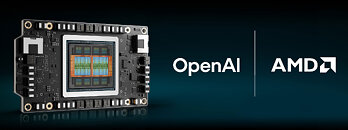 As part of the agreement, to further align strategic interests, AMD has issued OpenAI a warrant for up to 160 million shares of AMD common stock, structured to vest as specific milestones are achieved. The first tranche vests with the initial 1 gigawatt deployment, with additional tranches vesting as purchases scale up to 6 gigawatts. Vesting is further tied to AMD achieving certain share-price targets and to OpenAI achieving the technical and commercial milestones required to enable AMD deployments at scale.
Source:
AMD
Under this definitive agreement, OpenAI will work with AMD as a core strategic compute partner to drive large-scale deployments of AMD technology starting with the AMD Instinct MI450 series and rack-scale AI solutions and extending to future generations. By sharing technical expertise to optimize their product roadmaps, AMD and OpenAI are deepening their multi-generational hardware and software collaboration that began with the MI300X and continued with the MI350X series. This partnership creates a true win-win for both companies, enabling very large-scale AI deployments and advancing the entire ecosystem.

"We are thrilled to partner with OpenAI to deliver AI compute at massive scale," said Dr. Lisa Su, chair and CEO, AMD. "This partnership brings the best of AMD and OpenAI together to create a true win-win enabling the world's most ambitious AI buildout and advancing the entire AI ecosystem."
"This partnership is a major step in building the compute capacity needed to realize AI's full potential," said Sam Altman, co-founder and CEO of OpenAI. "AMD's leadership in high-performance chips will enable us to accelerate progress and bring the benefits of advanced AI to everyone faster."
"Building the future of AI requires deep collaboration across every layer of the stack," said Greg Brockman, co-founder and president of OpenAI. "Working alongside AMD will allow us to scale to deliver AI tools that benefit people everywhere."
"Our partnership with OpenAI is expected to deliver tens of billions of dollars in revenue for AMD while accelerating OpenAI's AI infrastructure buildout," said Jean Hu, EVP, CFO and treasurer, AMD. "This agreement creates significant strategic alignment and shareholder value for both AMD and OpenAI and is expected to be highly accretive to AMD's non-GAAP earnings-per-share."Through this partnership, AMD and OpenAI are building the infrastructure to meet the world's growing AI demands, by combining world-class innovation and execution to accelerate the future of high-performance and AI computing.
74 Comments on OpenAI will Buy AMD GPUs, AMD Offers $30+ Billion in Stock to Sweeten the Deal
You either have no idea of business or you have a need to make anything AMD look bad.
What is it?
Nvidia is growing, acquiring other major players. AMD is being acquired by major players.
Everyone is begging to use Nvidia's GPUs, offering pieces of themselves to sweeten the deal. AMD has to sell themself at a 99.99% discount to get OpenAI to use their GPUs.
And talk of "neutralizing" an investment is just silly. In fact, since Nvidia invested in OpenAI, and now OpenAI is investing in AMD... that means Nvidia (indirectly) has a stake in AMD.
Luckily, Intel did not agree to surrender their entire line of Xeons to Nvidia. That would have been a catastrophe. They only agreed to supply one line of Xeons with NVLink C2C IP under license from Nvidia.This is pure nonsense. There is no evidence of any mismanagement at AMD. It's just another movement of promises and assets in a burgeoning AI bubble, the bubble that may trigger another economic crash if mishandled badly by global investors and if there is lack of accountability of this sector by national governments around the world. But that's another topic for a different occasion.
However, don't forget that AMD has more diverse portfolio and increasingly important role in CPU business globally, commanding rather astonishing 42% of x86 revenue share with EPYC line alone, and growing as we speak. In addition, they have managed to gather support from the most important players globally and started the momentum of open standards and ecosystem in data center, which is extremely important for customers and the health of the industry. They co-developed and co-founded UALink Consortium, as well as UCIe, to open up the industry to more flexible and standardized silicon design without IP dependency on Nvidia, as well as more diverse and open deployments of hardware in data center that will allow customers to pick-and-choose several components of their liking, most suitable for their needs and budget rather than being completely dependent on Nvidia's closed ecosystem. This is going to materialize next year with Helios and other systems. It's an enormous effort on a scale that few really appreciate until they find out more about it. Most of investors without technical expertise are completely oblivious to such important developments. I don't blame them, but their technical advisers should know those movements and have an ability to present it to them in a digestible way.
Ownership-wise, Nvidia and others are also sliced and owned by gigantic asset management conglomerates, such as Vanguard, BlackRock and others, and myriad of investors and investment funds, some of which have other, sometimes dubious connections around the world, including in some countries where you and I would never like to live. It's a deep, deep rabbit hole, indeed.... Let's not go there in this forum. But hey, they are all happy to be gliding on AI wave that is getting increasingly speculative and therefore unstable. You'd better buy popcorn to see what's going to unravel from this raging beast.
Recent MIT study, publicly available, has warned us about serious problems with monetization of AI beyond a few companies and associated business ecosystem that provide silicon, infrastructure and auxiliary services. In other words, the amount of investment in one single segment of economy is currently very disproportionate to any returns on a wider global scale, including not knowing how to milk an average Joe and how to minimize damage to natural environment. If you produce 1 million liters/gallons of golden water and you can't find enough people to drink it in a sustainable way, you have a problem, a serious problem. It's not surprising that AI industry investments have built a high loss tolerance, being ready to write off $50-60 billions of losses from dozens of failed start-ups without any hiccup or worry. This can be done a few times, but not endlessly. The report has even rattled national banks in several leading countries, to the point that governors are releasing public statements of increased risk to local and global economies. It's not a joke, at all.
At least reply to my question.
Is it total lack of understanding business or simply passion for bashing AMD?
EPYC was not present in those rack-scalable systems anyway. If anything, Nvidia will pay less to Arm for licenses and Arm CPUs will face more challenges now that both AMD and Intel x86 CPUs are preparing to enter this big arena and become deployed in rack-scalable systems for the first time ever. It will be a new, sizeable segment of revenues for both. The question is to what extent would Nvidia replace Arm CPUs. I have not heard anything about the scale of change. Does anyone know more about this?Another dude who might benefit from a crash course in logic and causality. Just because two events are linked, it does not mean one causes the other, directly or "indirectly". If a cat like to eat birds, and birds like to eat worms, it does not mean that a cat likes to eat worms.
Anyway, just thoughts. But if AMD manages to get, let's say, a 25% of the AI market, that would be enough to keep AMD financialy and tecnnologically healthy and competitive, even if AMD does lose market share in CPUs/APUs/gaming GPUs.
The whole thing is a massive fire in the making.
For those that don't know OpenAI to this day still has losses in the billions.
"OpenAI buys AMD"
It's not quite the same as "OpenAI will buy AMD GPUs"...
As a tool, ChatGPT is kind of replacing Google search, but that's largely because of the enshitification of Google Search with sponsored results, shopping results, ads, and the inaccuracy of Gemini, all prioritised on the page above the first actual search result. Adding to that problem is that so many of the actual search results are pages of AI-generated slop that are either uselessly superficial, wildly inaccurate, or both.
AI might one day be a benefit to the internet, but right now AI is absolutely, visibly, provably, and rapidly ruining it.
Thanks for giving me a mini heart attack, TPU! -_-
The "push" is an attempt to delink/delimit the labour from actual production. An "AI" doesn't complain or ask for wage increase or take a day off or switch to a competitor.
Let's stick to the topic though lest we get our comments removed.
Or will each data center be used by a single company?