Friday, October 24th 2025

Intel Reassures 18A Yields Are Okay, Continues 14A Development
Intel has just reported its Q3 earnings, delivering stronger than expected results and major revival of operational income. During the conference call after the earnings were published, Intel reassured its investors that the company is working with good, predictable 18A yields. In addition to 18A, the company confirmed that 14A node development is shaping up to be a leading-edge node co-designed with customers. CFO David Zinsner confirmed "We are making steady progress on Intel 18A. We are on track to bring Panther Lake to market this year. Intel 18A yields are progressing at a predictable rate, and Fab 52 in Arizona, which is dedicated to high-volume manufacturing, is now fully operational. In addition, we are advancing our work on Intel 18A, and we continue to hit our PDK milestones. Our Intel 18A family is the foundation for at least the next three generations of client and server products."
Adding to that, the CFO commented on 18A yields: "I wouldn't say Intel 18A yields are in a bad place. They're where we want them to be at this point. We had a goal for the end of the year, and they're going to hit that goal. To be fully accretive in terms of the cost structure of Intel 18A, we need the yields to be better. That's like every process. That's what happens. It's going to take all of next year, I think, to really get to a place where that's the case." For Intel, 18A yields are now at a very low defect rate where manufacturing even some of the bigger dies is not a problem or financial burden. However, as every node, it matures over time where defect rates are constantly reduced to increase operating margin and reduce waste dies. Hence, Intel is still investing into the 18A refinement, and the node will stick for a very long time.
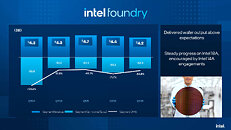 On the topic of 14A node, CEO Lip-Bu Tan confirmed: "On the 14A, clearly we're engaging with multiple customers in terms of milestone basis. We also really driving some of the yield and performance reliability that I'm seeing improvement." CFO David Zinsner added that "I would tell you on Intel 14A, we're off to a great start. If you look at Intel 14A in terms of its maturity relative to Intel 18A at that same point of maturity, we're better in terms of performance and yield. We're off to an even better start on Intel 14A." At this point in development, 14A is reaching better milestones than 18A. Thanks to the use of High-NA EUV tools from ASML, Intel has reported processing over 30,000 14A wafers in a single quarter using High-NA EUV exposure. The company achieving simplified manufacturing by reducing the required steps for a particular layer from 40 to fewer than 10, which has led to faster cycle times.
Source:
Q3 Earnings Call Transcript
Adding to that, the CFO commented on 18A yields: "I wouldn't say Intel 18A yields are in a bad place. They're where we want them to be at this point. We had a goal for the end of the year, and they're going to hit that goal. To be fully accretive in terms of the cost structure of Intel 18A, we need the yields to be better. That's like every process. That's what happens. It's going to take all of next year, I think, to really get to a place where that's the case." For Intel, 18A yields are now at a very low defect rate where manufacturing even some of the bigger dies is not a problem or financial burden. However, as every node, it matures over time where defect rates are constantly reduced to increase operating margin and reduce waste dies. Hence, Intel is still investing into the 18A refinement, and the node will stick for a very long time.


40 Comments on Intel Reassures 18A Yields Are Okay, Continues 14A Development
Intel, it’s nearly November, “this year” is getting sus. Hope 18A works out though especially since all competition is still on 3N at best.
And given that US taxpayers are taking the cost for Intel's comeback, yields information should be public.
George explored latency issue in his analysis of Arrow Lake on the system level:
chipsandcheese.com/p/examining-intels-arrow-lake-at-the
Some factors contributing to latency and under-utilization of cache in gaming on ARL:
1. ring-bus overload - there is a lot going on on Intel's ring-bus already. On Arrow Lake compute tile, there are at least 13 ring stops, 8 for P cores, 4 for four clusters of E cores, plus another stop for D2D Foveros to SoC tile. It's a long ring-bus too. In Zen CCD, there are 9 ring stops, 8 for cores and one for IF
2. D2D maturity - this seems to be the main culprit this generation. D2D has enough bandwidth, but it introduces two extra stops between tiles
3. distance of IMC - memory controller is far away from the compute tile, especially from cores on the fringes. It's 7 stops away from the farthest P core. On Raptor Lake, the farthest P core was 4 stops away from IMC.
4. the way instructions are queued and handled
It looks like Intel would only be able to add more L3 cache in Nova Lake if they manage to solve the above issues first, so that CPU could utilize more cache without being burdened by other factors. Indeed, Tom leaked the following tentative design of halo Nova Lake:
If two P cores are clustered, this would decrease the number of ring stops and length of ring bus. D2D is expected to be sorted out and polished. Perhaps IMC is closer to the compute tile, plus other optimizations. All this could help more cache on die, up to 144 MB, to be better utilized. We will find out soon.9950X3D is actually on par with 9800X3D in gaming, on average. This is due to introduction of more mature and comprehensive software optimization package that did not exist with Zen4 generation. Tuning 7950X3D and parking cores was a painful experience initially. This is gone now. Of course, there are individual games where 16-core CPU performs a bit worse and a also bit better. In Flight Simulator 24, which is CPU heavy, 16 core CPU is 8-10 fps faster 8 core part, and 25% faster than 7950X3D, which is sizeable in one generation, considering lower IPC for Zen5. Differences between Zen5 X3D models are smaller in comparison to differences between Zen4 X3D models. Even 9900X3D is closer to 9800X3D than 7900X3D was to 7800X3D. Tech matures over time.
If 9950X3D2 arrives, it will be a bit faster, nothing revolutionary, of course. Both V-cache CCDs will have 100 MHz higher clock (5.6) than V-cache CCD on 9950X3D (5.5). It would be a halo model for niche productivity folks who benefit form cache sensitive workloads. It's more of a second "crowing" and testing some technologies in real world, like testing new Infinity Fabric with Strix Halo. They don't have a refresh generation to compete for a few months with Arrow Lake refresh next year, so the only thing they could do is collect higher binned CCDs, crank up some features and power to 200W, until Zen6 is ready. I'd expect overall performance uplift 7-10% from those tweaks. Thewre will be G SKUs too. They don't need anything else until Zen6. The same for Intel with the refresh. It will be a few tweaks until Nova Lake is ready, similarly to what happened with Rocket Lake in May 2021, before Alder Lake was released a few months later.
Also, let's not forget that i9 uses up to ~200W in many scenes, almost twice as much power, and it requires much beefier coolers to try to tame this CPU guzzling power like crazy. It will warm you up in the winter, but I don't even want to imagine what happens in the summer without cranking up that AC unit too.
Regardless, when the sensors are removed on both platforms, the Intel system still runs admirably well with higher 0.1% & 1% lows although admittedly not by a lot.
Also, please remember the 200w is a 24 core CPU on 10nm arch.
Thread/
These are 2022 released Raptor Lake CPUs with Raptor Cove on the old Intel 10nm Enhanced SuperFin (Intel 7) node, which at the same time is a direct iteration and improvement over the 2021 Alder Lake's Golden Cove. And these CPUs are still giving somewhat comparable and competitive multicore performance in a lot of cases to the newer releases from both Intel and AMD, while the Raptor Lake-S i7s and i9s still manage to be faster in general for gaming than normal Zen 5 and Arrow Lake, the architecture on these has aged well.
I'm not sure if a Ryzen 7 9700X being around the same performance of a Core i5 14600K there is that good of a thing when the 9700X is newer and more expensive than the Core i5, Zen 5 Ryzen 5 and Ryzen 9 products do offer better value than the Ryzen 7 though (talking about the non 3D V-Cache parts).
If the system is for gaming, those extra cores are of little use. Will there be cases where the gamer will think "good to have all those cores"? Of course. Will it really matter? Probably not.
As for the 10nm arch, while we should congratulate Intel for being able to remain highly competitive with such an old manufacturing node, I bet the power company will not offer us a discount. Needing a much more expensive cooler and having to deal with more heat/power is a disadvantage.
And no one in the Trump administration will force Intel to do so either, because Intel failing means they also look stupid. Not like they are paragons of transparency anyway.
Most recently, Jarrod's Tech released a video comparing two Asus Strix G16 gaming laptops, one with 9955HX3D and another one with 275HX. Asus played dirty with Ryzen version and offered old laptop design with older cooling solution and components. Ironically, X3D still outperformed 275HX in gaming. It's embarrassing what they are doing. They are not the only OEM doing disservice to consumers with their little dirty games.
Jarrod's Tech - Asus Strix G16
XMG seems to be doing a far better job here with Neo 16 line-up than Asus. They offer comparable designs with the same components, both for Intel and AMD CPUs.
GizmoSlipTech - XMG Neo 16
Regarding CPU-bound games. Of course, more cores should bring advantage in some titles. This was tested on halo gaming laptops. When 16 core 9955HX3D competes with 24 core 275HX, the X3D chip is over 50% faster in several CPU-bound games. The X3D version is only 14% faster than non-X3D version of the same chip, suggesting that most of heavy lifting in some CPU-bound scenarios is done by having an extra CCD rather than V-cache.
In the past I was a huge fan of ASUS, loving giving money to them.
Today I love NOT giving money to them. So many alternatives anyway from other companies of the same or better quality.