Friday, October 24th 2025

Intel Reassures 18A Yields Are Okay, Continues 14A Development
Intel has just reported its Q3 earnings, delivering stronger than expected results and major revival of operational income. During the conference call after the earnings were published, Intel reassured its investors that the company is working with good, predictable 18A yields. In addition to 18A, the company confirmed that 14A node development is shaping up to be a leading-edge node co-designed with customers. CFO David Zinsner confirmed "We are making steady progress on Intel 18A. We are on track to bring Panther Lake to market this year. Intel 18A yields are progressing at a predictable rate, and Fab 52 in Arizona, which is dedicated to high-volume manufacturing, is now fully operational. In addition, we are advancing our work on Intel 18A, and we continue to hit our PDK milestones. Our Intel 18A family is the foundation for at least the next three generations of client and server products."
Adding to that, the CFO commented on 18A yields: "I wouldn't say Intel 18A yields are in a bad place. They're where we want them to be at this point. We had a goal for the end of the year, and they're going to hit that goal. To be fully accretive in terms of the cost structure of Intel 18A, we need the yields to be better. That's like every process. That's what happens. It's going to take all of next year, I think, to really get to a place where that's the case." For Intel, 18A yields are now at a very low defect rate where manufacturing even some of the bigger dies is not a problem or financial burden. However, as every node, it matures over time where defect rates are constantly reduced to increase operating margin and reduce waste dies. Hence, Intel is still investing into the 18A refinement, and the node will stick for a very long time.
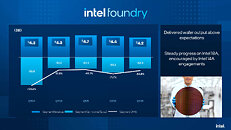 On the topic of 14A node, CEO Lip-Bu Tan confirmed: "On the 14A, clearly we're engaging with multiple customers in terms of milestone basis. We also really driving some of the yield and performance reliability that I'm seeing improvement." CFO David Zinsner added that "I would tell you on Intel 14A, we're off to a great start. If you look at Intel 14A in terms of its maturity relative to Intel 18A at that same point of maturity, we're better in terms of performance and yield. We're off to an even better start on Intel 14A." At this point in development, 14A is reaching better milestones than 18A. Thanks to the use of High-NA EUV tools from ASML, Intel has reported processing over 30,000 14A wafers in a single quarter using High-NA EUV exposure. The company achieving simplified manufacturing by reducing the required steps for a particular layer from 40 to fewer than 10, which has led to faster cycle times.
Source:
Q3 Earnings Call Transcript
Adding to that, the CFO commented on 18A yields: "I wouldn't say Intel 18A yields are in a bad place. They're where we want them to be at this point. We had a goal for the end of the year, and they're going to hit that goal. To be fully accretive in terms of the cost structure of Intel 18A, we need the yields to be better. That's like every process. That's what happens. It's going to take all of next year, I think, to really get to a place where that's the case." For Intel, 18A yields are now at a very low defect rate where manufacturing even some of the bigger dies is not a problem or financial burden. However, as every node, it matures over time where defect rates are constantly reduced to increase operating margin and reduce waste dies. Hence, Intel is still investing into the 18A refinement, and the node will stick for a very long time.


40 Comments on Intel Reassures 18A Yields Are Okay, Continues 14A Development
when intel cpu can beat amd in factorio, i will consider intel. that's my test representative
Now I don't know about old Intel CPUs, but the following video might be offering an explanation of why Intel haven't done X3D cache already with it's modern CPUs. The hybrid design might be adding more complexity, but Intel isn't a company that can't build hardware schejulers(or whatever) in it's chips to bypass these kind of difficulties.
In many cases we expect a feature to be equally good in every case of CPUs. So, when AMD introduced the 5800X3D everyone was asking X3D on the 16 core models. AMD did that, only for us to see that an 9950X3D is slower in most cases against an 9800X3D in games. It might be faster in 5 years when 8 P cores will not be enough. People then started asking AMD to integrate X3D in both CCDs. Well we have rumors about an 9950X3D2. We will see then if adding cache in both CCDs will do the trick or end up getting zero extra performance from that second cache, or even get a regression of performance if the CPU is trying to find in which X3D cache is the data it is looking for and which cores to use(I am not an engineear that last part might be a stupid guess - or all the post, who knows?).On the other hand, if Intel chooses to follow AMD by introducing a type of X3D cache, we can expect more in the beginning and almost all AAA games latter, to support X3D cache, meaning AMD's X3D cache CPUs will be seeing performance increases in almost all AAA games.
In any case both companies copy each other. Intel tried to make a rushed copy of AMD's Athlon X2 by gluing two cores, and we know that it worked, then moved the IMC on the CPU like AMD(AMD had copied it from? don't remember), AMD on the other hand copied Pentium 4 with Bulldozer and almost gone bankrupt, then use it's own glue to build the first Zen, understanding that trying to build the perfect chip in one go could end up with lost time, lost money and a nice feature called "TLB bug"(hello Barcelona). Then Intel copied ARM by building the hybrid CPUs to manage to match or exceed the number of advertised cores. Now who knows, they might integrate more cache, but in my opinion I expect just faster cores, higher IPC, not an X3D cache feature. Intel always tries to get higher IPC.
I guess they expected to be questioned on the yields, but the above response doesn’t provide any assurance or confidence in my opinion. The beat around the bush response seems to imply it’s not good. “Where we want them to be” meaning what? 20, 30%? It’s where they expect, but is it good such that they attract more customers and start making money?
The narrative about yields by Intel folks sounds too generic, without much substance. Worryingly, the article reads that it would take them until the end of 2026 to get yields high enough in order to balance financial books on a positive side.
I wonder if both AMD and Intel are reverse engineering Apples' M cores, trying to find the good ideas in those ARM cores that can be copied in X86 cores.
If the US administration does not care to release hard data (and why would they if it turns out to be negative on their actions), then they won't have to.
With Samsung and Intel both struggling to get GAAFETs fully operational, I'm curious how TSMC will handle the transition.
And in their core games have lots of serial code making memory access latency important for gaming performance.
That's why amount of cache has more than marginal effect.
And hence why everyone is hoping for this to be true:
www.techpowerup.com/341445/amd-d2d-interconnect-in-zen-6-gets-sea-of-wires-upgrade
Microsoft made an order with Intel for undisclosed amount of chips. Anyone knows how much? Qualcomm and Nvidia clearly said they are not ready, as yet, to place any orders on 18A. It's much easier for Nvidia to get Intel's Xeons ready-made CPUs than etch their own state-of-the-art chips on 18A. It's a precarious situation, as TSMC has been pushed hard behind the scenes... to invest over $160 billion into US expansion, so vast majority of the cutting-edge chips will be de facto produced by them. Together, all semiconductor fabs in the US are estimated to reach ~20% of global chip output by 2030, for 'advanced' chips. How much of that would be cutting-edge advanced is anyone's guess. We'd need an industry insider to crunch those numbers for us and define chip categories more precisely.
If the yields on 18A are below 50% at the moment, it will be tough until the end of 2026, as the bigger 16 core Panther Lake compute tile will arrive first. Bigger die means more defective dies. I'd expect a slow launch throughout H1 2026, on more expensive side of things.True that, I agree. Now that the company is partially owned by the public, they will need to be more explicit and upfront with the progress of yields. Such information should be more readily available, despite potentially being uncomfortable and any business sensitivities surrounding transparency. Somebody who invests individually or via bigger brokers, or companies investing public money in stock markets, should be asking those questions in order to avoid unplesant surprises and tame any decisions based on vague marketing language. I would not be surprised if yields leak into public domain at some point via tech websites or similar. It's a strange situation because such information should not leak, but simply be available now that the corporate ownership status has changed. Interesting times ahead to recovery, including recent brutal job cuts.
www.tomshardware.com/pc-components/cpus/intel-has-cut-35-500-jobs-in-less-than-two-years-more-than-20-000-let-go-in-in-recent-months-as-lip-bu-tan-continues-drastic-recovery-journey
AMD's L3 cache is just a victim cache, it only holds data ejected from L2, so it's almost like a big L2 extension. Data is only pulled from ram when it's needed, so latency is more important than bandwidth. with X3D the L2 extension is enormous.
Intel's L3 cache is more predictive and tries to prefetch to stream in data before it's needed, This means intel can take advantage of the bandwidth because its always streaming in data in an attempt to have it there before its needed I belive this is why It's less effected by slower memory.
so it will be interesting how much of a difference a big cache would make on intel as it would be used in a totally different way.