Tuesday, December 2nd 2025

Intel Arc Discrete GPUs Hit 1% Market Share for First Time

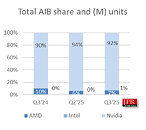
Jon Peddie Research has released a new report on the market share of discrete GPUs, noting that Intel achieved its first single-digit percentage breakthrough since the launch of its Arc "Alchemist" GPUs for gamers. This is not a small win, as Intel historically had around half a percent share among dGPUs. Intel's late entry into the overall dGPU market has caused it to gain market share glacially slowly. It hasn't been able to disrupt the already established group that includes AMD and NVIDIA, which are commanding the remaining 99% of the market. However, despite it being only a 1% share, Intel's breakout is notable for the first time, giving Intel dGPU gamers and team blue hope to continue investment in this market.

For the remaining 99%, AMD and NVIDIA split the market a bit differently now. AMD's market share increased by 0.8% from last quarter to 7% in Q3 2025, while NVIDIA remained at a strong top with a decrease of 1.2%, putting it at 92% of the overall AIB market share. Market dynamics such as availability and pricing are all impacting the buyer decision-making process, so a slight inventory adjustment from AIBs could translate to a big increase or decrease in market share from quarter to quarter, as we see with NVIDIA here. Hence, smaller fluctuations and market share "exchange" between AMD and NVIDIA are happening often, while smaller players like Intel seem to be rising.
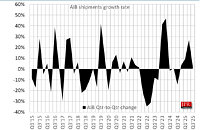
The discrete GPU market's modest 2.8% quarterly growth masks deeper underlying volatility, as JPR projects a -0.7% annual decline through 2029 despite shipments reaching 12 million units worth $8.8 billion in Q3 2025. Jon Peddie Research notes that while desktop CPU shipments climbed to 19.2 million units in the same quarter, the AIB sector faces considerable issues that may constrain its installed base to 152 million units at a 120% penetration rate by 2029. Dr. Jon Peddie cautions that socioeconomic turbulence and inflationary pressures stemming from trade conflicts demand cautious optimism, stressing that market stabilization will require several quarters of predictable performance before reliable forecasting can resume. Additionally, with GDDR prices expected to soar, we have to wait and see how the market reacts.
Source: JPR
Add your own comment

13 Comments on Intel Arc Discrete GPUs Hit 1% Market Share for First Time

#1
Onasi
See, AMD market share has grown this time around, which obviously now means that this JPR report is legit and non-fraudulent, unlike the last time when an entire debate around how they are bribed by NV was fought.

Me being glib aside, this is good news. All Arc foibles aside, the last thing the market needs is Intel deciding to pull the plug on their GPU division. Battlemage is a solid mainstream effort and I would very much like to see if they can transfer that to a more up-market SKU with Celestial. Nobody should want a market where NV is essentially a monopoly and AMD exists as “NV at home for slightly less money”.
Posted on Reply
#2
CharlesBK
AMD at 7% while Nvidia has 92% marketshare even after RDNA4 cards finally hit MSRP and were widely available was unexpected. The Radeon division really need to hit it big with FSR Redstone, otherwise the narrative of them finally turning it around and catching up to nvidia will fade. Feel like with the critical reception towards RX 5000 series this was their ryzen moment but now it looks like even clawling back to 10% marketshare if the Supers are cancelled and they manage to keep the msrp prices will be the best someone can hope for them.
Posted on Reply
#3
Tomorrow
OnasiSee, AMD market share has grown this time around, which obviously now means that this JPR report is legit and non-fraudulent, unlike the last time when an entire debate around how they are bribed by NV was fought.
I wouldn't call it fraudulent, but we also dont know what methodology they use to measure these market share numbers. As i understand it's only new dGPU's sold. It doesn't take into account already sold cards and historic market share. Rather the breakdown of the current sales and in this regard AMD being at 7% is far more believable than AMD holding only 7% share across all dGPU's ever sold or in use. There i think the more realistic number is around 15%-20%.

For example counting the total percentages from Steam all GPU chart (excluding iGPU's) shows AMD at 12,37%
Counting the total percentages from Steam DX10/11/12 GPU chart (excluding iGPU's) would likely show an ever bigger number, but i couldn't do that at the moment because i apparently broke ChatGPT (free version) with my long request.

Gemini calculated this at 19,06% (excluding iGPU and mobile designs).
And this is based on Steam data that already supposedly under represents AMD as is.
Posted on Reply
#4
Hecate91
JPR isn't fraudulent, but who knows what their data metrics and sources are as they're hiding them behind a paywall.
I've heard some tech Youtubers say JPR counts all GPU shipments, and a lot of those shipments are AI/datacenter cards which inflate AIB shipment numbers.
Good for Intel though, hopefully they stay in the market, not abandoning their GPU division as some rumors claim.
Posted on Reply
#6
RJARRRPCGP
@GeoffreyA My MSI B450 Tomahawk stopped powering on in August, 2022. Appears to be a common fault, when I looked on YouTube.
I just got it on January 3, 2020. I didn't try to fix it, after seeing a mess from the thermal pads for the MOSFETs.
Posted on Reply
#7
Dr. Dro
CharlesBKAMD at 7% while Nvidia has 92% marketshare even after RDNA4 cards finally hit MSRP and were widely available was unexpected. The Radeon division really need to hit it big with FSR Redstone, otherwise the narrative of them finally turning it around and catching up to nvidia will fade. Feel like with the critical reception towards RX 5000 series this was their ryzen moment but now it looks like even clawling back to 10% marketshare if the Supers are cancelled and they manage to keep the msrp prices will be the best someone can hope for them.
What they need to do is support their GPUs properly. And I disagree, there's no "Ryzen moment" for Radeon in sight. There's fleeting, short-term "success" that barely moves the needle, which may very well be undermined by their own actions if they stay the course of mercilessly dropping features and even regular updates from products that are in-market, in-production and in people's machines.
Posted on Reply
#8
GeoffreyA
RJARRRPCGP@GeoffreyA My MSI B450 Tomahawk stopped powering on in August, 2022. Appears to be a common fault, when I looked on YouTube.
I just got it on January 3, 2020. I didn't try to fix it, after seeing a mess from the thermal pads for the MOSFETs.
That's disappointing, to get only three years out of a motherboard. I don't want to jinx it, but mine has been working since August 2019 and saw a few upgrades this year.

Are you referring to an oily substance from the pads?
Posted on Reply
#9
DavidC1
Hecate91JPR isn't fraudulent, but who knows what their data metrics and sources are as they're hiding them behind a paywall.
I've heard some tech Youtubers say JPR counts all GPU shipments, and a lot of those shipments are AI/datacenter cards which inflate AIB shipment numbers.
Good for Intel though, hopefully they stay in the market, not abandoning their GPU division as some rumors claim.
Unfortunately this is not a positive for Intel. The first generation Arc Alchemist had up to 4% marketshare. 1% is a substantial reduction.
CharlesBKAMD at 7% while Nvidia has 92% marketshare even after RDNA4 cards finally hit MSRP and were widely available was unexpected. The Radeon division really need to hit it big with FSR Redstone, otherwise the narrative of them finally turning it around and catching up to nvidia will fade. Feel like with the critical reception towards RX 5000 series this was their ryzen moment but now it looks like even clawling back to 10% marketshare if the Supers are cancelled and they manage to keep the msrp prices will be the best someone can hope for them.
No, AMD and Intel needs to give up on their "value" GPU strategy and aim for the jugular - aka Halo. Every market perception is determined by the halo part. Nvidia had that for over a decade now. AMD should have got a 9080 and 9090 part out to fully compete with the 5080 and 5090. And stop being a follower with DLSS and Ray Tracing. Do something new with the Halo part. It doesn't matter how good XeSS or FSR4 is, the market perception is that they are just fast followers at best. With a halo part that beats the top Nvidia part, they can get a new feature out that isn't a fast follower move.

Follow and get a follower's marketshare. Lead for once. In all competition, #2 is a fraction of the #1. #1 in competitions make multi-millions while #2 barely make it above an average salaryman.
Posted on Reply
#10
GeoffreyA
DavidC1Unfortunately this is not a positive for Intel. The first generation Arc Alchemist had up to 4% marketshare. 1% is a substantial reduction.

No, AMD and Intel needs to give up on their "value" GPU strategy and aim for the jugular - aka Halo. Every market perception is determined by the halo part. Nvidia had that for over a decade now. AMD should have got a 9080 and 9090 part out to fully compete with the 5080 and 5090. And stop being a follower with DLSS and Ray Tracing. Do something new with the Halo part. It doesn't matter how good XeSS or FSR4 is, the market perception is that they are just fast followers at best. With a halo part that beats the top Nvidia part, they can get a new feature out that isn't a fast follower move.

Follow and get a follower's marketshare. Lead for once. In all competition, #2 is a fraction of the #1. #1 in competitions make multi-millions while #2 barely make it above an average salaryman.
I think Intel's pushing for the value market this year was a good move; the B580 entrenched itself as the budget champion till the 9060 came out, but as prices have dropped again, is still excellent value. All indicators were that they would release the B770, but nothing came, power consumption perhaps being problematic. To say nothing of the cost. So, why sully Arc's name if it wasn't going to be acclaimed like the B580? Their interesting compute offerings must also be mentioned.

All in all, Intel has taken more than its market share of GPU attention, gaining a strong following. If they can continue to execute in this fashion, their market share will grow, and it will benefit everyone. Instead of fighting the Green Despot, AMD went to bed with them. So, somebody has to put up a fight.
Posted on Reply
#11
RJARRRPCGP
GeoffreyAThat's disappointing, to get only three years out of a motherboard. I don't want to jinx it, but mine has been working since August 2019 and saw a few upgrades this year.

Are you referring to an oily substance from the pads?
Yes.
Posted on Reply
#13
DavidC1
GeoffreyAI think Intel's pushing for the value market this year was a good move; the B580 entrenched itself as the budget champion till the 9060 came out, but as prices have dropped again, is still excellent value. All indicators were that they would release the B770, but nothing came, power consumption perhaps being problematic. To say nothing of the cost. So, why sully Arc's name if it wasn't going to be acclaimed like the B580? Their interesting compute offerings must also be mentioned.

All in all, Intel has taken more than its market share of GPU attention, gaining a strong following. If they can continue to execute in this fashion, their market share will grow, and it will benefit everyone. Instead of fighting the Green Despot, AMD went to bed with them. So, somebody has to put up a fight.
There's nothing positive about market attention on B580. A750/A770 had 4% marketshare at one point. 1% is a 75% reduction. A quarter after B580 launch it registered 0%.
Posted on Reply
Add your own comment
Nov 21st, 2026 04:15 PST change timezone

New Forum Posts

Popular Reviews

TPU on YouTube

Controversial News Posts