Thursday, December 4th 2025

NVIDIA Restores PhysX Support for Select 32-Bit Games on GeForce RTX 50-Series GPUs
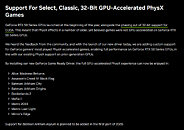
In early 2025, NVIDIA discontinued support for 32-bit software on its GeForce RTX 50-series "Blackwell" GPUs, which led to the end of PhysX support. However, the company is making exceptions for certain games to ensure they maintain performance and stability. Due to popular demand, the following titles will continue to run smoothly: Alice: Madness Returns, Assassin's Creed IV: Black Flag, Batman: Arkham City, Batman: Arkham Origins, Borderlands 2, Mafia II, Metro 2033, Metro: Last Light, and Mirror's Edge. With the latest GeForce Game Ready 591.44 WHQL driver, these games will be able to fully utilize RTX 50-series performance.
Earlier, the removal of 32-bit support was quietly acknowledged as NVIDIA's latest GeForce RTX 50 series GPUs transition away from 32-bit CUDA software, gradually shifting the gaming industry entirely to 64-bit software. While older NVIDIA GPUs from the Maxwell to Ada generations will continue to support 32-bit CUDA, NVIDIA's earlier update disrupted backward compatibility for physics acceleration in legacy PC games on new GPUs. Users playing these titles on RTX 50 series cards had to rely on CPU-based PhysX processing, which could result in less optimal performance compared to previous GPU generations. Thankfully, performance is now back in check as 32-bit exceptions start rolling in.
 PhysX began as the NovodeX engine, which Ageia acquired and rebranded in 2004, and NVIDIA later absorbed when it bought Ageia in 2008. The SDK was built to move complex simulations such as ragdolls, cloth, particle systems and fluid effects from the CPU to the GPU, enabling richer in-game physics without imposing a heavy CPU load. Over time PhysX's reliance on CUDA and its legacy 32-bit elements curtailed its portability to non-NVIDIA hardware, consoles and mobile platforms. As more flexible, cross-platform physics engines matured, many developers opted for those alternatives or for bespoke systems tailored to their needs, and PhysX's presence in new releases gradually diminished.
Source:
NVIDIA
Earlier, the removal of 32-bit support was quietly acknowledged as NVIDIA's latest GeForce RTX 50 series GPUs transition away from 32-bit CUDA software, gradually shifting the gaming industry entirely to 64-bit software. While older NVIDIA GPUs from the Maxwell to Ada generations will continue to support 32-bit CUDA, NVIDIA's earlier update disrupted backward compatibility for physics acceleration in legacy PC games on new GPUs. Users playing these titles on RTX 50 series cards had to rely on CPU-based PhysX processing, which could result in less optimal performance compared to previous GPU generations. Thankfully, performance is now back in check as 32-bit exceptions start rolling in.


38 Comments on NVIDIA Restores PhysX Support for Select 32-Bit Games on GeForce RTX 50-Series GPUs
It really begs the question of why they didnt just revert the change and support it wholesale.
Let's hope the community can sort this out with a permanent solution.
www.tomshardware.com/pc-components/gpu-drivers/nvidia-reinstates-32-bit-physx-support-for-rtx-50-series-as-part-of-its-latest-game-ready-driver-rollout-9-titles-included-in-initial-releaseI mean even if they do, it doesn't really matter, people can revert back to these drivers for these older games, cats out of the bag so to speak. I am guessing you mean with RTX 6000 series or something, meh i am too old to really care either way
That's why they're leading
The reason it didn't work on the 50 series was at the same time Nvidia released the 50 series, they released a new version of CUDA that no longer supported any 32-bit software. So no Blackwell GPU, consumer or professional, would run any 32-bit CUDA program. Since PhysX had its heyday when most games only had 32-bit versions, that meant Blackwell GPUs could no longer run GPU-accelerated PhysX effects in those games (PhysX as a basic physics engine still runs solely on the CPU and works completely fine).
With this, Nvidia must be manually replacing the CUDA software in each specific game with a 64-bit version that can utilize the supported CUDA software on Blackwell GPUs. That's also likely why there's an extremely limited selection of supported games, they have to manually dive into each games files, figure out what to replace and how to fix it, and do a lot of QA testing to make sure they didn't break the game.
Now I assume that Nvidia is using a whitelist system again because they want to thoroughly test each game themselves before enabling it, but it is nice that their drivers let users bypass this restriction.
They will deserve praise when they open source a lot of things. Until then we will continue to have $3000 high end GPUs from them.
Its a bit like upscaler support isnt it. Who else had been leading on that front? AMD? Intel? Whether that was bought tech or not... its a vibrant and free market where companies had every opportunity to come up with solutions.
The real story is this: Nvidia made sound choices in the past and restoring the support now is just a net positive. For all their closed bs we also have software Physx for everything that uses or needs it, for example.
We can whine all day but honestly, which competitor has a better track record? It certainly isnt AMD... they just dont have anything and what they do have most people dont care about because its generic shit competitors can do too, and probably have better support on as well. The only real exception is Freesync really which isnt tied to a GPU.
I wonder why they restore support for specific games and haven't worked on a general solution instead. Seems like a wasted opportunity.
en.wikipedia.org/wiki/Category:Video_games_using_Havok