Saturday, December 6th 2025

Intel Arc "Battlemage" BMG-G31 GPU Emerges in Official Software Support
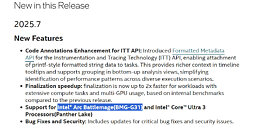
The fate of Intel's long-rumored big "Battlemage" graphics card may not be entirely sealed, as Intel has quietly placed the name of its "BMG-G31" SKU into a VTune Profiler software update. This is so far the clearest signal yet that a formal product announcement may be approaching. The VTune entry lists support for both the BMG-G31 GPU and Intel Core Ultra 3 processors based on "Panther Lake", which is already scheduled for a public debut at CES 2026. That co-listing increases the likelihood that Intel will time a "Battlemage" reveal to coincide with or follow closely after the "Panther Lake" debut at CES 2026.
This BMG-G31 "Battlemage" part will get packaged as B770 SKU, equipped with roughly 32 Xe2 cores and 16 GB of GDDR6 memory on a 256-bit interface. The design is reported to offer a full PCIe 5.0 x16 connection and to be offered in multiple SKUs, which would allow Intel to segment parts for gamers and professional users. A workstation-oriented Arc Pro variant could further expand memory capacity for single-GPU configurations. However, a launch this late in the "Battlemage" family cycle might be questionable from gamer's standpoint, as Intel is already shipping Xe3-based new iGPUs inside "Panther Lake."
 As a reminder, Intel recently achieved its first single-digit percentage market breakthrough since the launch of its Arc "Alchemist" GPUs for gamers, grabbing roughly 1% of the discrete GPU marker share. This is not a small win, as Intel historically had around half a percent share among dGPUs. Intel's late entry into the overall dGPU market has caused it to gain market share glacially slowly. With late product launches like this, it remains to be seen if Intel can continue to consistently gain new market share.
Sources:
Intel, via VideoCardz
This BMG-G31 "Battlemage" part will get packaged as B770 SKU, equipped with roughly 32 Xe2 cores and 16 GB of GDDR6 memory on a 256-bit interface. The design is reported to offer a full PCIe 5.0 x16 connection and to be offered in multiple SKUs, which would allow Intel to segment parts for gamers and professional users. A workstation-oriented Arc Pro variant could further expand memory capacity for single-GPU configurations. However, a launch this late in the "Battlemage" family cycle might be questionable from gamer's standpoint, as Intel is already shipping Xe3-based new iGPUs inside "Panther Lake."


40 Comments on Intel Arc "Battlemage" BMG-G31 GPU Emerges in Official Software Support
Anyway, imma buy one. 🤣
I wholeheartedly believe that this 'DRAM and NAND situation' is going to (be used as an excuse to) stagnate (and regress) the hell out of the market, for at least a year or 2.
Kinda looks like Intel sees similar...Also, this.
Imagine trying to release the B770/750 but requiring end users to basically have a 14700/265k or 7700x/9700x to be able to get anything above B580 performance?
I dont' understand
Gotta spend money to make money, lose some money building market share before you can screw us the way nvidia does
4K is more bandwidth limited so 33% more bandwidth on B770 would result in maybe 33%, which still beats 5060 Ti by 5% or so.
1440p, 1.33x is 5060 Ti levels, but is less bandwidth bound so it still can be faster
1080p, is behind 5060 Ti and 9060 XT 8GB levels, but even less bandwidth bound. It only needs to be 42% faster to equal 5060 Ti.
B770 has 1.6x the shaders, 1.33x the bandwidth and unknown clocks. So it can be 1.6x faster in certain scenarios. Actually if they can pull 3.1GHz boost in gaming that's a full 10% higher than 25 game average for B580, which would shift the above considerably. I think the TDP needs to be 300W though.
TDP breakdowns of 3090: www.igorslab.de/en/350-watts-for-nvidias-new-top-of-the-line-geforce-rtx-3090-ampere-model-explained-chip-area-calculated-and-boards-compared/
60W for 384-bit GDDR6x. 256-bit would be 40W and 192-bit would be 30W. If you assume the "board" power section takes up 60W like on the 3090, then the breakdown for B580 is:
-30W for 192-bit GDDR6
-60W for board
-100W for GPU
1.6x GPU + 1.33x memory equals, 40W + 60W + 160 = 260W. If 10% extra clocks result in 25% more GPU power, it can be 300W. Then they can make B750 with 250W and clocks same as B580.
In the end, the little details are what makes the difference. They need to nail it because it's already so late. The 5-10% difference can be something that's attractive at $399 vs needing to be at $339.