Tuesday, December 23rd 2025

LG Display Unveils World's First 240Hz RGB Stripe OLED Panel
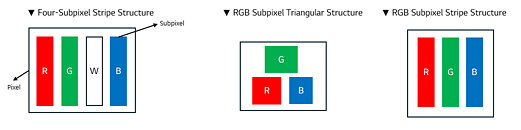
LG Display, the world's leading innovator of display technologies, announced today that it will debut the world's first 27-inch 4K OLED panel for monitors featuring an RGB stripe structure and a 240 Hz refresh rate at CES 2026, the world's largest IT and consumer electronics exhibition. The RGB stripe structure arranges the three primary color subpixels—red, green, and blue—in a straight line, significantly reducing visual distortions such as color bleeding and fringing, even at close viewing distances.
Although OLED panels using the RGB stripe method existed before, their maximum refresh rate reached around 60 Hz, making them unsuitable for use as gaming monitors. LG Display's new panel is the first in the world to achieve a 240 Hz refresh rate while maintaining an RGB stripe structure. It incorporates the company's specialized Dynamic Frequency & Resolution (DFR) technology, allowing users to directly switch between high-resolution (UHD 240 Hz) and high-refresh-rate (FHD 480 Hz) modes.
 This product's high refresh rate not only delivers optimal performance in first-person shooter (FPS) games and other applications that require rapid screen transitions, but it is also optimized for operating systems such as Windows and for font-rendering engines, ensuring excellent text readability and high color accuracy. Featuring a high pixel density of 160 pixels per inch (ppi), this panel additionally provides exceptional detail and precision.
With its plan to initially introduce the new pixel structure in its high-end gaming and professional monitor panels, LG Display will actively promote the technology at the upcoming CES 2026 as part of its strategy to expand its customer base and product lineup.
Existing high-end Gaming OLED monitor panels have primarily used RGWB structures, which include a white subpixel, or configurations where RGB pixels are arranged in a triangular pattern.
As LG Display developed its new pattern optimized for monitor use, it applied various new technologies—such as increasing the aperture ratio, which is the proportion of the pixel area that emits light. As a result, it achieved the world first of implementing both an RGB stripe structure and a high refresh rate simultaneously.
The company is actively targeting the high-end monitor market, mass-producing about 30% of the panels for the OLED monitor global market. In particular, among Gaming OLED panels currently in mass production, LG Display holds the world's top titles in all major specs—including highest refresh rate, response time, and resolution—affirming its overwhelming technological leadership.
"Technology is the foundation of leadership in the rapidly growing OLED monitor market," said Lee Hyun-woo, Head of the Large Display Business Unit at LG Display. He added, "We will continue to strengthen our global leadership by focusing on differentiated technologies compared to competitors, technologies that customers want, and technologies with strong business potential."
Source:
LG Display
Although OLED panels using the RGB stripe method existed before, their maximum refresh rate reached around 60 Hz, making them unsuitable for use as gaming monitors. LG Display's new panel is the first in the world to achieve a 240 Hz refresh rate while maintaining an RGB stripe structure. It incorporates the company's specialized Dynamic Frequency & Resolution (DFR) technology, allowing users to directly switch between high-resolution (UHD 240 Hz) and high-refresh-rate (FHD 480 Hz) modes.


With its plan to initially introduce the new pixel structure in its high-end gaming and professional monitor panels, LG Display will actively promote the technology at the upcoming CES 2026 as part of its strategy to expand its customer base and product lineup.
Existing high-end Gaming OLED monitor panels have primarily used RGWB structures, which include a white subpixel, or configurations where RGB pixels are arranged in a triangular pattern.
As LG Display developed its new pattern optimized for monitor use, it applied various new technologies—such as increasing the aperture ratio, which is the proportion of the pixel area that emits light. As a result, it achieved the world first of implementing both an RGB stripe structure and a high refresh rate simultaneously.
The company is actively targeting the high-end monitor market, mass-producing about 30% of the panels for the OLED monitor global market. In particular, among Gaming OLED panels currently in mass production, LG Display holds the world's top titles in all major specs—including highest refresh rate, response time, and resolution—affirming its overwhelming technological leadership.
"Technology is the foundation of leadership in the rapidly growing OLED monitor market," said Lee Hyun-woo, Head of the Large Display Business Unit at LG Display. He added, "We will continue to strengthen our global leadership by focusing on differentiated technologies compared to competitors, technologies that customers want, and technologies with strong business potential."
15 Comments on LG Display Unveils World's First 240Hz RGB Stripe OLED Panel
I’d love a max SDR brightness of 350-400 cd/m2 (compared to the usual 250 we see now in oled) and better peak HDR handling
I have tested a QD-OLED monitor (Alienware Aw3424DW) and while it was fantastic for games the abnormal pixel layout meant it was terrible for anything else. Because windows still doesn't have support for triangular sub-pixel layouts, so all the fonts and other UI elements always looked like they were slightly out of focus. Where as my LG 34GN850, is razer sharp by comparison.
So lets see whats this one goes for, if its much more than £750 (what I paid for my 34GN850 back in May 2022) I would be waiting for the price to drop and/or it goes on sale. I see two models listed on LG's website but with no prices yet - 34GS95QE-B & 34GS95QE-W.
And on a related note, the Alienware Aw3425DWF is on Amazon atm for as low as £380, but I think might be ex-display - www.amazon.co.uk/Alienware-Gaming-Monitor-3440x1440-Compatible/dp/B0F1CT2F71?th=1Same.Ok, young-un :p
I think the article would benefit from an "4k"/UHD addition in the title since there already were 27inch 1440p stripe oleds (see picture below)
rtings review of the 27gx790a-b: www.rtings.com/monitor/reviews/lg/27gx790a-b
Also I confused RGB with RGWB
edit: direct link to article in English
There's also this teaser from MSI:
Which also features stripe RGB layout but monitor looks like 34" variant. Could be that it's a new QD-OLED from Samsung, which also started 1st gen with 34" ultrawide panels.
Thanks a lot for correcting me.
Also a MSI OLED Monitor with an LG Panel would be a first or?
Among Windows, X11, Wayland, mac OS, no one seems to have an idea how to handle the font rendering issues with all the funny OLED subpixel layouts. Any info I can find about any of these OSes is basically horror stories about how they behave with plain RGB layout, with things regressing from good to worse (Windows, mac OS) or various issues (X11, Wayland). Only some Android OLED devices supposedly have proprietery subpixel-aware algorithms. I'm not even sure that a good solution can be found for RWGB, RGWB, triangular and possibly other layouts, unless the dpi is made so high that individual pixels become invisible.
The 32" 4K text is even better than the 1440p ones. Most people I find talking about these things don't even own these things. In the meantime, I've been living and enjoying this tech for years. :toast: