Monday, January 26th 2026
"GFX13" Target Spotted in AMD LLVM Update - Paving the Way for Radeon "RDNA 5" GPUs

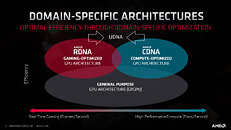
The intriguing "GFX13" identifier has turned up again, after many months of silence. Late last Friday (January 23), Kepler_L2 highlighted a public-facing LLVM Project update that defines initial support of Team Red's "gfx1310 target." One team member comment points to this new property being identical—as a temporary arrangement—to the RDNA 4 generation's "GFX12" and "GFX1250" IDs. Prior to 2026, a bunch of AMD patch notes mentioned early "GFX13" commitments, alongside next-gen "RDNA 5" or "UDNA" graphics architectures.

It is believed that last week's LLVM 23 compiler release only refers to "RDNA 5," leading to speculation about a forthcoming theoretical "Radeon RX 10000" discrete graphics card family. This next wave is not expected to launch any time soon; industry observers posit a vague mid-2027 launch window—maybe coinciding with unleashings of next-gen home consoles, although present-day market conditions could spoil Microsoft and Sony's best laid plans. Phoronix's founder and Editor-in-Chief, Michael Larabel, is looking forward to the August/September arrival of AMD's LLVM 23.1 stable release—by that time "GFX13" support could have advanced to another stage of development, thus providing further insights.

Sources: Kepler_L2 Tweet, Phoronix, Wccftech, LLVM GitHub
Add your own comment

14 Comments on "GFX13" Target Spotted in AMD LLVM Update - Paving the Way for Radeon "RDNA 5" GPUs

#1
RejZoR
Weren't we already at this "general GPU for everything" point and it didn't work out too well?
Posted on Reply
#2
john_
RejZoRWeren't we already at this "general GPU for everything" point and it didn't work out too well?
It was a good idea until the moment GPUs became also a tool for AI. AMD's RDNA architecture "keep the gaming part, throw the rest out", was a somewhat good idea if we assume that they lost interest for applications, like Photoshop and Blender and decided to focus on gaming only. Then AI became a trend in PCs, so they need to make their RDNA architecture capable for more than simple gaming. The timing was just bad.
Posted on Reply
#3
TheinsanegamerN
RejZoRWeren't we already at this "general GPU for everything" point and it didn't work out too well?
No, it worked great. GPUs have carried GPGPU tech for decades now. The big difference between consumer and professional cards has been FP performance ratios, but consumer and pro cards have shared architectures for a long time. It makes more sense to combine architectures since AI cores are also used in the likes of FSR.

It doesnt mean the GPUs are general designs though. You'll still have consumer facing designs and specialized designs, just all built from one common base instead of 2. nvidia's H accelerators for AI, for example, are built on Ada and Blackwell, not their own separate architecture. AMD tried to split them but I assume they figured the extra overhead from supporting multiple architectures did not justify performance increases.
Posted on Reply
#4
ARF
industry observers posit a vague mid-2027 launch window
Expected. TSMC is not ready, wafer prices are sky-rocketing, RAM prices are astronomical, the Moore's Law is Dead.
The question is - who will buy aging AMD graphics cards (namely 2022 RX 7900 XTX and its smaller and slower sibling RX 9070 XT) for so long?
Posted on Reply
#5
TheinsanegamerN
ARFExpected. TSMC is not ready, wafer prices are sky-rocketing, RAM prices are astronomical, the Moore's Law is Dead.
The question is - who will buy aging AMD graphics cards (namely 2022 RX 7900 XTX and its smaller and slower sibling RX 9070 XT) for so long?
Well, I dont think AMD is very concerned about the sales of a GPU that is EOL.

For the 9070xt, there are only 2 actively produced cards that are faster then it, the 5080 and the absurd 5090. The 5090 isnt a mass market product, and now even enthusiasts cant get them. So there is only 1 realistic opponent, the 5080. And there's only so many people willing to pay $500+ more for the relatively small bump.

Until nvidia releases the 6000 series, the 9070xt will still be in a perfectly good spot. Most of the market is still using older generations of card. It'll keep selling until something better comes along. GPUs will continue to fail. Games will keep coming out that dont really run well on 8+ year old cards, or even cards like the RX 6000 series. Anyone building a new system will default to the current generation too.
Posted on Reply
#6
EatingDirt
ARFExpected. TSMC is not ready, wafer prices are sky-rocketing, RAM prices are astronomical, the Moore's Law is Dead.
The question is - who will buy aging AMD graphics cards (namely 2022 RX 7900 XTX and its smaller and slower sibling RX 9070 XT) for so long?
9070XT is a capable card against their Nvidia counterparts, and I don't believe we expect we'll see any Nvidia cards until 2027 either... so.. some people? FSR 4 was a huge step and was, according to most outlets on par with DLSS 4. Not really sure how much further Nvidia can develop DLSS 4.5, so if AMD continues to improve FSR, I imagine there's still a market for the 9070XT.
Posted on Reply
#7
Steevo
RejZoRWeren't we already at this "general GPU for everything" point and it didn't work out too well?
It would be interesting to see if they devolve some part of the architecture back into VLIW to get more flexibility out of shader hardware.
Posted on Reply
#8
ARF
TheinsanegamerNWell, I dont think AMD is very concerned about the sales of a GPU that is EOL.

For the 9070xt, there are only 2 actively produced cards that are faster then it, the 5080 and the absurd 5090. The 5090 isnt a mass market product, and now even enthusiasts cant get them. So there is only 1 realistic opponent, the 5080. And there's only so many people willing to pay $500+ more for the relatively small bump.

Until nvidia releases the 6000 series, the 9070xt will still be in a perfectly good spot. Most of the market is still using older generations of card. It'll keep selling until something better comes along. GPUs will continue to fail. Games will keep coming out that dont really run well on 8+ year old cards, or even cards like the RX 6000 series. Anyone building a new system will default to the current generation too.
The RX 9070 XT doesn't even exist in the Steam Hardware Survey.


There are many cards faster than it - RTX 5090, RTX 4090, RTX 5080, RTX 4080 Super, RTX 4080 and RTX 5070 Ti.


The bad thing is that AMD doesn't work on its driver, either, since it loses performance over time compared to the RTX 5070 Ti and in general all Nvidia cards.

This is a bad sign, in general - the sales will deplete - anyone who wanted a new card, has already bought one.
Posted on Reply
#9
TheinsanegamerN
ARFThe RX 9070 XT doesn't even exist in the Steam Hardware Survey.

As has been covered extensively, Steam is not reliable for market share numbers for hardware due to flaws in how they sample their users.
ARFThere are many cards faster than it - RTX 5090, RTX 4090, RTX 5080, RTX 4080 Super, RTX 4080 and RTX 5070 Ti.

4090 is not manufactured anymore. 4080 is not manufactured anymore. 4080 super is not manufactured anymore. Pretty sure I specified that, since cards that are not made anymore have no bearing on current sales now VS 4 months ago.

On the 5070ti, in the last 3 games TPU has tested, the 9070xt generally beats it in one game, generally loses in another, and is tied in the third. At 2k and 1080p (the resolutions that the overwhelming majority play at) the difference between the two is more often then not within margin of error.
ARFThe bad thing is that AMD doesn't work on its driver, either, since it loses performance over time compared to the RTX 5070 Ti and in general all Nvidia cards.
You are in the extreme minority with that opinion. I've seen no evidence that the 9070xt has ceded significant performance to the 5070ti.
ARFThis is a bad sign, in general - the sales will deplete - anyone who wanted a new card, has already bought one.
LOLno.
Posted on Reply
#10
Craptacular
ARFThere are many cards faster than it - RTX 5090, RTX 4090, RTX 5080, RTX 4080 Super, RTX 4080 and RTX 5070 Ti.
The 4090, 4080 super, 4080 are no longer sold at stores like microcenter or BestBuy. Nor is there any new supply of them coming in. The only place to find them is from 3rd party sellers that have massive markups on them.

5070 ti is faster but on newegg from the 3rd part sellers it is a minimum of 1k usd, in fact a lot of them 1200-1500k usd. 9070 xt is much more cost effective per frame than the 5070 ti at those prices, especially so against the 5080 and 5090.
Posted on Reply
#11
Icon Charlie
CraptacularThe 4090, 4080 super, 4080 are no longer sold at stores like microcenter or BestBuy. Nor is there any new supply of them coming in. The only place to find them is from 3rd party sellers that have massive markups on them.

5070 ti is faster but on newegg from the 3rd part sellers it is a minimum of 1k usd, in fact a lot of them 1200-1500k usd. 9070 xt is much more cost effective per frame than the 5070 ti at those prices, especially so against the 5080 and 5090.
For now that is if you are referring to the 9070XT being more cost effective. The Cheapest XT is now in the $750 range if you want an AsRock that is. The average XT is in the $800+ range and the price continues to go up as of this posting.

There was a reason why I bought my video card at the time that I did. I saw the signs of things going down and I made my purchase before the prices shoot up again, which they are.

Like the reason I REFUSE TO PAY THE AMD TAX ON their recent motherboards.

I got a very good AM4 setup. Extremely balanced and does all of the things I am doing. Perhaps I'll build something slowly on the AM5 setup this year, as I can now find a decent MSI board that I am willing to purchase. And I am willing to make a premium puchase on a Ryzen 7900 (non XT) for my setup. AND I will still using my HYPER T2 CPU cooler as it is rated for the Ryzen Wattage. I also have everything else except memory but I can buy that on a monthly basis. It's not A BIG sweat on spending here. However I despise the modern day corporate mindset here in Silicon Valley.
People such as Jeff Bezos/Jenson Huang making their powerplay on turing PC usage into Rental Item.

Use the cloud they say.
Subriptions they say.
You will be happy when you own NOTHING they say.

Soon you will be nothing but a piece of meat of a certain value, well actually in many things you already -are- a piece of meat for the corporations to knaw on. They however not yet that blatant enough to say that to your face. Not yet that is.

I can't wait enough for the AI bubble to burst but I already know a few things about that too. Heh... no good.
Posted on Reply
#12
Vayra86
john_It was a good idea until the moment GPUs became also a tool for AI. AMD's RDNA architecture "keep the gaming part, throw the rest out", was a somewhat good idea if we assume that they lost interest for applications, like Photoshop and Blender and decided to focus on gaming only. Then AI became a trend in PCs, so they need to make their RDNA architecture capable for more than simple gaming. The timing was just bad.
Timing bad, or put differently, AMD is way too slow in their response to market demand and then in execution.

They are extremely good at missing the boat, and then responding half assed because they already half concluded they actually missed it.

Their GPU division is like a history book with that trend going on for decades.
Posted on Reply
#13
john_
Vayra86Timing bad, or put differently, AMD is way too slow in their response to market demand and then in execution.

They are extremely good at missing the boat, and then responding half assed because they already half concluded they actually missed it.

Their GPU division is like a history book with that trend going on for decades.
Just bad timing and their need to keep the gap with Nvidia as small as possible. They tried to create smaller and cheaper chips to go against Nvidia and they ended up with chips that could keep up with Nvidia's in performance but not in features, at a time that features started becoming an important factor, next to gaming performance. Nvidia had also it's bad timing when it introduced Fermi, if I remember correctly. It's about 15 years, but if I remember correctly, Fermi was a GPU architecture mostly for the professional market that was also good enough in gaming. But all those extra pro features meant a big hot chip that was having trouble going against AMD's HD 5000 series GPUs.
Posted on Reply
#14
Makaveli
ARFExpected. TSMC is not ready, wafer prices are sky-rocketing, RAM prices are astronomical, the Moore's Law is Dead.
The question is - who will buy aging AMD graphics cards (namely 2022 RX 7900 XTX and its smaller and slower sibling RX 9070 XT) for so long?
That is the question that I ponder.

I'm sitting on my 7900XTX until RDNA 5 launch. And I generally sell the old to buy the new. However the gap in years will be so large now that potential buyers for a 7900XTX in 2027 will be much smaller as I usually don't have 5 year gaps when I flip my gpu's. The one saving grace is this card has 24GB's of VRAM so there is potential for sales with people that run LLM's or AI and also linux performance is good.

If RDNA 3 does finally get FSR 4 that will help but still this long a gap is generally not good for resale value.
ARFThe bad thing is that AMD doesn't work on its driver, either, since it loses performance over time compared to the RTX 5070 Ti and in general all Nvidia cards.

This is a bad sign, in general - the sales will deplete - anyone who wanted a new card, has already bought one.
Not sure I agree with this last part :)

Posted on Reply
Add your own comment
Nov 21st, 2026 22:48 PST change timezone

New Forum Posts

Popular Reviews

TPU on YouTube

Controversial News Posts