Friday, January 30th 2026

AMD "Zen 6" CCD Packs 12 Cores, 48 MB L3 Cache
The standard CPU complex die (CCD) chiplet based on AMD's next-generation "Zen 6" microarchitecture is poised to feature a 50% increase in CPU core counts. This would be the first time that AMD has increased core-counts of its CCDs containing full-sized CPU cores capable of sustaining high clock speeds. It had developed CCDs with high core counts using compacted cores with lower clock speed limits until now. The standard "Zen 6" CCD is expected to come with a similar die-size to the current "Zen 5" CCD, with a rumored die size of 76 mm², which is slightly larger than the 71 mm² of the "Zen 5" CCD.
The "Zen 6" CCD is expected to pack 12 CPU cores, all part of a single CPU core complex (CCX). All twelve cores share a 48 MB L3 cache. Both the CPU core counts and L3 cache size hence see a 50% increase over "Zen 5." AMD is building the "Zen 6" CCD on TSMC N2 (2 nm nanosheet) process node, which evidently offers a massive increase in transistor densities over the current TSMC N4P (4 nm FinFET) on which the "Zen 5" CCD is made. With an eye on Intel's pivot towards a cache rebalancing in favor of large last-level caches on some of its premium Core Ultra 400 "Nova Lake-S" desktop processors, AMD is expected to give the "Zen 6" CCD full 3D V-Cache capability, and the company's next X3D processors could come with L3 caches of 144 MB per CCD for up to 288 MB of L3 cache on the desktop AM5 socket.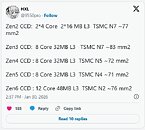
Sources:
HXL (Twitter), VideoCardz
The "Zen 6" CCD is expected to pack 12 CPU cores, all part of a single CPU core complex (CCX). All twelve cores share a 48 MB L3 cache. Both the CPU core counts and L3 cache size hence see a 50% increase over "Zen 5." AMD is building the "Zen 6" CCD on TSMC N2 (2 nm nanosheet) process node, which evidently offers a massive increase in transistor densities over the current TSMC N4P (4 nm FinFET) on which the "Zen 5" CCD is made. With an eye on Intel's pivot towards a cache rebalancing in favor of large last-level caches on some of its premium Core Ultra 400 "Nova Lake-S" desktop processors, AMD is expected to give the "Zen 6" CCD full 3D V-Cache capability, and the company's next X3D processors could come with L3 caches of 144 MB per CCD for up to 288 MB of L3 cache on the desktop AM5 socket.

99 Comments on AMD "Zen 6" CCD Packs 12 Cores, 48 MB L3 Cache
EDIT: Out of curiosity, I wanted to see how that could compare with a more modern $300 process. And the 9600X appears to hold its own pretty well against the 5950X.
Sure the cost of the rest of the system is/was probably cheaper but isolating the CPUs, it sort of drives my point that AMD could get away with not bumping up core counts because per-core performance makes up for it.
In properly optimised software the former is around 50% faster than the latter.
Right now the current value of the Ryzen 7 like the 7700/X and the 9700/X feels quite low when the Core Ultra 5 235 and 245K are around the same performance in most things while costing less and the gap with the Core Ultra 7 265/K in most things just grows bigger and right now it has a very good price. And this isn't that new either, it was and is already the same case against the Core i5 14600K and the Core i7 14700/K. If Nova Lake really is bringing back AVX-512 and technically even a bit better because the AVX10.2, which is an advantage that helps AMD performance in some applications right now, alongside some other said things like here and other reports, Nova Lake and Zen 6 could be an oppurtinity of interesting competition for consumers.It costs less, is more power efficient, LGA 1851 motherboards have good prices right now and part of the space is taken by the much better and useful iGPU on those than any of the current AMD integrated graphics options in desktop.
More cores is better, especially if you run several apps side by side. How many apps do you think a hexa-core CPU can run? 2 apps, 3 apps? And now compare with how many apps a 16-core CPU can run simultaneously. This means gaming, streaming, coding, rendering, all at the same time, side by side.
What would i use it for? adding a multiport high speed NIC, a sound card, PCIe to nvme card, or m.2 nvme slots on the motherboard that dont steal bandwidth from the only 16X slot on motherboards these days, and anything else in a PCIe form factor, and yes, potentially even another GPU. Multi GPU isn't dead, you can scale workloads to multiple GPUs just fine.
In any case, I could also be pedantic and say that since this news article is about the CCDs, it doesn't matter anyway. They don't have PCIe root complexes.
300.9 mm2 including filler tiles, 247.2 mm2 is for the actual logic tiles.
www.techpowerup.com/cpu-specs/ryzen-9-9950x.c3649
We have to consider the I/O die as well not just the CCDs (2x70.6 + 122 mm2).
If you want premium features, you pay for the premium Threadripper platform. That means 99% of people aren't paying extra to subsidize the extreme minority of power users.
You're dreaming. More logically it would be sold double that at least.
I won't upgrade with any AMD CPU in the distant future. I have my 24-thread Ryzen 9 5900X and it is very fast in its rated TDP of just 105W.