Friday, January 30th 2026

AMD "Zen 6" CCD Packs 12 Cores, 48 MB L3 Cache

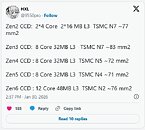
The standard CPU complex die (CCD) chiplet based on AMD's next-generation "Zen 6" microarchitecture is poised to feature a 50% increase in CPU core counts. This would be the first time that AMD has increased core-counts of its CCDs containing full-sized CPU cores capable of sustaining high clock speeds. It had developed CCDs with high core counts using compacted cores with lower clock speed limits until now. The standard "Zen 6" CCD is expected to come with a similar die-size to the current "Zen 5" CCD, with a rumored die size of 76 mm², which is slightly larger than the 71 mm² of the "Zen 5" CCD.

The "Zen 6" CCD is expected to pack 12 CPU cores, all part of a single CPU core complex (CCX). All twelve cores share a 48 MB L3 cache. Both the CPU core counts and L3 cache size hence see a 50% increase over "Zen 5." AMD is building the "Zen 6" CCD on TSMC N2 (2 nm nanosheet) process node, which evidently offers a massive increase in transistor densities over the current TSMC N4P (4 nm FinFET) on which the "Zen 5" CCD is made. With an eye on Intel's pivot towards a cache rebalancing in favor of large last-level caches on some of its premium Core Ultra 400 "Nova Lake-S" desktop processors, AMD is expected to give the "Zen 6" CCD full 3D V-Cache capability, and the company's next X3D processors could come with L3 caches of 144 MB per CCD for up to 288 MB of L3 cache on the desktop AM5 socket.
Sources: HXL (Twitter), VideoCardz
Add your own comment

99 Comments on AMD "Zen 6" CCD Packs 12 Cores, 48 MB L3 Cache

#51
ARF
AusWolfI'm not looking for blazing RAM speeds. I'm even fine with 4800 with my 7950X3D. I just want my kit to work at its expo rated speed without too much SoC voltage.
Is it not normal to have desktop DDR5 faster than the mobile DDR5 that is already mainstream with DDR5-7500?
Posted on Reply
#52
AusWolf
ARFIs it not normal to have desktop DDR5 faster than the mobile DDR5 that is already mainstream with DDR5-7500?
That depends on your platform and capacity. Intel can do 7-8000 as far as I've heard. AMD is fine with 6000-6200 with 32-48 GB, or 5200-5600 with more. Luckily, it doesn't matter with X3D.
Posted on Reply
#53
ymdhis
LastDudeALiveUnfortunately, every single thing you mentioned is extremely niche. Most users don't even use a NIC or are unaware they can. WiFi is internet, to them. Sound cards are the same, 99% of people plug their headphones into the motherboard, monitor, or use Bluetooth. 99% of users have no use for more than 2 or three NVME drives, if they're using multiple at all. I'm fairly tech-savvy, and I had to Google what MCIO is, I've literally never heard of it. 99% of users have no need for more USB than what comes on the motherboard. Keyboard, mouse, maybe a webcam, and that's it. Multi-GPU has no use for 99% of the market.

If you want premium features, you pay for the premium Threadripper platform. That means 99% of people aren't paying extra to subsidize the extreme minority of power users.
My last motherboard had a broken sound chip on it so I had to use an USB dongle to get sound. I also had boards with very loose network plugs which forced me to use network cards. These are valid scenarios and not extremely niche, unless you are suggesting that trying to get more life out of a semi-broken motherboard is niche and I should just be a good consumer and buy a whole damn replacement (the equivalent of buying a whole new car when you get a tire puncture). Either way, you now have to use USB ports for all of these, except that the lack of PCIE lanes also means that you are ultimately limited in USB ports, especially 10gb or 20gb USB ports. Most average motherboards still only have 2-4x USB3 5gb and MAYBE one or two 10gb (one USB-A, one USB-C).

The problem isn't just the lack of PCIe channels (though that is a problem too), it's that high end motherboards have 2 PCIe slots in total; low end boards may have more PCIe but in turn lack everything else. You now have to use m.2 to PCIE adapters for add-on cards because boards have more m.2 slots than useable PCIe ones. I can sort of understand because GPUs take 4 slots on average now and the only other thing you can do is stick in m.2 ports underneath them, but come on. Or you are forced to stick to USB dongles, which don't have enough space to add, say, proper cooling for a 10GbE NIC. On top of dealing with the inefficiency of USB protocol.

Motherboards also only come with 2-4 SATA ports now, and you have to use an add-on card for more... in fact the best choice I found was to use a six sata port ASM1166 controller that's on an m.2 card using a PCIE 3.0 x2 connector. You can put it on one of the chipset slots which usually use slower speeds anyway.

We are basically developing backwards so they can give us what we used to have at a premium. I have an FM2 motherboard here with 8 SATA ports that can take 4 expansion cards. And it's a cheap mid-range board. mATX even.
Dr_b_can we please have more PCIe Lanes? Ill trade 4 cores for another 16 PCIe 5.0 lanes
I'd be happy if they just had all 24 lanes on the APUs. Phoenix is gimped to only 16 usable lanes, Strix Point as well. The main PCIE slot runs at only x8 as a result. Back on Cezanne it could run at x16 and I could use a x8x4x4 bifurcation card to stick two extra m.2 drives all on the CPU and still have enough left for a potential GPU, or even a low profile 10GBE NIC.

We needed adapter boards and bifurcation to get more than basic IO, they are removing even that.
ARFIs it not normal to have desktop DDR5 faster than the mobile DDR5 that is already mainstream with DDR5-7500?
Mobile chipsets come out later and have improved memory controllers, usually because they use monolithic chips and not the very very poor chiplet IOD. I've seen people push 8600Gs to 9000+.
Posted on Reply
#54
Dr. Dro
jesdalsI wonder where the Gameing Champion is going to be - a top 12 core or a faster 8 or 10 core with higher boost
Some games already require more than 8 cores. In those cases, the 12-core version will be faster. This is why people want Bartlett Lake, which is just the A0 configuration of Raptor Lake 12P0E.
ARFGreed will lead you nowhere - especially when AMD is about to become the underdog once again after the release of the new 52-core Intel CPUs. AMD will have no answer, except lower pricings.
Nova Lake will undoubtedly be very powerful, and probably faster than Zen 6 overall. But I would not write AMD off just yet.
AusWolfThat depends on your platform and capacity. Intel can do 7-8000 as far as I've heard. AMD is fine with 6000-6200 with 32-48 GB, or 5200-5600 with more. Luckily, it doesn't matter with X3D.
On UDIMMs, yes. With the best CUDIMM bins (usually marketed DDR5-9600), adequate MB and a good 285K, the 10K range isn't too far fetched.
Posted on Reply
#55
Noci
Zen 6 on AM5 is from a AM4 user's point of view is a very nice upgrade perspective.
I still like my AM4 setup and it continues to serve me well, so not willing to abandon it yet ;) .

I wonder if there is also a maturing process on the AM5 chipset going on and a new chipset with added functionallity will be developed.

And then the elephant in the room, with all the prices rinsing in this sector atm, what will it bring? I guess the second hand kidney market will see a major uplift :roll:.
Posted on Reply
#56
Redwoodz
LastDudeALiveAnd what's the size of the IO die + infinity fabric?
about 120mm sq.
Posted on Reply
#57
melkor_unlimited
evernessince
QuicksSo they also upgrading the 64MB X3D cache to 96MB X3D? So its 48 + 96 = 144
AMD's CPU dies are used across segments. Doesn't make sense to bloat die size when you can just add cache via X3D. This ensures AMD can make the fewest different dies and there's no trade-off. Need more cache? Buy X3D. Simple as.
Looks like AMD decided to keep core:L3_size ratio for both CCD and 3D cache.
4 MB L3 per core in CCD
8 MB L3 per core in 3D V-cache
That means shift from 32MB (+64MB) in Zen3, Zen4, Zen5 to 48MB (+96MB) in Zen6
LastDudeALive
Redwoodz
LastDudeALiveEven a dual 12-core CCD Ryzen 9 won't be enough to match a 52-core Core Ultra 9, though.
That all sounds right untill you realise the Intel chip takes 280mm sq. to outperform an 84mm sq. chip.
And what's the size of the IO die + infinity fabric?
You need more info about how much silicon it will need.
Intel: CCD with bLLC + IOD + iGPU
AMD: CCD + IOD with iGPU

BTW ...
AMD can do IOD at older&cheaper node, even the 3D cache wont be made at the best node. Only 76mm² of CCD.
AMD removed the need of ser-des on both IOD and CCD saving some silicon area. And got lower latency as side effect.
Including the bLLC into CCD will make it big (280 mm²) and expensive
52 cores may look impresive, but ... its not 52 cores. Its (8+16)+(8+16)+4. And those 4 LPE wont do big difference.

TL;DR - 52 core Intel may or may not provide higher MT than 24core/48thread Ryzen. Have to wait for results.
hsewIt's possible Zen 6 or 7 transitions away from a Performance/Compact core design to just Compact cores, but without the distinction (no more C core designation if they're all the same core again), making scheduling a bit easier. This might negate any performance gains for a generation, but it is the easiest path to shrinking enough space to allow 50% more cores in less than 10% more die space.
May be Intel should consider stop mixing cores and go for only e-cores for lower price range.
Darkmont IPC is good enough to without big cores and finish this scheduler madness.
Show me where 8 big cores of Alder Lake performance wont be enough for office and everyday notebooks.
Mr. PerfectThe real question is how long are they going to make everyone wait for the X3D parts? They've traditionally been a year or so after the non-X3D parts as some sort of product segmentation play, which is extremely annoying for gamers who aren't even considering non-X3D parts.
Sep 27th, 2022 - Ryzen 7 7700x
Apr 6th, 2023 - Ryzen 7 7800x3D
6 months

Aug 8th, 2024 - Ryzen 7 9700x
Nov 7th, 2024 - Ryzen 7 9800x3D
Whole year has somehow shrinked into 3 months.
ymdhisOh you think waiting for X3D parts is bad, try waiting for their APU releases. Half-assed mobile chip ports every 2-3 years, and as of Phoenix they also have half the PCIE lanes and non-soldered IHS.
There is not big enough demand for them.
2 CU iGP in regular desktop Ryzen is good enough for office use and computing.

BTW .. 8 PCIe tha APU miss are used to connect their iGPU. Leaving 12 lanes for general use. 16 if you do not use chipset.
Need more connection? Buy that Promotory21 expansion card and put it into x4 slot.
shuffy_losysOut of curiosity, I wanted to see how that could compare with a more modern $300 process. And the 9600X appears to hold its own pretty well against the 5950X.

Sure the cost of the rest of the system is/was probably cheaper but isolating the CPUs, it sort of drives my point that AMD could get away with not bumping up core counts because per-core performance makes up for it.
Having both 5800x3D and 7600x I have compared them.
Somewhere 3D cache shows
Somewhere IPC and frequency shows
Somewhere core count shows (and that will be bigger with 16 vs 6 cores)
I am leaving 5800x3D for kids and their gaming. Going for 12+ core Zen6 for my mixed rendering/gaming use case.
RulumiI think it is time for at least an small core increment, it's already going to be 9 years of AMD keeping the same core count in most of their desktop consumer CPUs, it's going to become longer than the time Intel took with the dual and quad cores segmentation in the main consumer platforms.
Zen4 came with 16c cores on CCD (only for EPYCs)
Strix point came with 4 + 8c cores (for notebooks so far)
Now its time to introduce 12 cores into desktop and HEDT.
RulumiIf Nova Lake really is bringing back AVX-512 and technically even a bit better because the AVX10.2
The biggest benefit from AVX 10.2 is not performance or bigger instruction set.
Intel finally decided to clean up their mess. And that is good.
Rulumi... Nova Lake and Zen 6 could be an opportunity of interesting competition for consumers.
And that is good too.
RulumiIt costs less, is more power efficient, LGA 1851 motherboards have good prices right now and part of the space is taken by the much better and useful iGPU on those than any of the current AMD integrated graphics options in desktop.
I do not get it. How could be 280mm² (or is it only 114mm²) chip be less expensive than 76mm²?
Has 18A turn so good its cheaper to make than TSMC 2nm margin?
Dr_b_can we please have more PCIe Lanes? Ill trade 4 cores for another 16 PCIe 5.0 lanes
Yes. We can.
Ryzen 7960/7980 + TRX50 ... 48x Gen5 + 32x Gen4
Ryzen 9960/9980 + TRX50 ... 80x Gen5 + 8x Gen4
AM5 socket does not have free pins to add more.
ARFMore cores is better, especially if you run several apps side by side. How many apps do you think a hexa-core CPU can run? 2 apps, 3 apps? And now compare with how many apps a 16-core CPU can run simultaneously. This means gaming, streaming, coding, rendering, all at the same time, side by side.
Doing time sonsuming tasks at background? Sure.
Put everything I do to stream? Why not.
But how do you combine code developing and gaming at the same time?
Is that some cool game about coding?
LauncestonianZen 6 going to give us upgraded memory controller?.. I want 8000MT/S 1:1 :)
Are you willing to pay for it too?
FoulOnWhiteI have 3 M.2 drives. I had to use specific slots. If i had used others i would have had only x8 on my GPU, or disabled other things on the board. I guess a CPU with more PCIe lanes would be better but much more costly. They put 5 M.2 slots on a board for you not to use all of them?
Manufacturer decided to make one-size-all motherboard instead of several models focused on that or that.
It would be nice to finally get something capable instead of that crippled Promotory21. At least for the high-end.
AusWolfGive it a better IO die with seamless 6000-6400 MHz RAM speed support on high capacities, without the need for excessive VSoC, and I'll be happy. This will probably be my last upgrade for the next decade.
AusWolfI'm not looking for blazing RAM speeds. I'm even fine with 4800 with my 7950X3D. I just want my kit to work at its expo rated speed without too much SoC voltage.
There are rumors about rising up the base JEDEC speed from 4800 MT/s to 5600 MT/s. May be more.
N3utroThe recently released 8 core 9850X3D is sold $500, and you think they're going to sell $300 a 12 cores CPU with improved 2nm manufacturing process and cache size?

You're dreaming. More logically it would be sold double that at least.
Checked nearest e-shop
535€ / 313€ - 9850x3D / 9700x
618€ / 393€ - 9900x3D / 9900x
723€ / 550€ - 9950x3D / 9950x

I wont say it will be cheap. But the 3D V-cache is what makes the price so high.
My guess ... 550€ for 12core Zen6 without 3D V-cache at release.
ARFGreed will lead you nowhere - especially when AMD is about to become the underdog once again after the release of the new 52-core Intel CPUs. AMD will have no answer, except lower pricings.
I am afraid that AMD wont lower the prices.
Just because the price of that 52 core monster will be ... monstrous.
ARFIs it not normal to have desktop DDR5 faster than the mobile DDR5 that is already mainstream with DDR5-7500?
LPDDR5x already reached 9500 MT/s
AusWolfIntel can do 7-8000 as far as I've heard. AMD is fine with 6000-6200 with 32-48 GB, or 5200-5600 with more. Luckily, it doesn't matter with X3D.
Intel: 10000+ on UDIMMs or even 12000+ with CUDIMMs
AMD already can run 7200~8000 MT/s after gear shifting.
And yes. There is not big advantage of using faster modules with 3D V-cache.
NociI wonder if there is also a maturing process on the AM5 chipset going on and a new chipset with added functionallity will be developed.
Promotory21 connected to CPU via Gen4 PCIe just sucks.
NociAnd then the elephant in the room, with all the prices rinsing in this sector atm, what will it bring?
More elephant excrements.
Posted on Reply
#59
Punkenjoy
I assume that the generally available cutdown variant of Zen 6 will probably have 8 cores with the full 48 MB of cache. I expect that no matter the cores, the gaming performance will see a significant gain over non X3D Zen 4/5 parts. That alone make Zen 6 very interesting. I wonder what they are going to do for low power/mobile parts. 24 MB of cache ?

I also wonder how much the extra cache on the X3D parts will help. 48 MB total increase over 96 MB might fall in many workload in the diminishing return area. That will be interesting to see.

As for the RAM speed. The main thing is really how the CPU is connected to the I/O dies. The serial implementation of the infinity fabrics seems to be pretty much capped anyway. It add latency and on desktop CPU, it's not wide enough to sustain higher DDR5 ram speed anyway. It's expected/rumored that AMD will implement a new I/O die with Zen 6 including a new interconnect using fanout grid like RDNA3/Strix Halo.

Well AMD have to do it if they want to remain competitive anyway. They had the packaging advantage for few generation but Intel is now ahead. They must switch to that packaging just to remain competitive.

(and kids, this is why it's good to have a competitive market and we should never just want the same actor to win all the time).
Posted on Reply
#60
AusWolf
melkor_unlimitedLooks like AMD decided to keep core:L3_size ratio for both CCD and 3D cache.
4 MB L3 per core in CCD
8 MB L3 per core in 3D V-cache
That means shift from 32MB (+64MB) in Zen3, Zen4, Zen5 to 48MB (+96MB) in Zen6
That's probably due to core / die area constraints. If an 8-core CCD can fit a 64 MB V-cache on top / under it, then 12 cores should fit 96 MB on an even die shrink.
PunkenjoyI assume that the generally available variant of Zen 6 will probably have 8 cores with the full 48 MB of cache.
Doubtful because of the above. You either have 8 cores with 32 MB L3, or 12 with 48 on consumer Zen 6. 8 cores with 48 MB is also possible by cutting cores, like they do with Ryzen 5.
Posted on Reply
#61
Punkenjoy
AusWolfDoubtful because of the above. You either have 8 cores with 32 MB L3, or 12 with 48 on consumer Zen 6. 8 cores with 48 MB is also possible by cutting cores, like they do with Ryzen 5.
There was a missing word in my phrase, should have been generally available cutdown variant. (Previous Zen Arch had a 50% cutdown variant, but they were not really broadly available, this is why i don't think they will make a broadly available 6 core CPU with Zen 6).
Posted on Reply
#62
LastDudeALive
FoulOnWhiteI have 3 M.2 drives. I had to use specific slots. If i had used others i would have had only x8 on my GPU, or disabled other things on the board. I guess a CPU with more PCIe lanes would be better but much more costly. They put 5 M.2 slots on a board for you not to use all of them?
You're part of the 1%. 99% of people aren't even aware you can have more drives than what the computer comes with.
ymdhisMy last motherboard had a broken sound chip on it so I had to use an USB dongle to get sound. I also had boards with very loose network plugs which forced me to use network cards. These are valid scenarios and not extremely niche, unless you are suggesting that trying to get more life out of a semi-broken motherboard is niche and I should just be a good consumer and buy a whole damn replacement (the equivalent of buying a whole new car when you get a tire puncture). Either way, you now have to use USB ports for all of these, except that the lack of PCIE lanes also means that you are ultimately limited in USB ports, especially 10gb or 20gb USB ports. Most average motherboards still only have 2-4x USB3 5gb and MAYBE one or two 10gb (one USB-A, one USB-C).

The problem isn't just the lack of PCIe channels (though that is a problem too), it's that high end motherboards have 2 PCIe slots in total; low end boards may have more PCIe but in turn lack everything else. You now have to use m.2 to PCIE adapters for add-on cards because boards have more m.2 slots than useable PCIe ones. I can sort of understand because GPUs take 4 slots on average now and the only other thing you can do is stick in m.2 ports underneath them, but come on. Or you are forced to stick to USB dongles, which don't have enough space to add, say, proper cooling for a 10GbE NIC. On top of dealing with the inefficiency of USB protocol.

Motherboards also only come with 2-4 SATA ports now, and you have to use an add-on card for more... in fact the best choice I found was to use a six sata port ASM1166 controller that's on an m.2 card using a PCIE 3.0 x2 connector. You can put it on one of the chipset slots which usually use slower speeds anyway.

We are basically developing backwards so they can give us what we used to have at a premium. I have an FM2 motherboard here with 8 SATA ports that can take 4 expansion cards. And it's a cheap mid-range board. mATX even.
Just knowing the term "network card" shows you are the 1%. Sorry, but that's the way it is. And CPU/motherboard manufacturers are not going to include features that 1% of people will use and the other 99% of people have to subsidize.

Posted on Reply
#63
Hecate91
No one is asking the world to have more than 2 PCI-E slots, I find it sad the amount of I/O motherboards have has regressed into have 2-3 slots at most, but motherboards end up only getting more expensive.
And I disagree, saying something is for "the 1%" isn't a good defense for it either, all of the parts we're buying is for the few percent of enthusiasts anyway, I think there should be a X890E with more I/O for those who don't want to empty their wallet for an HEDT build.

Anyway, it would be great if this is true, with 8 or 10 cores being the minimum core count for Zen 6.
Posted on Reply
#64
FoulOnWhite
LastDudeALiveYou're part of the 1%. 99% of people aren't even aware you can have more drives than what the computer comes with.


Just knowing the term "network card" shows you are the 1%. Sorry, but that's the way it is. And CPU/motherboard manufacturers are not going to include features that 1% of people will use and the other 99% of people have to subsidize.

I'm sure there are more than 1% that have more than 1 m.2 drive. I don't use any internal sata drives inc hdd or ssd. Hdd are too noisy and take up too much space, and 2.5" ssd are too slow for the cost. i use 1 m.2 just for steam, 1 for boot and the gen5 2tb was just a impulsive lets see what gen 5 is like buy.
Posted on Reply
#65
sephiroth117
QuicksShould have doubled the L3 cache, then there would be less need for X3D chips or even add that on top.

So they also upgrading the 64MB X3D cache to 96MB X3D? So its 48 + 96 = 144
For me it's better to have more specialised CPUs, those x3D are good for gaming but maybe someone else doesn't need to pay for 3D cache for his/her use cases
Posted on Reply
#66
Assimilator
Zen6 will have at best an extra 4 PCIe 4.0/5.0 lanes, and those will be exclusively reserved for the ASM4242 USB4 chipset, because AMD has figured out that without any competition they can screw consumers just as much as Intel used to.
Posted on Reply
#67
efikkan
Unfortunately most of the CPU race is increasingly focused on synthetic and batch workloads, which mostly currently focuses on core count and L3 cache, because nice numbers sell. But hopefully there's some meaningful improvements in core performance this time around, because performance per core, not just peak, but also with mixed loads, is what actually matters to most desktop users.
AssimilatorZen6 will have at best an extra 4 PCIe 4.0/5.0 lanes, and those will be exclusively reserved for the ASM4242 USB4 chipset, because AMD has figured out that without any competition they can screw consumers just as much as Intel used to.
Are there really enough unused pins in the socket intended for this purpose?
If not, the best we can hope for is higher speeds, only for new motherboards.
Posted on Reply
#68
Sol_Badguy
Dr. DroNova Lake will undoubtedly be very powerful, and probably faster than Zen 6 overall. But I would not write AMD off just yet.
Gaming, AI Photo Enhance, 7-Zip and AES are weak points for Arrow Lake (in this testing suite) which need fixing obviously.
Gaming is close to non-X3D though, so if vanilla vs vanilla is comparable and also X3D vs bLLC is comparable then it's probably ideal for us consumers. Either player clearly dominating is not ideal as it pretty much halves the options and also keeps prices up for the winner, no reason to give discounts when you're dominating.
So as as tempting as it might seem (for some people) to root for Intel to knock it out of the park, I think a stalemate or a modest win for Intel is the best for us (a modest overall win is good for public perception, to make it seem like they learned the lesson with Arrow Lake).
As long as the gains are significant vs the current gens, because that's the priority for us, then having comparable performance in most scenarios is likely ideal.

Coming back to who would win, it's somewhat of a paradox but while a clear victory for Nova Lake is definitely going to win over the people who are on older platforms (LGA1700, AM4 or even older) and willing to upgrade the likely very spicy prices are surely going to turn some away... towards the competition? Because if Intel wins big they're definitely putting victory tax on those CPUs. Unless somehow they're willing to reduce those profit margins just to screw AMD.
melkor_unlimited52 cores may look impresive, but ... its not 52 cores. Its (8+16)+(8+16)+4. And those 4 LPE wont do big difference.
I'm not sure but those 4 LPE might only be for idle and perhaps some very light background tasks, I don't think they will contribute a single point in CB for example. They don't have cache, they're located on the I/O tile, I don't think they're included for extra compute power. So technically 52 but practically 48.
melkor_unlimitedTL;DR - 52 core Intel may or may not provide higher MT than 24core/48thread Ryzen. Have to wait for results.
Today 285K has 8P+16E -> 24t and against 9950X which has 16c+HT -> 32t it's not that far behind. With comparable frequency though.
Nova Lake doubles the core/thread count while Zen6 has a 50% increase. Even assuming shitty scaling Nova Lake appears to have an advantage. But that is with comparable frequency, if Zen6 has significantly higher frequency it can offset a lot of that core/thread advantage.
AusWolfDoubtful because of the above. You either have 8 cores with 32 MB L3, or 12 with 48 on consumer Zen 6. 8 cores with 48 MB is also possible by cutting cores, like they do with Ryzen 5.
9900X has full cache like 9950X. So it's possible but not likely perhaps.
Posted on Reply
#69
Punkenjoy
All the cut down cores version since Zen 3 at least all have all the cache. The 3600, 5600, 7600 ans 9600 all have 32 MB of L3.

I would be really surprised and think it's unlikely that the cut down cores Zen 6 will have its 48 MB cut down
Posted on Reply
#70
A Computer Guy
RedwoodzThat all sounds right untill you realise the Intel chip takes 280mm sq. to outperform an 84mm sq. chip.
Didn't Lisa Su say size doesn't matter?
shuffy_losysI don't think value proposition matters on a part that's that old. Especially when you consider that Zen 3 was the first generation AMD bumped up the price because they said they were the performance leaders back then and they could justify it.

EDIT: Out of curiosity, I wanted to see how that could compare with a more modern $300 process. And the 9600X appears to hold its own pretty well against the 5950X.

Sure the cost of the rest of the system is/was probably cheaper but isolating the CPUs, it sort of drives my point that AMD could get away with not bumping up core counts because per-core performance makes up for it.
14700K only $336 seems like a much better choice for gaming CPU. Sorry if I went off topic but ghosts from Christmas passed were revisiting me just now when looking at that chart.
Dr_b_from a NIC, to a sound card, to a nvme drives, to mcio connectors, to not having to have 2 chipsets to extend anemic IO on motherboards to allow for more USB ports/TB ports

What would i use it for? adding a multiport high speed NIC, a sound card, PCIe to nvme card, or m.2 nvme slots on the motherboard that dont steal bandwidth from the only 16X slot on motherboards these days, and anything else in a PCIe form factor, and yes, potentially even another GPU. Multi GPU isn't dead, you can scale workloads to multiple GPUs just fine.
One thing I dislike about AM5 other than the lack of PCIe lanes is how lane sharing is handled. They could have offered workstation based motherboards with more slots on AM5 by being smarter in the layout and perhaps putting M.2 connectors on the backside of the motherboard like they do with ITX boards.

See below (ignoring physical slot size)

potential 4 slot layout
  • from CPU
    • M.2 (standard)
    • Slot 1: x16 (x16, or x8, or x4x4, or x4x4x4x4)
    • Slot 2: shared x8 (disabled, or x8, or x4x4) or M.2+M.2
    • Slot 3: x8 (as x8, or x4x4) or M.2+M.2
  • from Chipset
    • Slot 4: x4 (as x4) or M.2
potential 5 slot layout
  • from CPU
    • M.2 (standard)
    • Slot 1: x16 (x16, or x8, or, x4x4, or x4x4x4x4)
    • Slot 2: shared x8 (disabled, or x8, or x4x4) or M.2+M.2
    • Slot 3: x4 (as x4) or M.2
    • Slot 4: x4 (as x4) or M.2
  • from Chipset
    • Slot 5: x4 (as x4) or M.2
Posted on Reply
#71
FoulOnWhite
A Computer GuyDidn't Lisa Su say size doesn't matter?


14700K only $336 seems like a much better choice for gaming CPU. Sorry if I went off topic but ghosts from Christmas passed were revisiting me just now when looking at that chart.


One thing I dislike about AM5 other than the lack of PCIe lanes is how lane sharing is handled. They could have offered workstation based motherboards with more slots on AM5 by being smarter in the layout and perhaps putting M.2 connectors on the backside of the motherboard like they do with ITX boards.

See below (ignoring physical slot size)

potential 4 slot layout
  • from CPU
    • M.2 (standard)
    • Slot 1: x16 (x16, or x8, or x4x4, or x4x4x4x4)
    • Slot 2: shared x8 (disabled, or x8, or x4x4) or M.2+M.2
    • Slot 3: x8 (as x8, or x4x4) or M.2+M.2
  • from Chipset
    • Slot 4: x4 (as x4) or M.2
potential 5 slot layout
  • from CPU
    • M.2 (standard)
    • Slot 1: x16 (x16, or x8, or, x4x4, or x4x4x4x4)
    • Slot 2: shared x8 (disabled, or x8, or x4x4) or M.2+M.2
    • Slot 3: x4 (as x4) or M.2
    • Slot 4: x4 (as x4) or M.2
  • from Chipset
    • Slot 5: x4 (as x4) or M.2
I agree, my B850E/7800X3D combo has 5 m.2 and you can barely use 3.Is this the same with the 870 boards or higher end ones, or is it totally dependant on the CPU you use.
Posted on Reply
#72
AusWolf
Sol_Badguy9900X has full cache like 9950X. So it's possible but not likely perhaps.
PunkenjoyAll the cut down cores version since Zen 3 at least all have all the cache. The 3600, 5600, 7600 ans 9600 all have 32 MB of L3.

I would be really surprised and think it's unlikely that the cut down cores Zen 6 will have its 48 MB cut down
What I mean is, if the full die comes with 48 MB, then we'll probably have 12 cores on it (how many they cut down for lower SKUs is inconsequential). I highly doubt we'll see 32 MB cache with 12 cores.
Posted on Reply
#73
Assimilator
efikkanAre there really enough unused pins in the socket intended for this purpose?
If not, the best we can hope for is higher speeds, only for new motherboards.
That's why I said at best. AM5 was an anemic socket at launch and Zen6 won't change that, actual power users will almost certainly have to wait until the next socket for any real IO updates. That of course of course assumes AMD will even develop a new socket, or just use AM5 forever like they did with AM4 and subject us to even more years of mediocrity.
Posted on Reply
#74
AusWolf
AssimilatorZen6 will have at best an extra 4 PCIe 4.0/5.0 lanes, and those will be exclusively reserved for the ASM4242 USB4 chipset, because AMD has figured out that without any competition they can screw consumers just as much as Intel used to.
Do consumers even need more PCI-e lanes?
Posted on Reply
#75
Noci
AusWolfDo consumers even need more PCI-e lanes?
The average consumer probably not, but here with all the enthousiast there can never be enough :D
Posted on Reply
Add your own comment
Nov 17th, 2026 13:51 CST change timezone

New Forum Posts

Popular Reviews

TPU on YouTube

Controversial News Posts