Friday, January 30th 2026

AMD "Zen 6" CCD Packs 12 Cores, 48 MB L3 Cache

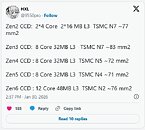
The standard CPU complex die (CCD) chiplet based on AMD's next-generation "Zen 6" microarchitecture is poised to feature a 50% increase in CPU core counts. This would be the first time that AMD has increased core-counts of its CCDs containing full-sized CPU cores capable of sustaining high clock speeds. It had developed CCDs with high core counts using compacted cores with lower clock speed limits until now. The standard "Zen 6" CCD is expected to come with a similar die-size to the current "Zen 5" CCD, with a rumored die size of 76 mm², which is slightly larger than the 71 mm² of the "Zen 5" CCD.

The "Zen 6" CCD is expected to pack 12 CPU cores, all part of a single CPU core complex (CCX). All twelve cores share a 48 MB L3 cache. Both the CPU core counts and L3 cache size hence see a 50% increase over "Zen 5." AMD is building the "Zen 6" CCD on TSMC N2 (2 nm nanosheet) process node, which evidently offers a massive increase in transistor densities over the current TSMC N4P (4 nm FinFET) on which the "Zen 5" CCD is made. With an eye on Intel's pivot towards a cache rebalancing in favor of large last-level caches on some of its premium Core Ultra 400 "Nova Lake-S" desktop processors, AMD is expected to give the "Zen 6" CCD full 3D V-Cache capability, and the company's next X3D processors could come with L3 caches of 144 MB per CCD for up to 288 MB of L3 cache on the desktop AM5 socket.
Sources: HXL (Twitter), VideoCardz
Add your own comment

99 Comments on AMD "Zen 6" CCD Packs 12 Cores, 48 MB L3 Cache

#1
SemperPC09
I am very excited for Zen6, it seems like it will be quite good. Also, hopefully HammerLake and all the other -lakes from Intel are competitive so that AMD doesn't slack off. A 12 core for 300$ with a better ipc than zen5 would be perfect. Even a 10 core for 300$ would be banger. I don't need more than about 8 cores, especially if they are relatively modern/have decent ipc.
Posted on Reply
#2
Quicks
Should have doubled the L3 cache, then there would be less need for X3D chips or even add that on top.

So they also upgrading the 64MB X3D cache to 96MB X3D? So its 48 + 96 = 144
Posted on Reply
#3
sam_86314
The question is will they actually up core counts across the lineup or is it still going to be 6C12T for R5, 8C16T for R7, 12-16C 24-32T for R9, and then a special tier with the full 24C48T (R9 XTX?).
Posted on Reply
#4
R-T-B
QuicksShould have doubled the L3 cache, then there would be less need for X3D chips or even add that on top.

So they also upgrading the 64MB X3D cache to 96MB X3D? So its 48 + 96 = 144
I would not get so excited. Of all logic densities, cache scales by far the worst.
Posted on Reply
#5
LastDudeALive
sam_86314The question is will they actually up core counts across the lineup or is it still going to be 6C12T for R5, 8C16T for R7, 12-16C 24-32T for R9, and then a special tier with the full 24C48T (R9 XTX?).
I imagine they'll boost it up. Maybe even bring back a Ryzen 3 for a 6-core model. Intel's inclusion of e-cores has massively boosted even the Core 5 strength. The Core Ultra 5 245K handily beats the 9700X and even the 7900 in Blender, for instance. AMD is now the one behind on core count/multithreading power, and needs to catch up.

Even a dual 12-core CCD Ryzen 9 won't be enough to match a 52-core Core Ultra 9, though.
Posted on Reply
#6
Bruno Vieira
LastDudeALiveI imagine they'll boost it up. Maybe even bring back a Ryzen 3 for a 6-core model. Intel's inclusion of e-cores has massively boosted even the Core 5 strength. The Core Ultra 5 245K handily beats the 9700X and even the 7900 in Blender, for instance. AMD is now the one behind on core count/multithreading power, and needs to catch up.

Even a dual 12-core CCD Ryzen 9 won't be enough to match a 52-core Core Ultra 9, though.
Everything depends on performance. Sure, Intel can call a 52-core part 'Desktop', but if it's not the fastest gaming chip ever, people will not care. There are 64- and 96-core ThreadRippers around; the 56-core Intel may beat the 64-AMD; the few who care and don't want to spend on Epyc can buy them. The 9800X3D sells because it does one thing no other chip does, and it has just 8 cores.
Posted on Reply
#7
Pets4Ever
I'm dreaming of a 24 core 48 thread beast that meets or exceeds the 9800X3D in gaming performance. If that doesn't materialize then a 12 core successor to the 9800X3D would also be really amazing.
Posted on Reply
#8
LastDudeALive
Bruno VieiraEverything depends on performance. Sure, Intel can call a 52-core part 'Desktop', but if it's not the fastest gaming chip ever, people will not care. There are 64- and 96-core ThreadRippers around; the 56-core Intel may beat the 64-AMD; the few who care and don't want to spend on Epyc can buy them. The 9800X3D sells because it does one thing no other chip does, and it has just 8 cores.
Yeah, gaming is a different matter. X3D vs bLLC is going to be very exciting. I was mostly referring to how Zen's big impact was beating Intel in core counts, even if gaming performance was lacking and the dual-CCD design created scheduling issues. Core counts on Intel CPU's had stagnated, and Zen made Intel panic, eventually leading to the innovation of e-cores. Now, the situation is reversed.
Posted on Reply
#9
Chane
I wonder if Zen 6 will have the new Level 2 cache design AMD has been working on too or maybe that's a Zen 7 thing. Anyway, I'm excited to get more cores in a single CCD without doing bigLITTLE.
Posted on Reply
#10
hsew
It's possible Zen 6 or 7 transitions away from a Performance/Compact core design to just Compact cores, but without the distinction (no more C core designation if they're all the same core again), making scheduling a bit easier. This might negate any performance gains for a generation, but it is the easiest path to shrinking enough space to allow 50% more cores in less than 10% more die space.
Posted on Reply
#11
FoulOnWhite
Yummy, glad i stuck with my 7800X3D now.
Posted on Reply
#12
LastDudeALive
hsewZen 6 or 7
GET OUT OF MY HEAD GET OUT OF MY HEAD GET OUT OF MY HEAD
hsewIt's possible Zen 6 or 7 transitions away from a Performance/Compact core design to just Compact cores, but without the distinction (no more C core designation if they're all the same core again), making scheduling a bit easier. This might negate any performance gains for a generation, but it is the easiest path to shrinking enough space to allow 50% more cores in only 9% more die space.
On a serious note, I think you're right. I don't think they'll change their entire lineup for a generation, but they probably will release some C core only models, like how Intel has some low-end e-core only designs. It would be especially helpful for mobile chips. A Threadripper with C core only would also be pretty cool, like how they have C core EPYC designs.
Posted on Reply
#13
Unregistered
sam_86314The question is will they actually up core counts across the lineup or is it still going to be 6C12T for R5, 8C16T for R7, 12-16C 24-32T for R9, and then a special tier with the full 24C48T (R9 XTX?).
I think it's almost a guarantee because these CCDs already exist with EPYC (192 core chip uses 16 of the 12-core CCDs), so you will see 12-core replacing the 9700/9800X3D and 24-core replacing the 9950/9950X3D.
Posted on Edit | Reply
#14
jesdals
I wonder where the Gameing Champion is going to be - a top 12 core or a faster 8 or 10 core with higher boost
Posted on Reply
#15
LastDudeALive
jesdalsI wonder where the Gameing Champion is going to be - a top 12 core or a faster 8 or 10 core with higher boost
I mean, AMD sets their higher core count models to also have higher boost clocks, so that's not going to be a problem.
Posted on Reply
#16
evernessince
QuicksShould have doubled the L3 cache, then there would be less need for X3D chips or even add that on top.

So they also upgrading the 64MB X3D cache to 96MB X3D? So its 48 + 96 = 144
AMD's CPU dies are used across segments. Doesn't make sense to bloat die size when you can just add cache via X3D. This ensures AMD can make the fewest different dies and there's no trade-off. Need more cache? Buy X3D. Simple as.
Posted on Reply
#18
Mr. Perfect
The real question is how long are they going to make everyone wait for the X3D parts? They've traditionally been a year or so after the non-X3D parts as some sort of product segmentation play, which is extremely annoying for gamers who aren't even considering non-X3D parts.
Posted on Reply
#19
LastDudeALive
Mr. PerfectThe real question is how long are they going to make everyone wait for the X3D parts? They've traditionally been a year or so after the non-X3D parts as some sort of product segmentation play, which is extremely annoying for gamers who aren't even considering non-X3D parts.
Yeah, it sucks. I'd love to see Intel release bLLC models at launch, or even a week or two later, to really put pressure on AMD in that regard.
Posted on Reply
#20
R0H1T
R-T-BI would not get so excited. Of all logic densities, cache scales by far the worst.
It isn't just that, doubling cache doesn't guarantee anything although in practice you would get slightly ~ massive performance increase in most applications. Otherwise Intel, Nvidia, QC, Apple would simply be doubling their L1//L2/L3 caches annually & that'd be it! It's usually a tradeoff between (die) space, latency, clocks, power consumption et al.
Posted on Reply
#21
TheinsanegamerN
R0H1TIt isn't just that, doubling cache doesn't guarantee anything although in practice you would get slightly ~ massive performance increase in most applications. Otherwise Intel, Nvidia, QC, Apple would simply be doubling their L1//L2/L3 caches annually & that'd be it! It's usually a tradeoff between (die) space, latency, clocks, power consumption et al.
All this same reasoning was used for the 5800x3d, as an explanation of how it would fail. Look how that turned out.
Posted on Reply
#22
R0H1T
Turned out like what? Also did you forget the 5775C before that?

Cache helps, like I said, but just doubling/trebling or quadrupling it blindly doesn't help much, not to mention it would greatly diminish your clock speeds.
Posted on Reply
#23
Redwoodz
LastDudeALiveI imagine they'll boost it up. Maybe even bring back a Ryzen 3 for a 6-core model. Intel's inclusion of e-cores has massively boosted even the Core 5 strength. The Core Ultra 5 245K handily beats the 9700X and even the 7900 in Blender, for instance. AMD is now the one behind on core count/multithreading power, and needs to catch up.

Even a dual 12-core CCD Ryzen 9 won't be enough to match a 52-core Core Ultra 9, though.
That all sounds right untill you realise the Intel chip takes 280mm sq. to outperform an 84mm sq. chip.
Posted on Reply
#24
LastDudeALive
RedwoodzThat all sounds right untill you realise the Intel chip takes 280mm sq. to outperform an 84mm sq. chip.
And what's the size of the IO die + infinity fabric?
Posted on Reply
#25
Frick
Fishfaced Nincompoop
Bruno VieiraEverything depends on performance. Sure, Intel can call a 52-core part 'Desktop', but if it's not the fastest gaming chip ever, people will not care. There are 64- and 96-core ThreadRippers around; the 56-core Intel may beat the 64-AMD; the few who care and don't want to spend on Epyc can buy them. The 9800X3D sells because it does one thing no other chip does, and it has just 8 cores.
To continue the hyperbole people care about the top end and the low end; the hexacores have also been hugely popular. Bumping up the entry level model to 8C will be pretty significant.
Posted on Reply
Add your own comment
Nov 17th, 2026 13:14 CST change timezone

New Forum Posts

Popular Reviews

TPU on YouTube

Controversial News Posts