Thursday, February 5th 2026

NVIDIA Confirms Dynamic Multi-Frame Generation and 6x Mode Arrive in April
According to HardwareLuxx, NVIDIA has confirmed that Dynamic Multi Frame Generation (MFG) and Multi Frame Generation 6x mode are scheduled for release in April. HardwareLuxx visited NVIDIA's Munich office in Germany and obtained some exclusive information from the company. This includes the exact release date for NVIDIA's latest Dynamic Multi Frame Generation and Multi Frame Generation 6x mode, which are bringing NVIDIA DLSS 4.5 technologies to the public. With DLSS 4.5, NVIDIA can get the GPU to draw up to 5 frames following each traditionally rendered frame, made entirely using generative AI. Using the new MFG 6x mode results in a 6x performance uplift, where a game that traditionally runs at 60 FPS can now run at 360 FPS.
However, for setups where a monitor is maxed out at 240 Hz or 144 Hz, like many gaming panels are, using 6x MFG would be overkill. This is where Dynamic MFG comes into play. This technology will determine which MFG multiplier is needed based on the display's refresh rate capability that is used for the MFG target and the input framerate from the upscaler. The company calls this "automatic transmission" for MFG, making a parallel to modern vehicle automatic transmission systems that also switch gears based on the need. For example, in demanding game scenarios, the MFG multiplier could be 4x, 5x, or 6x, while less demanding game sections like the settings menu or some static scenes will require only a 2x multiplier to achieve the FPS goal. HardwareLuxx tested this and reported smooth transitions while keeping the FPS stable.
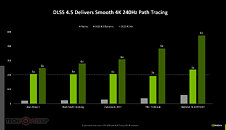 Finally, the MFG 6x mode and Dynamic MFG will be exclusive to NVIDIA's GeForce RTX 50-Series "Blackwell," which uses hardware flip-metering that is only available on the newest GPU generation. While the regular DLSS 4.5 super resolution technology, based on the second-generation Transformer, is already available for over 400 games, it is only a visual makeover without any performance boost. For Dynamic MFG and MFX 6x mode, gamers will have to wait until April. For comparison, Intel's latest XeSS 3 can only draw up to 3 frames for every rendered frame, making it only a 4x improvement over the standard FPS increase. AMD, on the other hand, has no comparable technology as of now.
Source:
HardwareLuxx
However, for setups where a monitor is maxed out at 240 Hz or 144 Hz, like many gaming panels are, using 6x MFG would be overkill. This is where Dynamic MFG comes into play. This technology will determine which MFG multiplier is needed based on the display's refresh rate capability that is used for the MFG target and the input framerate from the upscaler. The company calls this "automatic transmission" for MFG, making a parallel to modern vehicle automatic transmission systems that also switch gears based on the need. For example, in demanding game scenarios, the MFG multiplier could be 4x, 5x, or 6x, while less demanding game sections like the settings menu or some static scenes will require only a 2x multiplier to achieve the FPS goal. HardwareLuxx tested this and reported smooth transitions while keeping the FPS stable.


54 Comments on NVIDIA Confirms Dynamic Multi-Frame Generation and 6x Mode Arrive in April
Indie and smaller budget AA titles are more entertaining, IMO.
I want better visual clarity in games with either native and/or upscaling technologies.
I suppose there is comfort in letting a big corporation limit your options so you don’t have the anxiety of choosing. Myself, I prefer choosing what is right for me.
The 6x means more potential power saving when needed too.
20 --> 120 FPS on a gaming desktop isn't the point.
Dynamic FG means it will use the LOWEST multiplier it can, while maintaining the desired FPS.
Overall, it's good news for games that show a wide spread from min to max FPS, and user with very high refresh monitors.
I don't understand why 6x FG really such a butt-hurty subject for some people?
Notice they stopped hating on upscaling now that AMD has a decent implementation.
But I'm not seeing this benefiting gaming. Its more like a crutch to keep gaming with some semblance of performance. Latency, nah. They're just slowly easing you into that. First you got DLSS and RT that added a few ms. Then you got FGx2. Then x4. Now x6. You turn on Reflex and you think you're back with the cool guys. And now you're in so deep into the Nvidia featurefuck, you can't get out anymore, and you'll defend that next release of theirs with 20 odd missing ROPs, a shitty power plug and weak quality control overall plus degradation in driver quality because, yeah, you NEED THEM.
Or you're already out of liquid to actually buy an Nvidia GPU and you sub to NOW, so now you're in the crowd of own nothing and be happy, all you can pray for is the service doesn't turn to shit like it does already, limiting your playtime.No I still hate it, because we need it to get those shitty UE5 graphics to be playable.
You can't possibly be looking at the state of 'on the graphics edge' gaming and say things are going well. Did we get ANY further than we were 10 years ago? Not in frames... And ever more often not in looks either.
It's like saying that the Toyota Camry is slow, and someone responding "yes, but if I was driving a Ferrari..." Well, of course... :rolleyes:Again, I was comparing FG on vs off on the same hardware. Don't compare apples to oranges, please.When I tried FG in The Talos Principle 2, the controls in a normal 60 FPS actually felt more responsive and direct than in a generated 100.It's not a butt hurt topic. I'm trying to understand the reasoning behind it.There is no decent implementation.It amuses me how you fail to understand my point or question every single time. :(
I'm trying to understand the technology and why it exists. This is not a red vs green war.
You’ve had years to understand the technology. It’s just that your team is losing and you are looking for a means to fight back about it.
Of course, I don't begrudge anybody genuinely disliking this tech or not using it. It's just I have a strong feeling that a vast majority of people who complain about it either haven't tried it at all, and just parrot what Steve et al says, or are trying it on underpowered rigs. The former is a kind of a standard for outrage larping these days on the web, and applies to many things, including game reviews and so on.
Pick any game you would like. State specifically what you would do to optimize it. Provide technical details, such as incorrect API usage, inefficient memory management, or just plain bad coding practices (such as overuse of UE blueprints).
Do you need a link to the UE source on GitHub? Please provide examples of how UE can be optimized.
In the meantime I’ll be enjoying my ability to play games the way I want to, not being told by my hardware vendor of choice what software features I’m allowed to have.
I must have misunderstood you again. I’ll fix that so I won’t misunderstand your posts anymore.
Please enjoy your games also.
'Cause based on what I've seen with normal FG, I don't see how this is beneficial in any way.
I personally still play older games from my childhood, or retro style Indie.
Latency is also a thing you get used to. I can understand that people perceive a decent experience if they have been knee deep in console port/UE5/RT/upscaler territory. They will soon be telling the world how they can stream their games just fine, as they barely perceive a difference from their local gaming.
Nudge.. nudge...and the Lemmings slowly inch towards the cliff.
[INDENT]If they are previous frames based predictions, then every time player turns to other direction generated frames keep turning to wrong direction and when actual new real frame rendered from player's input comes, there's going to be some lag and especially "rubber banding"/sudden jerk/judder what ever you want to call it.[/INDENT]
[INDENT]Only way to avoid those total errors is buffering one frame waiting for next to have two real frames to interpolate frames in between them. But that's going to cause lots of lag.[/INDENT]
So until time machine is invented to fetch that next real frame from the future, there's just no way to get this working without problems in one or another.
Especially in faster action games where frame rate and smoothness really matters for the immersion.
Slow paced games in which erroneous frames wouldn't be visible again aren't sensitive to frame rate in the first place as long as it stays above slide show.
In comparison upscaling is scientifically well researched subject, and if hardware isn't capable to rendering at higher resolution, able to give some real benefit without downsides.
But even that should be considered stop gap solution and not reason to stop pushing actual hardware performance forward.