Thursday, February 5th 2026

NVIDIA Confirms Dynamic Multi-Frame Generation and 6x Mode Arrive in April
According to HardwareLuxx, NVIDIA has confirmed that Dynamic Multi Frame Generation (MFG) and Multi Frame Generation 6x mode are scheduled for release in April. HardwareLuxx visited NVIDIA's Munich office in Germany and obtained some exclusive information from the company. This includes the exact release date for NVIDIA's latest Dynamic Multi Frame Generation and Multi Frame Generation 6x mode, which are bringing NVIDIA DLSS 4.5 technologies to the public. With DLSS 4.5, NVIDIA can get the GPU to draw up to 5 frames following each traditionally rendered frame, made entirely using generative AI. Using the new MFG 6x mode results in a 6x performance uplift, where a game that traditionally runs at 60 FPS can now run at 360 FPS.
However, for setups where a monitor is maxed out at 240 Hz or 144 Hz, like many gaming panels are, using 6x MFG would be overkill. This is where Dynamic MFG comes into play. This technology will determine which MFG multiplier is needed based on the display's refresh rate capability that is used for the MFG target and the input framerate from the upscaler. The company calls this "automatic transmission" for MFG, making a parallel to modern vehicle automatic transmission systems that also switch gears based on the need. For example, in demanding game scenarios, the MFG multiplier could be 4x, 5x, or 6x, while less demanding game sections like the settings menu or some static scenes will require only a 2x multiplier to achieve the FPS goal. HardwareLuxx tested this and reported smooth transitions while keeping the FPS stable.
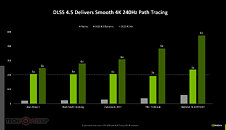 Finally, the MFG 6x mode and Dynamic MFG will be exclusive to NVIDIA's GeForce RTX 50-Series "Blackwell," which uses hardware flip-metering that is only available on the newest GPU generation. While the regular DLSS 4.5 super resolution technology, based on the second-generation Transformer, is already available for over 400 games, it is only a visual makeover without any performance boost. For Dynamic MFG and MFX 6x mode, gamers will have to wait until April. For comparison, Intel's latest XeSS 3 can only draw up to 3 frames for every rendered frame, making it only a 4x improvement over the standard FPS increase. AMD, on the other hand, has no comparable technology as of now.
Source:
HardwareLuxx
However, for setups where a monitor is maxed out at 240 Hz or 144 Hz, like many gaming panels are, using 6x MFG would be overkill. This is where Dynamic MFG comes into play. This technology will determine which MFG multiplier is needed based on the display's refresh rate capability that is used for the MFG target and the input framerate from the upscaler. The company calls this "automatic transmission" for MFG, making a parallel to modern vehicle automatic transmission systems that also switch gears based on the need. For example, in demanding game scenarios, the MFG multiplier could be 4x, 5x, or 6x, while less demanding game sections like the settings menu or some static scenes will require only a 2x multiplier to achieve the FPS goal. HardwareLuxx tested this and reported smooth transitions while keeping the FPS stable.


54 Comments on NVIDIA Confirms Dynamic Multi-Frame Generation and 6x Mode Arrive in April
This is not true for 90% of people playing. Unless you have enough headroom to spare to allow you to render the game and run framegen, you inevitably loose base FPS. For most people it will be a 15-30% loss, so if you run at 60 you'll be looking at around 280FPS output