Thursday, February 5th 2026

NVIDIA Confirms Dynamic Multi-Frame Generation and 6x Mode Arrive in April
According to HardwareLuxx, NVIDIA has confirmed that Dynamic Multi Frame Generation (MFG) and Multi Frame Generation 6x mode are scheduled for release in April. HardwareLuxx visited NVIDIA's Munich office in Germany and obtained some exclusive information from the company. This includes the exact release date for NVIDIA's latest Dynamic Multi Frame Generation and Multi Frame Generation 6x mode, which are bringing NVIDIA DLSS 4.5 technologies to the public. With DLSS 4.5, NVIDIA can get the GPU to draw up to 5 frames following each traditionally rendered frame, made entirely using generative AI. Using the new MFG 6x mode results in a 6x performance uplift, where a game that traditionally runs at 60 FPS can now run at 360 FPS.
However, for setups where a monitor is maxed out at 240 Hz or 144 Hz, like many gaming panels are, using 6x MFG would be overkill. This is where Dynamic MFG comes into play. This technology will determine which MFG multiplier is needed based on the display's refresh rate capability that is used for the MFG target and the input framerate from the upscaler. The company calls this "automatic transmission" for MFG, making a parallel to modern vehicle automatic transmission systems that also switch gears based on the need. For example, in demanding game scenarios, the MFG multiplier could be 4x, 5x, or 6x, while less demanding game sections like the settings menu or some static scenes will require only a 2x multiplier to achieve the FPS goal. HardwareLuxx tested this and reported smooth transitions while keeping the FPS stable.
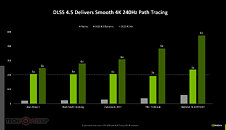 Finally, the MFG 6x mode and Dynamic MFG will be exclusive to NVIDIA's GeForce RTX 50-Series "Blackwell," which uses hardware flip-metering that is only available on the newest GPU generation. While the regular DLSS 4.5 super resolution technology, based on the second-generation Transformer, is already available for over 400 games, it is only a visual makeover without any performance boost. For Dynamic MFG and MFX 6x mode, gamers will have to wait until April. For comparison, Intel's latest XeSS 3 can only draw up to 3 frames for every rendered frame, making it only a 4x improvement over the standard FPS increase. AMD, on the other hand, has no comparable technology as of now.
Source:
HardwareLuxx
However, for setups where a monitor is maxed out at 240 Hz or 144 Hz, like many gaming panels are, using 6x MFG would be overkill. This is where Dynamic MFG comes into play. This technology will determine which MFG multiplier is needed based on the display's refresh rate capability that is used for the MFG target and the input framerate from the upscaler. The company calls this "automatic transmission" for MFG, making a parallel to modern vehicle automatic transmission systems that also switch gears based on the need. For example, in demanding game scenarios, the MFG multiplier could be 4x, 5x, or 6x, while less demanding game sections like the settings menu or some static scenes will require only a 2x multiplier to achieve the FPS goal. HardwareLuxx tested this and reported smooth transitions while keeping the FPS stable.


54 Comments on NVIDIA Confirms Dynamic Multi-Frame Generation and 6x Mode Arrive in April
😛
I personally have not had any issues with multi frame gen though, it has made games look much smoother. Expedition 33 is the one I enabled it in most recently.
it's here to stay whether we like it or not, too many games use it and will continue to use it
As for the OP, yeah, 6x is an overkill - I personally have yet to go past 2x - but it's just an option. Nobody is forced to use it. Adaptive FG could be interesting, though I’m usually wary of adaptive things ("adaptive resolution", ugh).
Makes everything feel weird sometimes, out of sync.
You know a feature that they don't care about and yet too bothered by, so much so they can't stop commenting about it. :rolleyes:
Technically speaking, I don't see how more generated frames could alleviate issues inherently present in frame generation as a technology.
Let's all just embrace something being constantly shoved in our faces that causes more input lag, then I may as well game on a console with a controller. When a company constantly waves a feature in everyones faces telling you how great it is like you're getting "free performance", maybe it's really not so amazing. IMO, if it was worth using then perhaps the feature would be better to stand on its own benefit than getting waved around as the best thing ever.
I also don't like lag and wouldn't play aforementioned titles if it was high. This is one of the reasons I upgraded from 4070 to a higher end machines, because on paper the performance in 4K is not far off using FG, but in reality feels completely different.
Also, lag is a different matter. People can get it from other sources such as laggy wireless pads, monitors, or TVs, and yet it seems to be only complained about when the topic is FG. Wonder why...
I see Hecate91 just popped in, offering even more FUD. Oh dear :)
Some people are not as affected by this MFG "trick" but I am not one of them, and I am less than amused.
Maybe I am thinking of DLSS on.
Reflex & Anti lag 2 are much bigger contributors to overall latency. Reflex + FG gives better latency than no Reflex for example. It varies from game to game but some games have better latency with Reflex at 45-50 fps than 80 fps with no Reflex.
Most people overestimate how much they really notice latency. You say you care about latency but you own AMD. That's a contradiction imo. You're already getting worse latency than people on Nvidia who use FG as Reflex support is in the majority of AAA games while almost no game supports Anti Lag 2.
You feel fine with AMD latencywise, right? That means you wouldn't care about the latency from FG either. In some games someone with 100 fps FG would be getting better latency than you at 65-70fps. Reflex no FG vs Reflex with FG is the only real valid comparison where people can complain about latency. And like I said most people aren't that sensitive to latency. People say they are but it's like how everyone says they're an above average driver.
at least this has been my experience. techspot did review of it one time and I think latency beats Native sometimes with reflex+boost
This is the turd thats mixed in with some good stuff they do, taking the rough with the smooth.
Me running away from this bullshit era of gaming hardware.