Monday, February 9th 2026

Intel 900-series Desktop Motherboard Chipset Specs Leak
Toward the end of 2026, Intel will debut its next generation Core Ultra Series 4 "Nova Lake-S" desktop processors, introducing new CPU core IP and a significant uplift in CPU core counts, besides special SKUs with large L3 caches to take the fight to AMD's X3D processors with 3D V-Cache. Much has been reported on the processors, but not much about the platform and chipsets, until Jaykihn dropped a new leak. We are now hearing that Intel could take a similar approach to AMD in differentiating its desktop chipsets, with two enthusiast-segment chipset models, and a mainstream model, besides the usual chipset models for commercial desktop and workstation segments.
This approach would see the introduction of the new Z970 chipset positioned a notch below the flagship Z990 chipset that succeeds the current Z890. There will not be an "H970," as Intel has seen consistently low demand for such a chipset, and there's no "H870" in the current generation. The Intel 900-series "Nova Point" chipset family will begin with the B960 mainstream chipset succeeding the current B860. Positioned above this will be the new Z970, offering enthusiast features such as multiplier-unlocked CPU overclocking when paired with K-series processor models. Above this, is the flagship Z990 with significantly more platform I/O features. The Q970 will be the commercial desktop chipset from this generation, while W980 will cater to workstation platforms powering Xeon W-series processors based on "Nova Lake-S."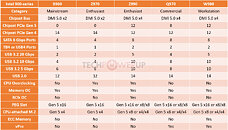 The B960 and Z970 will share a PCH silicon that's physically smaller the one powering the Z990, W980, and Q970. The B960 and Z970 share a mostly identical feature-set, except for the Z970 supporting multiplier-based CPU overclocking. This smaller common silicon has a DMI Gen 5 x2 chipset bus, with bandwidth resembling DMI 4.0 x4 for the current B860, which is 64 Gbps per direction. The chipset puts out 14 downstream PCI-Express 4.0 lanes, and no PCI-Express 5.0 downstream lanes. It's also configured to provide at least one 40 Gbps USB4 or Thunderbolt 4 port from the processor. On B960 and Z970 motherboards, the processor will put out one PCI-Express 5.0 x16 slot, and one M.2 Gen 5 x4 slot, the other CPU-attached slot will be limited to Gen 4, or freed up for onboard devices.
The Z990 is a significant step up from the Z970. For starters, the DMI chipset bus bandwidth is doubled to 128 Gbps per direction, as it implements DMI 5.0 x4, or bandwidth comparable to the current DMI 4.0 x8 of the Z890. The new Z990, along with Q970 and W980, will be the first desktop chipsets to put out PCIe Gen 5 downstream platform lanes. The Z990 and W980 put out 12 Gen 5 and 12 Gen 4 PCIe lanes. The Q970 does 8 Gen 5 and 12 Gen 4 lanes. These three higher chipset models offer two 40 Gbps USB4 or Thunderbolt 4 ports from the CPU. The PCI-Express 5.0 x16 PEG slot from the processor is allowed to be segmented to x8/x8 or other combinations using lane switches. Both CPU-attached M.2 NVMe slots are allowed to be configured as Gen 5. The Z990 supports multiplier-based and BClk-based CPU overclocking, while the Q970 and W980 lack this. The Q970 and W980 support vPro remote management features that the Z990 lacks.
Source:
Jaykihn (Twitter)
This approach would see the introduction of the new Z970 chipset positioned a notch below the flagship Z990 chipset that succeeds the current Z890. There will not be an "H970," as Intel has seen consistently low demand for such a chipset, and there's no "H870" in the current generation. The Intel 900-series "Nova Point" chipset family will begin with the B960 mainstream chipset succeeding the current B860. Positioned above this will be the new Z970, offering enthusiast features such as multiplier-unlocked CPU overclocking when paired with K-series processor models. Above this, is the flagship Z990 with significantly more platform I/O features. The Q970 will be the commercial desktop chipset from this generation, while W980 will cater to workstation platforms powering Xeon W-series processors based on "Nova Lake-S."

The Z990 is a significant step up from the Z970. For starters, the DMI chipset bus bandwidth is doubled to 128 Gbps per direction, as it implements DMI 5.0 x4, or bandwidth comparable to the current DMI 4.0 x8 of the Z890. The new Z990, along with Q970 and W980, will be the first desktop chipsets to put out PCIe Gen 5 downstream platform lanes. The Z990 and W980 put out 12 Gen 5 and 12 Gen 4 PCIe lanes. The Q970 does 8 Gen 5 and 12 Gen 4 lanes. These three higher chipset models offer two 40 Gbps USB4 or Thunderbolt 4 ports from the CPU. The PCI-Express 5.0 x16 PEG slot from the processor is allowed to be segmented to x8/x8 or other combinations using lane switches. Both CPU-attached M.2 NVMe slots are allowed to be configured as Gen 5. The Z990 supports multiplier-based and BClk-based CPU overclocking, while the Q970 and W980 lack this. The Q970 and W980 support vPro remote management features that the Z990 lacks.
17 Comments on Intel 900-series Desktop Motherboard Chipset Specs Leak
To be fair, AMD is doing the same with the 800 series chipsets where for example what was the 650E chipset it is now called 870 chipset, meaning AMD replaces the 5 with a 7 to make it look higher end.
- DDR5 or DDR6?
At least we are starting to see more more WXXX motherboards, sounds good for Workstations, instead of using ZXXX.
Maintaining signal integrity for new PCIe version has gotten harder and lot harder in last couple versions and you want to ramp it up further...
And might as well ask for the Moon with all DRAM in short supply and at off the charts bat crazy prices than DDR6.
In other words, previous W motherboards where for core iX, now are for Xeon only.Then there's no reason for me to upgrade until those two technologies appear.
I know the craziness of current DRAM short supply, but that doesn't means are should stay stuck to DDR4, besides, AMD next sock is supposed to be using DDR6DDR6 and PCI express 6, that's when I'm gonna upgrade my current rig (hopefully).
Excuse my ignorance, but What do you mean with 1954 and V1?
Back in the real world thats bonkers, DDR6 would mean requiring new RAM purchase at sky scraper prices, and Gen6 would obviously make boards even more expensive.
Both Nova Lake and Zen6 are going to be DDR5.
And unless AI bubble finally collapses, can't see AMD or Intel wanting to introduce new memory needing platform in hurry, making even memory of next CPUs after those uncertain, or at least time tables.
Any limited new memory stock could simply evaporate faster than water under oxy-acetylene flame instant killing sales of new CPUs. Which would be pain for AMD and Intel and also make motherboard makers real unhappy, leading again to stall in chipset sales.Intel's OCD for swapping sockets as often as socks by either adding some new pins or pulling out one or two pins from existing socket.