Friday, February 13th 2026

Micron 9650 PCIe Gen 6 SSDs Enters Mass Production
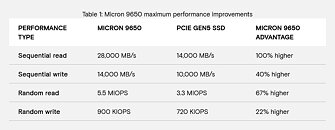
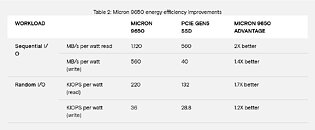
Micron announced its 9650 NVMe SSD has entered mass production, making it the first PCIe Gen 6 data center drive to reach this milestone. The series was first unveiled in July 2025, and it features Micron G9 TLC NAND, including Micron designed SSD controller ASIC, DRAM, and Micron produced and validated firmware. The Micron 9650 delivers up to 28 GB/s in sequential reads, double that of PCIe Gen 5 drives. The drive's sequential write speed reaches 14 GB/s, while its random read performance hits 5.5 million IOPS and its random write achieves 900,000 IOPS. These numbers show 100%, 40%, 67%, and 22% gains over Gen 5. At a 25-watt power state, the drive offers double the performance of PCIe Gen 5 options. It has a sequential read efficiency of 1,120 MB/s per watt (2× better than Gen 5), and its sequential write efficiency is 560 MB/s per watt (1.4 times better). The random read efficiency stands at 220 KIOPS per watt (1.7 times higher) and random write at 36 KIOPS per watt (1.2 times improved).
The Micron 9650 supports both air-cooled and liquid-cooled configurations to handle higher performance densities in modern data centers. Micron conducted 18 months of interoperability testing across the PCIe Gen 6 ecosystem, including validation with high-port switches, retimers, and demonstrations at industry events. The drive is now being qualified by OEM and AI data center customers for deployment in AI training and inference workloads, particularly those requiring high-throughput data access for large language models and retrieval-augmented generation pipelines. The Micron 9650 is available in E1.S and E3.S form factors with E1.S available for liquid cooling.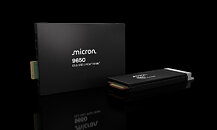
Source:
Micron blog
The Micron 9650 supports both air-cooled and liquid-cooled configurations to handle higher performance densities in modern data centers. Micron conducted 18 months of interoperability testing across the PCIe Gen 6 ecosystem, including validation with high-port switches, retimers, and demonstrations at industry events. The drive is now being qualified by OEM and AI data center customers for deployment in AI training and inference workloads, particularly those requiring high-throughput data access for large language models and retrieval-augmented generation pipelines. The Micron 9650 is available in E1.S and E3.S form factors with E1.S available for liquid cooling.


48 Comments on Micron 9650 PCIe Gen 6 SSDs Enters Mass Production
but for ordinary computer users a simple heatsink is fine, you aren't reading/writing 24/7 at full speed
Sandisk dashboard only shows 1 temp which look like it was based of either the 1st or 3rd
update: sadly only has the one but I don't think I'll worry too much.
There currently isnt any motherboards on the consumer market that can use gen 6. On top of that. It most definitely isnt worth the money. going from Gen 5 to 6 when going from 4 to 5 is already a little bit questionable depending on your usage case.
These are just passively cooled. Some airflow, not a lot.There will be a return to normalcy at some point and when it happens gen6 drives will be some of the most thermally insane and worn NAND getting dumped to 2nd hand markets.
New batches will be extremely fast (and expensive) but the capacities should also go up just enough to make HDD prices crash again. This is just a hobby but I like to see opportunity.Sooooo that thing that me and every engineer out there keeps screeching about when arguing with designers is the thermal envelope of these products and "acceptable" quality.
On most modern chips 15W passive cooled is a big no. It needs airflow. Not a lot, just some airflow.
On older chips, 20W passive needs a moderate heatsink with airflow. My one network card in this area, the NC523SFP will still burn you on a good day.
The chip is a chonker but those things shipped without a fan. It's purposed for high density racks where the cooling solution is already arranged for it.
Even in custom low noise medium flow racks like mine it's not enough. 25W is pushing it to where active/custom cooling is a must and for us that means water.
Good luck nobody. The doomer screeching was correct.
You better have big honkin chonkin redundant power systems and FULLY loaded lanes for that.
Yes those loadouts are for absolute 8x GPU accelerator maxxing but my ears are too big for that.
I do my best to gravitate to 1-2U solutions only and cram everything into a 10-12U open frame.
Yes I know the engineers and admins will tell you to fill it ceiling high. I don't operate that way.
I'm compact footprint. If I need 2+ GPU accelerators for long term service, first of all no I don't.
That's a sign it's time to make it someone else's problem. My bias is: storage, memory and CPU.
From there it's cooling, general software and then all the specialty acceleration you'll never need.Yeah F that. Do yourself a favor and value your ears. Those of us with homelab or whatever know better.
Retired racks are cool but the noise isn't. It's also awful how useless many servers become once EOL.
Be aware of what you're getting into before you get into it.
Sounds like vaporware to me.