Thursday, February 19th 2026

NVIDIA GeForce RTX 5090 Melts 12V-2×6 Connector Despite -100 W Power Limit
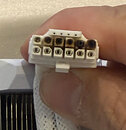
The melting and burning 12V-2×6 connectors on high-end NVIDIA—and some AMD—GPUs is well documented at this point, and although there is mounting evidence to support the fact that the new connector standard itself is partially to blame, there is still the idea that high power draw is to blame for these meltdowns. This is not necessarily the case, according to one user of the Mobile01 forum. According to the forum post about the incident, the top row of pins in a Gigabyte Aorus Master Ice RTX 5090's GPU power connector has melted down, despite the user having implemented a steep undervolt and power limit.
When installed, the user had limited GPU power to 500 W and dropped the voltage limit down to 0.9 v—that's a reduction of 100 W and 0.205 v compared to stock settings. It's worth noting that the GPU in question was connected to the PSU using a 16-pin adaptor, and the connector melted at the GPU side, not the PSU side, and the first indication of the meltdown was frequent crashing during gaming sessions. Both connector ends at the GPU side seem to be affected, but it's entirely possible that the GPU would have suffered even more damage had the power limit been higher. Currently, independent research seems to indicate that the 12V-2×6 cable itself seems to suffer from an unstable or inadequate connection, which increases the current and temperature across individual pins. Unofficial adaptors also seem to exaggerate these contact issues.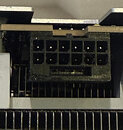

Source:
Mobile01 forum
When installed, the user had limited GPU power to 500 W and dropped the voltage limit down to 0.9 v—that's a reduction of 100 W and 0.205 v compared to stock settings. It's worth noting that the GPU in question was connected to the PSU using a 16-pin adaptor, and the connector melted at the GPU side, not the PSU side, and the first indication of the meltdown was frequent crashing during gaming sessions. Both connector ends at the GPU side seem to be affected, but it's entirely possible that the GPU would have suffered even more damage had the power limit been higher. Currently, independent research seems to indicate that the 12V-2×6 cable itself seems to suffer from an unstable or inadequate connection, which increases the current and temperature across individual pins. Unofficial adaptors also seem to exaggerate these contact issues.


133 Comments on NVIDIA GeForce RTX 5090 Melts 12V-2×6 Connector Despite -100 W Power Limit
The 12V-2×6 Connector is GREAT for the Economy!
Ask all the GPU-Repair-Shops, who are drowning in GPUs, who need a repair due to a melted Connector!
Without the 12V-2×6 Connector, they would make it poorly, if at all.
So support the Economy, support the 12V-2×6 Connector!
Nvidia most likely tying to control the blame on the 'cables' and never admit problems on their electrical design.
And keep honoring the warranty claims on the burnt cards.
Then silently roll out load-balancing designs back in the next-gen GPUs.
The cables and pins of the connector are rated for 10A each, which is 120W, but they could handle 150W.
Any more then that, there is the risk of heating up to a point that is melts.
The problem is that differences in the resistance makes the power flow unevenly through the connector. And there is no safety machanism like loadbalancing that prevents more then 150W going through one cable.
I use a 5090 atm with undervolting and a 70% powerlimit, which is 402,5W. I can't set the PL lower, but the PL is not even used, because my 5090 uses 350W or less in games.
It is powerlimited only when doing benchmarks.
I've been using the 12VHPWR for 3 years on 3 different cards (4090,5080,5090) now. Never had a problem.
A: I believe an 8pin is rated for 150Watts, but could go beyond apparently... So since 5090 can consume over 600W, still not enough even if accounting for the 75W PCIe slot.
B: More cost in copper for the wires.
C: 3x8pin takes up more space on the PCB to have the 3 connectors.
D: More cables to plug in and room for error. But... would still be fine if people leave some unplugged, wasn't causing fires? Plugged in a 6pin or 4pin and not the full 8pin.
E: Having 3x 8pin or more blocks air flow coming out of the metal fins air is being pushed through? People do be liking braided cables that have more air resistance.
F: I know the lower powered cards can have less 6/8 pin connectors. But does high-end to enthusiast community want 4x 8pin connectors...? I know it prefers the 6/8 pin because it works, but does it want 4x 8pin connectors?There is a the 4 sense pins. So the "safety measure" is there, but still can be making contact but still not plugged in all the way. Useless if...... they use the adapters! I thought the RTX 50 Series would drop giving adapters with cards, but maybe it will be the RTX 60 Series.But emphasis on thick. Do you want your case to be wider/larger in order to make that bend? Cable management becomes impossible. Guess better build those thick cables into the case to work. Or put the connector on the motherboard side of the graphics card and angle it down instead? I want that to happen, cleaner looking. But people like their colored cables, cable combs, and RGB strips on the cables.applause That's what I've been saying!
Still looking for a burnt connector report where they use a PCIe 5.1/ATX 3.1 PSU and uses cables that came with PSU, not adapters or older PSUs.
| would like to mention here that JTC also showed how a brand new 12v-2x6 cable connector had pushed in clasps. Which is my theory why this burning is happening, semi or no contact between pin and clasps. Or as we already now from SIG that these connectors rated for like only 15 or 30 unplug/plug cycles. I'm thinking the clasps are just getting pushed in each time from poor manufacturing tolerances or the connector's durability. I'd imagine in most cases people plug in their card and plug in the 12v-2x6 once, but maybe they sell that GPU, that's another plug. Or people take out the GPU to work on assembling other parts, need to get at the m.2 slot they forgot to plug their m.2 drive into. Plugged their GPU into the wrong PCIe slot. I've switched cases a lot before, so there's those times of disassembles and reassembles. Sometimes people move and they don't want that heavy card to snap the PCIe connector, so they take out the GPU. Or someone's going to sell their card so they take it out to take pictures and put it back in to keep using. Or someone plugs in the 12v-2x6 just see how the mechanism works first before plugging into their computer. Or people route their 12v-2x6 cable wrong and causes another cycle.
12vhpwr had a 14 mm long male plug, paired with 12x16AWG wires and with a huge recommended bending distance of 35mm away from the connector and bending radius of 10mm, So it is 59mm in total.
If strict safety regulations are followed,
The much safer XT90 solution actually takes LESS vertical space than the 12vhpwr solution.
And the XT90 solution only needs 2 wires, that makes it infinitly more clean, tidy, and easy to manage.
Safety regulators need to enforce a change to something better, load balancing and thermal sensors need to be part of a standard if Nvidia wants to have a form over function single connector.
But sadly a change probably wouldn't happen unless someone gets seriously injured or has significant fire damage because of this connector.Of course they're deliberately derailing the thread, people have to bring in false equivalencies and whataboutisms into the thread, because they don't dare criticize their knight in shining leather.
If AM5 was a problem like 12vhpwr then we'd be seeing AM5 CPU's blow up in higher numbers on every brand of board, but so far the overwheling majority are Asrock boards, with Asrock still not saying why their motherboards have higher failure rates.A- Molex 8 pin is capable of 250W as a safety margin, 3x 8 pins would work but is above the rating.
Although maybe we shouldn't have GPU's chugging down 600W in the first place. Or GPU's need to be powered by 8 pin EPS.
B- Oh no a few cents more in copper when these GPU's cost $2-3k, and because putting them at risk with with tiny wires on a single connector was a great idea.
C- More PCB space isn't an issue with AIB cards, some even have solder pads for another 16 pin connector.
D- Many GPU's with 8 pins won't power on if a plug isn't inserted all the way, I fail to see why this isn't a requirement with 12vhwpr.
E- I'll take air flow being slightly blocked over the melting risk.
F- IMO, the high end community needs to learn that computers have wires, not everything has to be an RGB with screens on everything light show in a fishtank case.So how is every user supposed to know they can't use the included adapter?
It's funny because people were saying only use an adapter included with the GPU, and now the goalposts have moved to all adapters are bad, just buy a new PSU with your GPU every time.The 12vhwpr cable is already thick and can't be bent in order to maintain full connection and pin contact, I'd rather have 2 thicker cables being easier to manage than 1 thick cable that can't be bent to fit into smaller cases.Again how are people supposed to know the adapter isn't supposed to be used when it comes with the GPU?
Adapters weren't an issue with 8 pins unless using the most cheap random garbage.
All power comes from a single source (single-rail PSU) and goes into a single source (single powerplane on GPU). And the connection between those single sources is split up into 6 wires without any current protection.
In my case, I have a ATX 2.42 SF750 PSU from Corsair. It is special case, because the 8-Pin on the PSU-side deliver 300W (even before the 12VHPWR was on the market). So the 3x12V lines from the 8-Pin are combined with another 8-Pin into a 600W 12VHPWR with 6x12V lines. It is as native as it can get, my adapter cable has only 12 wires (6x12V, 6x ground) + 2 sense wires (2 sense pins are unused).The specs vary widely... some say 40A continuous, some say 90A. Also 8AWG to 12AWG, which is also a big range. The 12VHPWR needs 50A btw.
And it also gets quite warm, warmer then the 12VHPWR (if it works how it supposed to).
The cables 8 and 10AWG, which is 5-7 times the thickness of the 16AWG the 12VHPWR uses. You can't bend 8-10AWG in tight spaces... There is a difference between several cables bundled togather and a single thick one...
And yet somebody defends that solution?
Incredible...
It is poor engineering from any point of view...
Anecdotally, when researching this particular card to see if the OP used the OEM splitter, I happened across 2 store reviews (Amazon and Best Buy) were the customer claimed the connector burned up, providing similar pictures of white, melted splitter cables. I know that doesn’t equal a lot of evidence, but I also wasn’t even looking for it. I just wanted to see what the OEM splitter looked like.
XT90's limit is 72V 90A, a continuous 12V 50A is a piece of cake for XT90.
For the wire thickness,
XT90 only needs 2 wires, 12VHPWR needs 12, that adds up.
And bending,
Official 12VHPWR spec says you need 35mm away from the connector body before you start ANY bending.
I won't say XT90 is the only solution
But Nvidia should create their new connector based on the same principle.
Less, but thicker pins/wires
If they really want the style of 'several cables bundled together',
They could build an enlarged 6-Pin connector with 12AWG wires and the problem goes away.
or
Fix their faulty electrical design.
It is bad design and that is it. Unsafe by default. Hell, you would get fired as electrical engineer if you suggested this kind of design anywhere...