Thursday, February 19th 2026

NVIDIA GeForce RTX 5090 Melts 12V-2×6 Connector Despite -100 W Power Limit
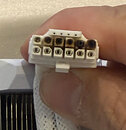
The melting and burning 12V-2×6 connectors on high-end NVIDIA—and some AMD—GPUs is well documented at this point, and although there is mounting evidence to support the fact that the new connector standard itself is partially to blame, there is still the idea that high power draw is to blame for these meltdowns. This is not necessarily the case, according to one user of the Mobile01 forum. According to the forum post about the incident, the top row of pins in a Gigabyte Aorus Master Ice RTX 5090's GPU power connector has melted down, despite the user having implemented a steep undervolt and power limit.
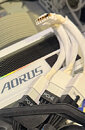
When installed, the user had limited GPU power to 500 W and dropped the voltage limit down to 0.9 v—that's a reduction of 100 W and 0.205 v compared to stock settings. It's worth noting that the GPU in question was connected to the PSU using a 16-pin adaptor, and the connector melted at the GPU side, not the PSU side, and the first indication of the meltdown was frequent crashing during gaming sessions. Both connector ends at the GPU side seem to be affected, but it's entirely possible that the GPU would have suffered even more damage had the power limit been higher. Currently, independent research seems to indicate that the 12V-2×6 cable itself seems to suffer from an unstable or inadequate connection, which increases the current and temperature across individual pins. Unofficial adaptors also seem to exaggerate these contact issues.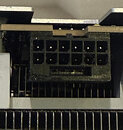
Source:
Mobile01 forum
When installed, the user had limited GPU power to 500 W and dropped the voltage limit down to 0.9 v—that's a reduction of 100 W and 0.205 v compared to stock settings. It's worth noting that the GPU in question was connected to the PSU using a 16-pin adaptor, and the connector melted at the GPU side, not the PSU side, and the first indication of the meltdown was frequent crashing during gaming sessions. Both connector ends at the GPU side seem to be affected, but it's entirely possible that the GPU would have suffered even more damage had the power limit been higher. Currently, independent research seems to indicate that the 12V-2×6 cable itself seems to suffer from an unstable or inadequate connection, which increases the current and temperature across individual pins. Unofficial adaptors also seem to exaggerate these contact issues.


133 Comments on NVIDIA GeForce RTX 5090 Melts 12V-2×6 Connector Despite -100 W Power Limit
Let me remind you of the WHOLE 12VHPWR problem.
There is no load balancing between the 6x12V lines of the 12VHPWR and the powerplane of the GPU.
Old cards with 8-Pins had load balancing for EACH 8-Pin. (usually no more then 150W per 8-Pin)
The 3090Ti has load balanced the 12VHPWR into 3 sections with 2 wires each. (also 150W between 2 wires, I haven't heard of a melted 3090TI)
RTX4000, RTX5000 and some 9070XTs with 12VHPWR have NO load balancing, that is why they melt.
If you use more then 1x XT90, you also need loadbalancing or they WILL suffer the same fate as the 12VHPWR.
So the solution is NOT to introduce a new connector, but to load balance the 12VHPWR like on the 3090TI. Then all problems will be fixed.
The ONLY thing does that is the third party adapter "Ampinel" of the german company Aquacomputer.
On 300w gpu's you'd be correct though.
Is usage of adapters forbidden by them?
If answer on both question is no, then it is obvious whose fault it is.
Regardless of those two question, moving such wattage through several lines without load balancing is act of madness.
But they're not. Which is at the least implicit consent to use adapters with the connector. And the thing with the adapters is they're usually a couple of bits of copper wire wrapped in plastic. It's not rocket science, yes there can be variations in copper quality and what-not but the fact of the matter is something that simple shouldn't be catching fire so frequently.
The common denominator is the 12VHPWR connector itself. And it should be engineered in such a way that it can tolerate non-optimal scenarios like adapters, older PSUs etc.
It has to be repeated: we rarely see this issue with 8-pin and it is FAR more widespread.
Problem is that sometimes it can be loose crimping on the wire, lower gauge wire, lesser quality metals used so they get hotter due to resistances etc.. Trying to make it nicer and neater is one thing but when you have to handle so much current, especially peak current, I wouldn't care if the connector was ugly so long as it was beefy and impossible to melt!
Its an 8-Pin with 4x12V and 4x ground, it is rated for 300W.
That EPS12V has been used for GPUs in servers for a long time, but never for consumer GPUs.
On my Corsair PSU SF750 the EPS12V and PCIe 8-Pins use the same Type4 connector. The 8-Pins are then daisychained to 2x150W.
My Corsair 12VHPWR Adapter uses 2x of those 8-Pin connectors on the PSU side for 1x 12VHPWR. It is actually as native as it can be.
So its not like it doesn't exist in some form...
The pins are very small for such an amount of power, and with the downward force applied, if the pins do not fit very tightly, you create a resistance and then temperature rises. This is basic electricity engineering.
And what about transients, when current reaches above 600w? For a short amount of time, sure, but if it is repeated the connector gradually heats up and then, this happens.
Anyway, if it happens, it just means that it is not strong enough for this amount of power. Granted, this is rather rare given the number of graphic cards around, but this should never happen on such an expensive piece of equipment!
We never saw this with classic PCIe connectors, or barely, so, there is definitely a problem with those.
Surely there is no reason to be concerned :D
You do not need to watch the video as the video is very blurry and only 1080p
it s interesting, that guy mention he review bal bla.
I wonder why that person does not know about the novuton initialisation sequence. The fans on ASUS and MSI, the few boards i bought and owned on am4 and am5, always spin the fans on maximum until the boards enter a certain initialisation sequence, from the mentionend novuton chip, which set the fan values.
how many unplug and plug cycles are allowed? Was it not around 20 maximum? for that connector?
That guy annoys me. First no cheap shit camera can focus when you always move the center focus point around like a maniac. Fill in "static smartphone pictures" and fix the connector first with decent light and dark. Such a youtuber should have plenty of "studio lights" with proper light colour etc.
Are you sure you watched the whole video?