Friday, March 6th 2026

NVIDIA Grabs 94% AIB GPU Market Share, AMD Falls to 5%

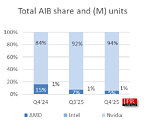
According to a new report from Jon Peddie Research, NVIDIA has once again increased its market share in the AIB GPU sector, reaching 94% in Q4 2025. This marks a 1.6% rise from the previous quarter and sets a new all-time high in recent reports. Meanwhile, AMD's market share has been declining, with a 1.6% decrease that appears to have benefited NVIDIA's partners and their shipments. Overall, JPR records indicate that the AIB GPU market sold 11.5 million units in the final quarter of 2025, a reduction of half a million units from Q3, but a significant 36% increase compared to 8.45 million units in the final quarter of 2024. JPR attributes the slight decline in overall GPU AIB shipments to rising memory prices and tariffs affecting the global supply chain, which have driven up the costs of discrete GPU solutions that use expensive GDDR7 and GDDR6 memory.

Intel's market share in AIB GPU shipments remains steady at around 1%, consistent with its performance in Q3 2025 when the company achieved its first single-digit percentage since launching its Arc "Alchemist" GPUs for gamers. This indicates that Intel's progress is stable, with demand remaining consistent as gamers continue to choose Intel GPUs at the same rate as before. For Intel to break out of the single-digit bracket, the company likely needs more GPU designs, such as the anticipated "Battlemage" B770 graphics card.

Regarding the shifting market share among GPU vendors, the numbers reflect what many gamers are experiencing. For instance, AMD only supports certain technologies like FSR 4 "Redstone" on its latest Radeon RX 9000 series graphics cards, leaving older generations without support. Additionally, RDNA 4 graphics are only competing with NVIDIA in the mid-range sector, with no high-end competition this generation. Intel also faces challenges in the mid-range GPU segment, suggesting that future GPU generations from both companies might alter the market share landscape. For now, NVIDIA remains the dominant force.
Source: JPR
Add your own comment

157 Comments on NVIDIA Grabs 94% AIB GPU Market Share, AMD Falls to 5%

#26
Dr. Dro
DavidC1This is revisionist history. Arc "Alchemist" at one point had 4% share. 1% is a substantial degradation. Although mostly because Alchemist had hype and it died down after driver debacle.
Not necessarily. The market is always growing, and if Intel didn't grow in the same proportion (it hasn't) its relative market share would also decrease. Last report had them at below 1%.

Similarly despite AMD's decrease to 5% - 9000 series' sales are about as healthy as AMD would like them to be. They have sold many cards - just not as many as Nvidia did.
KritNot completely sure about that becouse AI in thoose days is like a pleuge (black death or crypto) too many people are interested in it.
This is a volume survey, not a segment survey. It's everything that AIBs shipped put together.
KritIn 2014 AMD has better market share than now or 28/72 but worse actual products. R9 290X vs GTX 970
Right now 2026 when AMD is closer to nvidia market share is 5/94 RX 9070 XT vs RTX 5070 Ti
The R9 290/X was actually intended to compete with the GTX 780/Ti. For Maxwell, AMD introduced GCN 3 Tonga and Fiji parts, reusing Hawaii to make the Grenada cards that were just memory doubled. GCN 4 (Polaris) is effectively GCN 3 ISA with the addition of a newer display controller and updated geometry engine. It's binary compatible with Tonga overall.

Back then they had many issues with driver quality, but the hardware was indeed top tier and I'd argue better than Nvidia's for gaming overall until Pascal came about.

In compute, though, GCN was on paper heaven and in practice, hell (see meme tweet posted above, residency and scalability problems plus lack of viable standardized runtime)
Posted on Reply
#27
_roman_
GrimlingOnly Nvidia-Slop-Cards in the Future with AI-Slop-generated buggy Drivers?
amd does not work on the drivers. i did not bought a 5th amd card because of the windows driver quality and lack of linux support.

when nvidia has won we have only one driver stack to maintain and check. that is also good news. it's time amd get rid of their gpus in the cpus.

the market share aligns with the bad driver support and not fixing long time bugs on the amd side. dropping driver support and rephrasing less driver support in my personal viewpoint equals no driver support.

intel has too many fail products with bugs. those intel network cards and intel cpu gpu notebooks annoyed me personally too much and too often to consider any intel product again with my own personal money. intel also quite often market technical products and drop them. i think we had optane, some sort of extra fast memory, we had storage and maybe other products which are gone. intel can not keep their motivation on anything. i think they dropped intel cpus with integrated amd gpus also for the mobile market.

--

those 94% shows a quite rate problematic 12 volt high power connector does not matter. people are happy to buy 130€ thermal grizzly and the other company voltage sensors for the nvidia card to have something to measure permanently the currents on that connector.
Posted on Reply
#28
Krit
Dr. DroBack then they had many issues with driver quality, but the hardware was indeed top tier and I'd argue better than Nvidia's for gaming overall until Pascal came about.
Maxwell GTX 970 was better in almost all fronts if compare to R9 290X..... Price, performance, noise, drivers and power consumption. Overall GTX 970 was way better. Nothing like today where AMD more often than not have better drivers and not as huge gap between power consumption. Though only real competitor today is RX 9070 XT because of it's price that's probably the key for AMD market share dive.
Posted on Reply
#29
FR3D1
Ninja Cat
GrimlingOnly Nvidia-Slop-Cards in the Future
NVIDIA delivers the better product. Period! And with Jensen Huang at the helm, it will stay that way.
Grimlingwith AI-Slop-generated buggy Drivers?
So far, Microsoft is the king of the hill when it comes to AI-generated garbage.

With a friendly smile,
Fred.
Posted on Reply
#30
swaaye
I feel like the last time ATI/AMD tried to do something to really claw back marketshare was 2008-2009 with the HD 4850/4870. What a price war that was.

290X did come before GTX 970. Maxwell was just an astonishing improvement in efficiency compared to Kepler and GCN. It looked especially good because they could keep the clocks in a particularly efficient region and still win, unlike with say 290X or GTX 480.
Posted on Reply
#31
evernessince
KritMaxwell GTX 970 was better in almost all fronts if compare to R9 290X..... Price, performance, noise, drivers and power consumption. GTX 970 was way better. Nothing like today where AMD more often than not have better drivers and not as huge gap between power consumption. Though only real competitor today is RX 9070 XT because of it's price.
Yep, that's probably the most telling. Despite AMD making strides in the driver department (especially after Nvidia keeps dropping the ball with 5000 series drivers) the market gap has continued to widen.

With Nvidia and Apple eating up most of the silicon, no matter what AMD does they aren't going to beat Nvidia. They'd need a ot more wafers to do that. It's either "Do we want to make 20% margin in the gaming market" or "Do we want to make 70% margin in the AI market (and that's 70% of $10,000 - $25,000 to boot)".
Posted on Reply
#32
TheinsanegamerN
DavidC1It's like this because of their flawed strategy of not going for the halo market. And they have to do it for years, not just one-off like RX 6000 generation. Nvidia had top products and they gained mindshare and pushed proprietary tech like RT and DLSS. If AMD did the same thing for years, eventually they'll share like they did in CPUs vs Intel.
I agree. They need to consistently release an entire product stack, not bits and pieces where you end up on a screwed cadence of upgrades.

For DLSS and RT, AMD has a competent feature set in FSR, but they are unwilling to put in the kind of effort nVidia does to integrate that tech into developers' games. Some will claim that what nVidia does is "locking downt he market" or "buying developers" but in reality its gettign their tech into the heads of developers and showing them how to use it.
DavidC1Is this written by AI or does TPU writers suck?

This is revisionist history. Arc "Alchemist" at one point had 4% share. 1% is a substantial degradation. Although mostly because Alchemist had hype and it died down after driver debacle.
It makes perfect sense. There are 2 statements in this sentence structure.

The first is that Intel's dGPU marketshare is consistent with its performance VS last quarter. The Second is that Battlemage is maintaining that single digit marketshare since Arc, because there was a nearly year long period where intel didnt show up at ALL on JPR sales numbers.
LastDudeALiveThe large and consistent improvements in the shader cores over RDNA generations certainly deserves credit (especially since Nvidia has not been improving their shader cores), but consistently lagging generations behind Nvidia in every other aspect can't be blamed on the marketing team. I don't think the the marketing team decided that RDNA would lack DX12_2 support, or that RDNA 2 would half-ass RT and have no AI acceleration, or that RDNA 3 would never get an ML-powered upscaling model despite FP16 WMMA hardware support equivalent to Turing/Ampere, etc.
True, but when rDNA1 came out, it was being developed during AMD's dark age. GPU arch development usually takes about 4 years from start to finish. Ada started development when Turing was the current GPU gen, for example. For rDNA1, that would have put it in 2015, when AMD was facing bankruptcy. So it makes sense rDNA1 wasnt feature complete nor as competitive as it should have been.

rDNA2/3 were a step behind nvidia for the same reason. nVidia had a multi year head start on the RT thing and also was playing with the AI cores that AMD wasnt considering, until nVidia started really pushing with upscaling via FP core. Once that became the standard we saw that tech in rDNA4.

The utter lack of modern FSR4 support in rDNA2/3 is a decision by the suits at AMD. Developers have stated that the decision was out of their hands, and the code does still exist for INT8.
swaayeI feel like the last time ATI/AMD tried to do something to really claw back marketshare was 2008-2009 with the HD 4850/4870. What a price war that was.

290X did come before GTX 970. Maxwell looked great because they didn't need to push it hard to compete. 290X was clocked too high in order to be competitive (with Kepler) and they also used a cooler that was not really designed for 260W so it was super noisy.
The 290x not only came out before Maxwell, it was well over a year before! Hawaii was a Kepler competitor, not Maxwell! And how quickly we forget nVidia's panic attack at how good/cheap the 290x was, and the rush job that was the GTX 780ti.

The third party coolers for Hawaii had no issue maintaining temps, it was only AMD's ancient blower design that couldnt cope. Even then that isnt what did the 290x in, that would be the mining craze eating up the entire supply for over half a year, by the time it ended Maxwell was on the horizon.

The 290x was the last time AMD was truly competitive with nVidia, and also the last time they had significant market share (38%). Maxwell had no real competition, as AMD just rebranded the GCN lineup (see the dark ages bankruptcy thing), Pascal was in the same boat. AMD finally got around to something decent with Polaris but then never released Big Polaris. Vega was a year late, hot, and too expensive to compete. rDNA1 was feature incomplete. rDNA2 was more then a gen behind in everything but raster, rDNA3 continued that trend.

rDNA4 is the closest, being competitive with Ada feature wise, except for the new DX12_2 where nVidia once again holds a major generational gap.
Posted on Reply
#33
Julhes
Steam does not support AMD graphics cards when the CPU has an integrated graphics processor (IGPU). This issue has been known for a long time.
Posted on Reply
#34
swaaye
TheinsanegamerNThe 290x not only came out before Maxwell, it was well over a year before! Hawaii was a Kepler competitor, not Maxwell! And how quickly we forget nVidia's panic attack at how good/cheap the 290x was, and the rush job that was the GTX 780ti.

The third party coolers for Hawaii had no issue maintaining temps, it was only AMD's ancient blower design that couldnt cope. Even then that isnt what did the 290x in, that would be the mining craze eating up the entire supply for over half a year, by the time it ended Maxwell was on the horizon.
Yeah I remember that mining craze. You are the first person I've seen mention that in ages. I bought a 290X second hand when it was over. It had the AMD OEM blower.
Posted on Reply
#35
Krit
TheinsanegamerNThe 290x not only came out before Maxwell, it was well over a year before! Hawaii was a Kepler competitor, not Maxwell! And how quickly we forget nVidia's panic attack at how good/cheap the 290x was, and the rush job that was the GTX 780ti.
It does not matter at all because R9 390 and R9 390X was released too late!
Posted on Reply
#36
swaaye
JulhesSteam does not support AMD graphics cards when the CPU has an integrated graphics processor (IGPU). This issue has been known for a long time.
Do you mean the survey?
Posted on Reply
#37
TheinsanegamerN
KritIt does not matter at all because R9 390 amd R9 390X was released too late!
What do the 390/X have to do with kepler? The 390/x were rebranded 290/x cards priced to fight Maxwell GPUs, not Kepler.
swaayeYeah I remember that mining craze. You are the first person I've seen mention that in ages. I bought a 290X second hand when it was over. It had the AMD OEM blower.
It was a great time to buy. Getting a 8GB 290x for $200 was just nuts.

Unfortunately it was really REALLY bad for AMD whose sales just flatlined for months as the supply worked its way through the system.
Posted on Reply
#38
LastDudeALive
TheinsanegamerNTrue, but when rDNA1 came out, it was being developed during AMD's dark age. GPU arch development usually takes about 4 years from start to finish. Ada started development when Turing was the current GPU gen, for example. For rDNA1, that would have put it in 2015, when AMD was facing bankruptcy. So it makes sense rDNA1 wasnt feature complete nor as competitive as it should have been.

rDNA2/3 were a step behind nvidia for the same reason. nVidia had a multi year head start on the RT thing and also was playing with the AI cores that AMD wasnt considering, until nVidia started really pushing with upscaling via FP core. Once that became the standard we saw that tech in rDNA4.
Correct, which is their engineers' fault. Nvidia's engineers were smart enough to see that ray tracing and neural networks were the next step in real-time rendering. They designed their architectures accordingly. AMD's engineers were not smart enough to see where graphics were heading, and got caught off-guard.
Posted on Reply
#39
Krit
swaayeI feel like the last time ATI/AMD tried to do something to really claw back marketshare was 2008-2009 with the HD 4850/4870. What a price war that was.
If i'm not mistaken HD5870 also was ahead of nvidia in terms of efficincy smaller better chip but price was not so agressive.
Posted on Reply
#40
Makaveli
ToTTenTranzSounds like the Radeon graphics group are hanging by a thread and they'll be gone the moment AMD loses a console contract.
Well lets see what does the radeon group produce.

AMD Radeon™ RX Graphics (Desktop & Laptops)
AMD Radeon™ PRO Graphics (Workstations)
Data Center & Server GPUs
Embedded & Console GPUs

Consoles fit in the last group and there no steam data for Workstation and Data center and server GPU products or embedded

So hard to tell based on that limited info.
Posted on Reply
#41
Chrispy_
LastDudeALiveThe large and consistent improvements in the shader cores over RDNA generations certainly deserves credit (especially since Nvidia has not been improving their shader cores), but consistently lagging generations behind Nvidia in every other aspect can't be blamed on the marketing team. I don't think the the marketing team decided that RDNA would lack DX12_2 support, or that RDNA 2 would half-ass RT and have no AI acceleration, or that RDNA 3 would never get an ML-powered upscaling model despite FP16 WMMA hardware support equivalent to Turing/Ampere, etc.
I can't argue with that. I suspect RTG were limited by time and money. They are always going to be playing catchup to the changes Nvidia make, since Nvidia drives the market with their huge market share.

RDNA2's RT was added at Sony's request for the PS5, and RDNA was always originally a graphics-specific architecture hence why it didn't do AI datacenter stuff. Nvidia's marketing department are the geniuses, convincing everyone they need local AI processing and hardware RT. Finally, 7 years after launching RTX I think Nvidia have actually cracked AI upscaling with DLSS 4.0Transformer / DLSS 4.5. As for RT, it's only path-tracing that really makes a huge difference and 7 years into RTX we're still counting path traced games on just our fingers at phenomenal performance cost. Don't get me wrong, I think the fully ray-traced games look awesome, but even with a 5070Ti and using liberal amounts of upscaling and framegen, I'm still on the fence about whether this long, painful, and expensive RT journey has been worth it.
Posted on Reply
#42
soulphie
Jon peddie is good with tracking sales numbers but this doesnt show that a huge portion of gaming GPU sales are just 5090s that are sold for AI. They have the clear market lead but even 85% would be a stretch.
Posted on Reply
#43
RandallFlagg
Dr. DroNot necessarily. The market is always growing, and if Intel didn't grow in the same proportion (it hasn't) its relative market share would also decrease. Last report had them at below 1%.

Similarly despite AMD's decrease to 5% - 9000 series' sales are about as healthy as AMD would like them to be. They have sold many cards - just not as many as Nvidia did.
AMD clearly isn't really prioritizing these markets. Same goes for their desktop CPUs, just do a price/performance comparison.

If I go by Steam surveys from previous few months (this months numbers seem borked), Nvidia has been selling about as many 5070s per month as AMD has sold 9070/9070XT total.

AMD had a bit of a respite on those charts when GPU prices spiked, and supplies of old AMD cards suddenly appeared for relatively cheap. Those are sold out now, and they're all dropping like rocks on the survey.

The current top AMD cards (7700XT 7800XT 6600) are in danger of falling off the list entirely. 6 more months like this and the only AMD cards on the chart will be APUs which all fall under the generic Radeon Graphics moniker.
Posted on Reply
#44
LastDudeALive
Chrispy_Nvidia's marketing department are the geniuses, convincing everyone they need local AI processing and hardware RT.
Movies have been path-traced since 2006. It was always going to be the next step in video game graphics, as soon as it was feasible to do in real-time on consumer GPUs, instead of spending days to render a frame with a server farm. Nvidia's early implementations may not have been movie-quality, but it's undeniable that being the first to bring it to the consumer market was absolutely the right choice.
Posted on Reply
#45
Tomorrow
Oh god not this again. Quoting JPR's numbers again as be all and end all?
JPR tracks quarterly shipments of all dGPU regardless of their target market. Hence it includes a ton of cards never intended for regular consumers either because they're too expensive, lack display-outs, lack active cooling or all of the above combined.
mb194dcMeh, the steam survey doesn't suggest AMD market share is that low. More like it's 10-20% depending on which month you take the survey from.
18,44% as of January 2026.

Ignore February 10% nonsense. They screwed up February data collection. It will be corrected with March data again as it has happened before.
john_In GPUs Nvidia's sticker is simply blinding. AMD is offering better products at $300-$400, better products between $550 and $800, still it's market share is decreasing.
And yet people criticize them for their pricing. Pricing alone doesn't make a good or a compelling product.
Dr. DroIncluding iGPU. JPR is counting AIB dGPU shipments, Steam's survey reflects poor AMD dGPU market penetration overall.
It doesn't make as much difference as you think. Removing iGPU's from Steam data actually increases AMD dGPU share because unlike Nvidia and Intel, AMD iGPU share is much smaller than those two. So by removing iGPU data AMD's share actually rises. Granted it's not much. Maybe only ~1,5% since i last manually did the calculation last year.
Dr. DroI don't say this to be mean, but the honest truth is that "Radeon isn't cool" and next to nobody wants them even with a massive price advantage over Nvidia.
Like i said above. Even if AMD decided to sell Radeon's at or near the BOM cost they would just lose massive amount of money with next to no benefit.
Im not surprised they've adopted the -50 strategy.
Legacy-ZAYou are right, I would have gotten a 9070XT, but they decided to play hard to get with their GPUs when they sat on stock for months and could have relieved the market with the shortages. Kind made me feel a certain kind of way, that I won't buy your product and would rather wait even more? Heheh, yes, they shot themselves in the foot, at least from my end.
I see you have already forgotten that 50 series launch was unobtanium. The stock was nonexistent and prices were sky high.
AMD at least had some stock, but even they sold out because of demand and despite launching after 50 series.
Building up stock was absolutely the right idea instead of releasing air in January 2025 like Nvidia did.
KritIn 2014 AMD has better market share than now or 28/72 but worse actual products. R9 290X vs GTX 970
Right now 2026 when AMD is closer to nvidia market share is 5/94 RX 9070 XT vs RTX 5070 Ti
290X was not 970 competitor. Completely different class of cards.

290X was only 3% slower than the first TITAN (Kepler based). At half the price and more VRAM (8GB vs 6GB).
970 released nearly a year later with Maxwell and was as fast, but much more efficient.
Like i said - completely different class of card.

And the market share now is 18/81, not 5/94.
Dr. DroThe R9 290/X was actually intended to compete with the GTX 780/Ti.
Even the GTX TITAN. Say what you will, but being only 3% slower at half the price was damn impressive.
KritMaxwell GTX 970 was better in almost all fronts if compare to R9 290X..... Price, performance, noise, drivers and power consumption. Overall GTX 970 was way better. Nothing like today where AMD more often than not have better drivers and not as huge gap between power consumption. Though only real competitor today is RX 9070 XT because of it's price that's probably the key for AMD market share dive.
Like i said. Released nearly a year later. It bloody well be better for a newer product.
I would not say that 9070 XT is coasting on it's price alone.
It's a genuine step forward with RT and upscaling much closer to Nvidia. The drivers (unlike Nvidia) have been rock solid.
Plus for people like me using the tried and true reliable power connector is a must have.
FR3D1NVIDIA delivers the better product. Period! And with Jensen Huang at the helm, it will stay that way.
Better hardware. I cant say the same about their drivers. Also putting too much faith in one person is dangerous.
Prior success does not guarantee future success and having only one person at the helm is dangerous if they eventually step down.
For Nvidia's sake they better hope they have competent replacements when that eventually happens.
TheinsanegamerNrDNA2/3 were a step behind nvidia for the same reason. nVidia had a multi year head start on the RT thing and also was playing with the AI cores that AMD wasnt considering, until nVidia started really pushing with upscaling via FP core. Once that became the standard we saw that tech in rDNA4.
Hardware wise RDNA2 was a success. Even years later people use the 16GB cards and the 7nm TSMC process at the time was ahead of the Samsung 8/10nm Nvidia used. I think RDNA2's success even surprised AMD themselves. Of course due to AMD's decisions it has not aged as well as it should have.
TheinsanegamerNrDNA4 is the closest, being competitive with Ada feature wise, except for the new DX12_2 where nVidia once again holds a major generational gap.
Nvidia only holds small edge with SER feature in DX12_2 and this too only on 40 and 50 series. Not their entire lineup going back to 20 series.
Given that SER with other features requires developer integration i very much doubt it's major feature that RDNA4 users will miss anytime soon.

Likely most, if not all DX12_2 features will share the same fate as Sampler Feedback, VRS etc that were introduced before and that hardly anyone uses.
Off the top of my head i can only recall 3DMark where i have even seen these in action.
Posted on Reply
#46
Krit
Tomorrow290X was not 970 competitor. Completely different class of cards.
At the time it was the only competitor as poor R9 390 and R9 390X refresh (basically the same gpu) was launched too late after R9 290X execution! You can only compete what is available at that moment.

GTX 980 was overpriced but GTX 970 was a weapon.
Posted on Reply
#47
coozie87
Never mind, AMD won't even bother to aim for a ' new gen ' design, why should they even bother?
I mean, just looking at the comments here it's obvious that whatever AMD does it'll be wrong
and inferior for everyone.
With Intel not even in the running we can all bask in the glow of a warm, cuddly Nvidia, who,
as we all know are the Saviours of All Things.
Don't bother to reply, I know EXACTLY what you're going to say and I have no
interest in hearing more pointless AMD bashing-You've won! The game is over!
Long Live King Jensen!
Posted on Reply
#49
Thunderslat
Chrispy_Part of the problem stems from high costs of everything right now and AMD offering no RDNA4 cards below a 9060XT 8GB, which is barely faster than a vanilla 5060, doesn't have anywhere near as much upscaling support as the 5060, and costs more than the 5060. The 8GB variant of the 9060XT is pretty horrible as a product anyway, but it doesn't help that the cheaper, better-supported, lower-power 5060 gets GDDR7 for it's puny 128-bit bus, while the 9060XT is stuck on poor-man's GDDR6. There's no way in hell it should be on sale at the price is is.

If AMD were on thin ice with the "Geforce minus $50" tactics, today's pricing of the 9060XT is a total disaster. They're about $20 more expensive than the 5060 and you end up with an inferior solution all round.. It's a truly horrible product to have on the shelf next to a cheaper RTX 5060 8GB.

I don't want to sound like an Nvidia shill, honestly I think even the most biased PC enthusiast wants to see the market competition a bit more balanced than it is right now, but Nvidia's popularity is because AMD's pricing sucks, and outside of the 9070XT vs 5070Ti, it hasn't even been close to where it needs to be.


Who in their right mind is going spend an extra $20 on the Radeon that gives up DLSS4.5, MFG, CUDA, NVENC, and also runs about 25W hotter?
Sorry AMD, but that's a total failure. The 9060XT needs to be at least $50 cheaper than a 5060, so a sub-$300 card in today's market of $350 RTX 5060s.
The 9060 XT 16GB is $100 cheaper than the 5060 Ti 16GB.
Posted on Reply
#50
Dr. Dro
ThunderslatThe 9060 XT 16GB is $100 cheaper than the 5060 Ti 16GB.
It also has roughly $100 less in a combined features, long term driver support and performance figures. Until Radeon can be something other than a discount GeForce with a little worse everything, I do not see this trend bucking. Radeon needs identity, and above all, it needs universal compatibility. Which is improving, but not quite there yet.
Posted on Reply
Add your own comment
Nov 28th, 2026 11:46 CST change timezone

New Forum Posts

Popular Reviews

TPU on YouTube

Controversial News Posts