Friday, March 6th 2026

NVIDIA Grabs 94% AIB GPU Market Share, AMD Falls to 5%
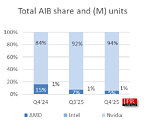
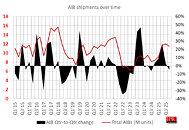
According to a new report from Jon Peddie Research, NVIDIA has once again increased its market share in the AIB GPU sector, reaching 94% in Q4 2025. This marks a 1.6% rise from the previous quarter and sets a new all-time high in recent reports. Meanwhile, AMD's market share has been declining, with a 1.6% decrease that appears to have benefited NVIDIA's partners and their shipments. Overall, JPR records indicate that the AIB GPU market sold 11.5 million units in the final quarter of 2025, a reduction of half a million units from Q3, but a significant 36% increase compared to 8.45 million units in the final quarter of 2024. JPR attributes the slight decline in overall GPU AIB shipments to rising memory prices and tariffs affecting the global supply chain, which have driven up the costs of discrete GPU solutions that use expensive GDDR7 and GDDR6 memory.
Intel's market share in AIB GPU shipments remains steady at around 1%, consistent with its performance in Q3 2025 when the company achieved its first single-digit percentage since launching its Arc "Alchemist" GPUs for gamers. This indicates that Intel's progress is stable, with demand remaining consistent as gamers continue to choose Intel GPUs at the same rate as before. For Intel to break out of the single-digit bracket, the company likely needs more GPU designs, such as the anticipated "Battlemage" B770 graphics card.
 Regarding the shifting market share among GPU vendors, the numbers reflect what many gamers are experiencing. For instance, AMD only supports certain technologies like FSR 4 "Redstone" on its latest Radeon RX 9000 series graphics cards, leaving older generations without support. Additionally, RDNA 4 graphics are only competing with NVIDIA in the mid-range sector, with no high-end competition this generation. Intel also faces challenges in the mid-range GPU segment, suggesting that future GPU generations from both companies might alter the market share landscape. For now, NVIDIA remains the dominant force.
Source:
JPR
Intel's market share in AIB GPU shipments remains steady at around 1%, consistent with its performance in Q3 2025 when the company achieved its first single-digit percentage since launching its Arc "Alchemist" GPUs for gamers. This indicates that Intel's progress is stable, with demand remaining consistent as gamers continue to choose Intel GPUs at the same rate as before. For Intel to break out of the single-digit bracket, the company likely needs more GPU designs, such as the anticipated "Battlemage" B770 graphics card.


157 Comments on NVIDIA Grabs 94% AIB GPU Market Share, AMD Falls to 5%
"Until AMD formally announces FSR 4.1 and details its architecture, hardware requirements, and rollout plan, conclusions should remain cautious. But if the leak reflects AMD’s final direction, the message is clear: the next stage of GPU competition may hinge less on who can apply AI broadly—and more on who can integrate it precisely."
insighttechdaily.com/amd-fsr-4-1-dll-leak-game-integrated-ai-upscaling/
wccftech.com/i-tested-amds-ray-regeneration-in-cyberpunk-thanks-to-optiscaler-and-its-surprisingly-good/
Edit: I'm pretty sure we've seen this 94-6 division before. Did JPR falsify their past data, or is this old news reposted for a few extra clicks?
No sample is an accurate representation of the entire buyer base.
AMD needs to start protecting it's reputation, not just from bad decisions of its staff, like FSR 4 INT8 not offered to FSR3 cards, but also from the tech press and the random youtuber. The average tech site knows, the last 20 years or more, that attacking AMD has no consequences. Sites are using the art of "bashing AMD" for decades to show their viewers that they are willing to go against multi billion companies for the sake of truth, only to sugarcoat everything bad about Intel (in the past) and Nvidia.They do like to shoot themselves in the foot. Coming out and talking about "end of support" or "maintenance" for products still on sale, is stupid and AMD exclusive. There should have been active support even for VEGA(5000 series APUs are still on sale), not just RDNA2 GPUs, or at least to look like there is support for those. Nvidia will wait years before it announces that it is ending support for certain GPU series making it look like ancient GPUs enjoying long lasting support. And the reality might be completely different. For years people where talking, not just for AMD's "Finewine", but also about how Nvidia drivers are degrading performance for previous series of GPUs when a new Nvidia GPU is out. But Nvidia managed to keep that as a rumor, never came out to acknowledge that active support isn't there anymore for old series of cards, or that changes in the drivers that could be beneficial to newer cards could be affecting negatively older cards. They are way more careful there. That "FineWine" reputation wasn't just AMD's continuous support, was also an indication that Nvidia was abandoning optimizations for older cards. Again, the difference is that Nvidia doesn't even gives an official hint that this is the case. AMD will come out and shout it like someone completely drunk who doesn't understand the damage this will do.
It's also an indication that those in the CPU department with those in the Radeon department, are not in cooperation and don't share the same ideas. Where the CPU department is betting on the longevity of a platform, the Radeon department tries to survive today, seeing the past as a heavy burden that needs to be thrown away as soon as possible.AMD probably considers only gaming features as important, not other features. That was probably the idea behind splitting the architectures to CDNA and RDNA. That in gaming, only gaming performance and features have value. So a card with more VRAM and about the same performance as an Nvidia GPU, should be priced close to the equivalent Nvidia model. This isn't a wrong approach, when those taking the decisions understand what it is important to the average gamer. For example, those thinking that raytracing was still unimportant when they released RDNA3, where clearly wrong. At least with RDNA4 they were correct not to only address raytracing and better upscaling, but also offer better support for AI applications. Still I think Radeon group isn't considered important this period of time for AMD. Its not just RDNA2/3 drivers that are in maintenance support. I think the whole Radeon group is in maintenance mode. And we can see it with Redstone and FG. Redstone isn't moving fast and AMD hasn't created a 4X FG mode for it's RDNA4 cards, when even Intel is promoting now 4X FG.Until a few years ago when choosing older graphics cards I was usually choosing AMD cards for two reasons. Lower prices, good drivers. I only bought a few Nvidia cards the last 18 months (1660, 650Ti, 760, 980, K2000D), for two reasons (excluding that I found good deals). Have a good GPU for PhysX (not that it makes much sense today), have a look at what those cards can offer when using CUDA. People using graphics cards outside of gaming like video transcoding, Adobe software, raytracing and stuff like your case, obviously they will go with Nvidia cards. Especially after GCN, AMD cards are only for gaming and nothing else. Bad timing from AMD to split the architectures.When AMD makes a bad decision, it's all over the internet. When Nvidia makes a bad decision, it's nothing. It will be forgotten a week latter if not sooner. There are double standards in how tech sites and users treat AMD and Nvidia. That means that AMD needs to be way more careful. Nvidia is killing the average user's trust every few months and people still trust them with their money and not just that but even non stop support online. Fire hazard connectors? "User error". Bad drivers? "That 2 months old driver still works most of the time for me, so I am fine". Bad pricing? "It's AMD's fault". Less VRAM? "It's enough for today". No new features for my graphics card that clearly can support them? "I will accept Nvidia's excuses".
AMD can't fight Nvidia in the pricing battlefield. They will lose the moment they will try it. Nvidia has better pricing from TSMC and more capacity from TSMC. Better pricing from RAM manufacturers and higher capacity from RAM manufacturers. Higher profit margins. Stronger brand. Stronger ties to OEMs. Sells 10-15 times more cards. People are used those last years using their cards, so they will not swap to AMD without a lengthly thought first. And AMD has probably relegated gaming GPUs market to secondary at best. You know when AMD will be looking God damn serious about gaming GPUs? When they go Samsung or Intel for manufacturing. Not go to Samsung or intel for cheaper manufacturing, but for the higher capacity. It will be an indication that they are looking for excess capacity, which is needed if they wish to try to get back meaningful market share.
Edit: Here we go!Funny how they seem to be comparing random quarters to show a trend that isn't there otherwise.
point 2- People still think that Nvidia's cards are better at things that AMD is already equal to (think Nvenc) or that AMD cant be equal to (think CUDA)
AMD's documentation is poor, their website does not make any reference to VCN 4.0 andrelevant RDNA 4 architecture slidesdo not reference multiple instances of VCN. Then again, this is the same company that made the deliberate choice to disable DP80 support on consumer-grade GPUs, so it's hardly their most questionable decision.
When I need multi-HDMI out, 60Hz 2K resolution, retro gaming with multi-broadcast, low noise and CUDA, I go Quadro.
When I need multi-DP, 1080p144 gaming, way more vram, lightweight broadcast and a good chunk of FP64, I go Radeon.
If I need 4K90 VR raster, any AI card works. I'm able to dunk on the crybabies with a 2GB card and only do it because I can.
Not everybody has something RX580 or 9070XT tier, which is a serious problem in an era of bad games but they do have 2GB.
Many are the same bad games that people want to play but can't because they can't get their hands on competent hardware.
So a lot of the time my gaming sessions have me feeling a lot like Jay reviewing another card that may as well be vaporware.
It has been one year and I don't feel the push to pull up the AI card for gaming/LLM. It's just not welcome outside encode duty.
You can also bet that I'm not alone in this feeling and that gets reflected real hard in Steam survey. Not even a blip.
Doing just enough on the GPU side of things to keep semi-custom interested. Coming out with technology at the cadence of console launches. AMD didn't need to go heavy on RT or AI because it wasn't the focus for the latest console generation. If PS4 Pro wasn't a thing, we likely wouldn't have FSR4.
AMD doesn't even have a full product stack for RDNA4. They could easily fill it in with at least RDNA3 if they wanted. Port FSR4 to INT8 for RDNA3 9000 series cards (and 7000 series). But they don't really care.
They are fallowing the quick and easy money. There is a lot of market share for someone to come in and grab away from Nvidia, but even Intel is showing that it is very challenging market space. They have invested billions and haven't gotten anywhere. Dedicated GPU market isn't quick and easy money.
I, for example, would very much like to buy GPUs and iGPUs that encode H.265 and AV1 videos at the maximum quality preset of these two codecs, so that I could have video files with very high quality and the lowest possible MB/GB file size.
Nvidia's drivers are much more buggy than most coverage would lead people to believe. Though it seems like people have more confidence in Nvidia releasing driver updates or at least hotfixes when people report issues. Especially since they would address performance issues even of cards that are multiple generations old. The issue is that once a card goes into a maintenance support cycle, then Nvidia won't do anything beyond addressing CVEs, and showstopper bugs.
AMD usually has far worse reactions to attention to bugs or bad decisions. For example, In the past with their HD series cards, AMD largely took a stance of silencing criticism, especially on their forums. They eventually started turning things around and seriously improving, at least up until their most recent RDNA scandals.
In areas where certain issues are shared, AMD is likely to get more of the blame, though there is one way to rationalize it considering that this behavior pattern is repeated in other industries as well. The root of it in my opinion, is AMD in a misguided effort to copy the success of a competing product, they end up copying the flaws/ negative aspects of the product. In those cases, people will pile on the blame more because they see it as a deliberate choice to harm the product.
For example, consider this aspect of the smartphone market. Many phone makers would use the option for expanded storage via a Micro SD card. Due to the slot design for the SIM tray, lower height surface mount PCB components could still be placed under the area of the SIM tray, and thus a dual SIM tray didn't really eat into the board space use. Samsung and others used to even make TV commercials teasing Apple for not giving their iphones expandable storage. During that time period, there were some failed devices that tried to copy the iphone's success, by copying their flaws. For example, some companies did phone models with more rounded corners for a more apple-like look, and then they got rid of things like expandable storage. It ultimately didn't help them, and they got bashed far more harshly than Apple did for not including a micro SD card slot on the iphone.
In the case of AMD, they did dumb things, e.g., looking at the trouble that Nvidia is having with the 12VHPWR connector, and deciding that would be perfect for their cards. and there have been many reports since then of the connector melting on the AMD cards as well.
People judge issues more harshly if someone fails to learn from the mistake of others. For example, if someone mistakenly grabs an exposed bus bar at an active power substation, people will express their sympathies. If someone nearby who watch the whole thing happen decides to walk up to the bus bar and grab it shortly after, then people will harshly criticize that decision even though both the first and second person got an equally bad shock.
Or another way to think about it, some men will see a rich celebrity who has horrible and rude behavior, but they will still have women attracted to them, and they will even have a girlfriend riding in the Lamborghini with him. People will notice the poor behavior but and other than a few choice words, think nothing of it. Then you will see some people who are envious of the celebrity or rapper's success, and decide to emulate that individual. They can't copy the wealth or the exotic cars, but they can copy the attitude/ behavior. Then they are surprised when people avoid them.
In circling back to videocards, AMD will get harsh coverage when they do something negative that their main competitor does because often they are seen as willfully making the same mistake, and with the larger competitor, while the issue is just as bad with them, people are more willing to tolerate it because of the areas where they do well in.
I have two ancient cards: Pascal and Polaris. Polaris fell out of support (for Win7) less than 2mon before I bought it and then fell out of total support 3 years later.
I still mained this card for full time VR gaming until mid-2022. Didn't have issues with core clock, memory crashes or raster problems, just gave up due to politics.
That was the RX580, a card that I still use daily. There is nothing wrong other than being precluded by the current slop climate of unoptimized desktop/VR games.
On this day last year I tried replacing it yet again with a much newer AI card. Nothing to write about, just unnecessary. It's collecting dust until I find a purpose for it.
Here's the issue: The Pascal unit is a Quadro P620 I bought at the end of March just to finally have NVENC. It's an nvidia exclusive feature but not GeForce exclusive.
Is it supported? We thought it was so Octover until 582.41 appeared this morning, so maybe?
Is it reliable? I sent it to production to be the mission critical component for daily broadcast.
Is it overkill? If I did CPU only encode, a DX11 card is still needed just to run the compositor, so no.
Can a Radeon card do the same work? It's possible but the RX580 definitely can't do it. RX9000 only.
Neither one of these cards use 12VHPWR connectors or even dual 8-pin. They fill a unique purpose.
The only fault I see with AMD switching to the connector is introducing it to the consumer lineup.
The only suitable reasons I can see for the connector are sleek discreet power and dual operation.
That is to say, running an nvidia and AMD card in the same workstation and ditching bulky cables.
Other than the fact these modern cards drink so much power and the cables often fail, it was a try.
Now if AMD keeps using the 12VHPWR connector in the next batch of cards, that's not good at all.
btw - latest Quadro driver for Pascal is 582.16. You're using the gaming driver on a pro card.
One of the contesting differences is product quality. I trust Radeon to NOT burn the house down. Won't say that about nvidia and 12VHPWR.Latest Win10/11 driver for Quadro is later than mine. I'm on 553.62 for production but will only consider moving to a game ready driver if needed (it's not).
It's doing the heavy lifting of 60FPS gaming and streaming well within that 2GB buffer and whatever CUDA necessary. Routinely only gets used for broadcast.
Quadro shouldn't be used balls to the wall like that as a gaming GPU but for emulation and older desktop titles this is more than good enough for everything.
When the name of the mission is newer NVENC 1080p60 at preset 5 with at least two video outs, I'm not going to say no to the $40 option even with adapters.
Luckily when you have an audience that prefers 720p60 at ultra low bitrates these cards allow for some serious corner cutting. We're all perfectly okay with it.
I don't think VCN is a priority at all to Radeon, as ironic as it may be considering ATI's background with some audio and video products before being bought by AMD.
For those of us paying attention, we recognize on 5090FE PCBs there's a 12v-2x6 connector which is a change ONLY to the connector, not the harness itself and there's still a problem.
The media has continually adopted this topic as a "connector issue" even though that demonstrates the problem is elsewhere. Jay covered it and I barely have a reason to notice or care.
Sometimes it helps to look at the prior gen flagship and we see the 4090 Matrix has proper shunt resistors with a pair of INA3221s. No problems there. Hmmm....This might be a beneficial technology to those just getting started in streaming or needing a catch all encoder for transcode duty but I have only found ONE guy using it.This is the unfortunate reality with Radeon. Creator features seem to be an afterthought in production until 7000 series where some big changes happened.
It took 9000 series to finally fix the H.264 encoder, which is a really good sign we'll see at least that much improvement in UDNA if not a straight copy.
Soooo on that point alone I'm happy with it. The only things really driving those improvements is the current streaming climate.
It simply has to work, full stop. The overwhelming majority have defaulted to nvidia NVENC for encode and I can see why.
If there's some dramatic shift to AV1 and AMD solves for an issue happening on nvidia encoders, that will shake things up.
For now I would say RX9000 has leveled the playing field for gaming and creation and any kind of leverage starts there.
Since the resulting card reflects on the brand, they take steps to prevent reputational damage. AMD should have been on top of things and demand that no 12VHPWR be used.
Beyond that, with power consumption constantly increasing with newer cards, I feel a better solution would be a 2 wire system with high strand count wires which are quite flexible and are very popular with residential battery backup systems. Then just give the videocard 2 solid bus bars and have the users bolt the power cables to the card.
That style of power connection has proven itself to work for decades. and you can regularly see is used on trains, as well as factory machinery. You also see it on the connectors for EV chargers, overall a similar design for a video card would help prevent issues of loose connectors that lead to melting.
They're not only creating new technologies, they have been reshaping the global market around them. Ray tracing, DLSS, AI, ect... All AMD has been able to do so far is lag behind and try to catch the train with disappointing results. They even gave up completely on the high end segment.
I really hope AMD and Intel will live up to the competition in the future as nvidia having a monopoly means higher prices for us. In 2004 I bought an ATI X800 XT Platinum Edition, the best available graphic card at that time. Inflation adjusted its price was 800€. Now If you want to have the best graphic card you need to pay 2500€ or more. The cost has more than tripled.
Still i'm curious about the reliability of all these reports. JPR doesn't provide their sources on their website. With steam surveys there are no precise or verifiable details on how the data is gathered either.