Friday, March 6th 2026

NVIDIA Grabs 94% AIB GPU Market Share, AMD Falls to 5%
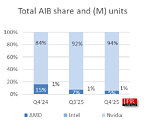
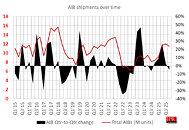
According to a new report from Jon Peddie Research, NVIDIA has once again increased its market share in the AIB GPU sector, reaching 94% in Q4 2025. This marks a 1.6% rise from the previous quarter and sets a new all-time high in recent reports. Meanwhile, AMD's market share has been declining, with a 1.6% decrease that appears to have benefited NVIDIA's partners and their shipments. Overall, JPR records indicate that the AIB GPU market sold 11.5 million units in the final quarter of 2025, a reduction of half a million units from Q3, but a significant 36% increase compared to 8.45 million units in the final quarter of 2024. JPR attributes the slight decline in overall GPU AIB shipments to rising memory prices and tariffs affecting the global supply chain, which have driven up the costs of discrete GPU solutions that use expensive GDDR7 and GDDR6 memory.
Intel's market share in AIB GPU shipments remains steady at around 1%, consistent with its performance in Q3 2025 when the company achieved its first single-digit percentage since launching its Arc "Alchemist" GPUs for gamers. This indicates that Intel's progress is stable, with demand remaining consistent as gamers continue to choose Intel GPUs at the same rate as before. For Intel to break out of the single-digit bracket, the company likely needs more GPU designs, such as the anticipated "Battlemage" B770 graphics card.
 Regarding the shifting market share among GPU vendors, the numbers reflect what many gamers are experiencing. For instance, AMD only supports certain technologies like FSR 4 "Redstone" on its latest Radeon RX 9000 series graphics cards, leaving older generations without support. Additionally, RDNA 4 graphics are only competing with NVIDIA in the mid-range sector, with no high-end competition this generation. Intel also faces challenges in the mid-range GPU segment, suggesting that future GPU generations from both companies might alter the market share landscape. For now, NVIDIA remains the dominant force.
Source:
JPR
Intel's market share in AIB GPU shipments remains steady at around 1%, consistent with its performance in Q3 2025 when the company achieved its first single-digit percentage since launching its Arc "Alchemist" GPUs for gamers. This indicates that Intel's progress is stable, with demand remaining consistent as gamers continue to choose Intel GPUs at the same rate as before. For Intel to break out of the single-digit bracket, the company likely needs more GPU designs, such as the anticipated "Battlemage" B770 graphics card.


157 Comments on NVIDIA Grabs 94% AIB GPU Market Share, AMD Falls to 5%
However in UK the price difference is larger.
Circa £300 for a 5060, and circa £400 for a 9060XT. £300 probably right at the upper limit of 8gig pricing thats justified. I think both are viable options depending on priorities on what you want from the card.
Realistically, NVENC's value is for livestreaming only. If you don't livestream you can ignore it, and if you want to encode something for maximum quality/compression you shouldn't be using NVENC, VCN, or QuickSync - you should be transcoding in software on the CPU.
I believe RDNA4 encoding is enough of an improvement for casual streamers that it's not a glaring issue, but A-B testing at 6Mbit between my 9070XT and 5070Ti is still very very obviously better on NVENC than VCN5.0 - it's just that the Radeon's output is no longer so terrible that it's distractingly bad.
If you're doing any kind of video editing, NVENC is valuable - not because of the output quality because you wouldn't use it for final render, but because it's better supported, more often supported, and and faster for scrubbing and preview workflows. Again, irrelevant to the Radeon if you don't edit video.
I needed something its own dedicated encoder and nothing else was reasonable.
HD6570? 2GB DDR3 that constantly stutters in DX11, no encoder.
x264 options on a FX-8370 are doable but I really need that resource open and still need a GPU for the compositor.
RX580? 8GB GDDR5 is within the territory for running DX11 VR stuff and has an encoder but it overloads too easily.
Quadro P620? 2GB GDDR5 is the same territory, doesn't like DX11 VR but the encoder is competent and card is $35.
I punch those numbers into my calculator and get a happy face. :)This is true. The h264 encoder has finally been fixed on RDNA4 and that's reason enough for me to use it but right now it isn't needed.
When I run live content, I go with NVENC because it is a feature on a perfectly packaged product. The quality is extremely high and consistent.
I don't need to worry about encoder overload, NVENC going kerchunk randomly, sockets exploding or anything of that nature. It just works.
New NVENC on Blackwell is a whole other animal. Nobody "needs" it but very nice to have. I would become an RTX customer for NVENC9.
However AMD has neglected this for a while that they are still behind, and people looking at alternatives for NVENC and NVDEC won't be looking at VCN, people looking for alternatives will look at Intel QSV options and Apple options. AMD still has a lot of work to do with VCN in both performance and compatibility if they want to be considered and used more for video work tasks in the future.