Friday, March 6th 2026

NVIDIA Grabs 94% AIB GPU Market Share, AMD Falls to 5%
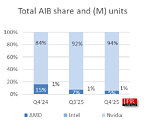
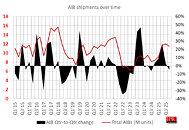
According to a new report from Jon Peddie Research, NVIDIA has once again increased its market share in the AIB GPU sector, reaching 94% in Q4 2025. This marks a 1.6% rise from the previous quarter and sets a new all-time high in recent reports. Meanwhile, AMD's market share has been declining, with a 1.6% decrease that appears to have benefited NVIDIA's partners and their shipments. Overall, JPR records indicate that the AIB GPU market sold 11.5 million units in the final quarter of 2025, a reduction of half a million units from Q3, but a significant 36% increase compared to 8.45 million units in the final quarter of 2024. JPR attributes the slight decline in overall GPU AIB shipments to rising memory prices and tariffs affecting the global supply chain, which have driven up the costs of discrete GPU solutions that use expensive GDDR7 and GDDR6 memory.
Intel's market share in AIB GPU shipments remains steady at around 1%, consistent with its performance in Q3 2025 when the company achieved its first single-digit percentage since launching its Arc "Alchemist" GPUs for gamers. This indicates that Intel's progress is stable, with demand remaining consistent as gamers continue to choose Intel GPUs at the same rate as before. For Intel to break out of the single-digit bracket, the company likely needs more GPU designs, such as the anticipated "Battlemage" B770 graphics card.
 Regarding the shifting market share among GPU vendors, the numbers reflect what many gamers are experiencing. For instance, AMD only supports certain technologies like FSR 4 "Redstone" on its latest Radeon RX 9000 series graphics cards, leaving older generations without support. Additionally, RDNA 4 graphics are only competing with NVIDIA in the mid-range sector, with no high-end competition this generation. Intel also faces challenges in the mid-range GPU segment, suggesting that future GPU generations from both companies might alter the market share landscape. For now, NVIDIA remains the dominant force.
Source:
JPR
Intel's market share in AIB GPU shipments remains steady at around 1%, consistent with its performance in Q3 2025 when the company achieved its first single-digit percentage since launching its Arc "Alchemist" GPUs for gamers. This indicates that Intel's progress is stable, with demand remaining consistent as gamers continue to choose Intel GPUs at the same rate as before. For Intel to break out of the single-digit bracket, the company likely needs more GPU designs, such as the anticipated "Battlemage" B770 graphics card.


157 Comments on NVIDIA Grabs 94% AIB GPU Market Share, AMD Falls to 5%
I'm hoping for their success in breaking into the GPU market at lower cost; if only to revive competition in the space proper. Intel hasn't really been the 3rd rival as many had hoped, AMD is currently in the process of resetting their GPU division by going back to a unified architecture instead of splitting up their teams between gaming and enterprise and thus is behind as well, and Bolt Graphic's Zeus GPU is still vaporware despite their lofty claims.
Fermi got 8 years, Kepler got 9 (although there is July 2024 security update), Maxwell got 11, Pascal got 9, Volta got 8. Turing is still actively supported and being developed against.Except that you know that the delusional one is you, stop projecting.
they could put their 9070 series for sale for $250 and people would still by nvidia.
RTX 5060 8GB ~ 311€
RTX 5060 Ti 16GB ~ 572€ +84% (RTX 5070 12GB only 5.5% more expensive but ~ +40% faster) p/p ratio outside of AI is for idiots. In most cases RTX 5060 8GB will completely destroy RTX 5060 Ti 16GB p/p wise.
RTX 5070 or RX 9070 XT is way better deal than RTX 5060 Ti 16GB it's not close.
Also pricing varies world wide. I was looking at a 5060 8GB and 9060 XT at Christmas for my son and the 16GB 9060xt was $40 cheaper than the 8GB 5060, and the 5060ti with 16GB was close to $80 more, so went with the 9060XT 16GB.
Now the 5060ti 16GB is about $800 and 9060xt 16GB is about $650 - however they are both overpriced (blame ram pricing I guess?). I'm not paying over $500 wo taxes for either of those cards.
The 9060XT 16GB may well be a better buy than the 5060Ti 16GB, but that's not the point I raised. I said that the lack of a cheap RDNA4 card was AMD's problem; You can get DLSS 4.5 on a $200 RTX 3050 but FSR4 support pales into irrelevance against the number of games that can run DLSS 4.5. No, the 3050 isn't anywhere near the 9060XT in performance but decent upscaling goes a long way to close the gap.
RX 9070 for 550€, (now it costs 615€+) right now RTX 5070 12GB is 607€+
RX 9060 XT 8GB for 270€, (now it costs 360€+ which is completely ridiculous) right now RTX 5060€ 8GB is 311€+
RX 9060 XT 16GB for 380€, (now it costs 444€+) right now RTX 5060 Ti 16GB costs 572€+
As for pricing, what you have might be an anomoly. Are those prices in maple bucks? I know Canucks get short-changed for hardware pricing at the best of times, so throw in some AI-driven RAMpocalypse and supply issues during the holiday season and it's a recipe for mad pricing. I only really keep tabs on pricing in the Europe and the US. Buy what makes sense for the money and never ignore performance/$ unless you're rich enough to not care.
I ended up with a middle of the road ASUS Strix G16 with the AMD 9950HX but went with the 5070TI for graphics. Seems more than adequate for everything it is needed for plus some light gaming at 1600 240hz.
I was always hoping Intel would crack the nut on graphics but that seems a bridge too far right now.
Bought everything off OG Newegg when they had amazing customer service.
Now here we are today. Wish AMD never bought ATI at this point.
What I care about: opening GPU-Z and seeing every single API feature marked as "Yes, supported, enabled", with the highest tier that the hardware can realistically support. DirectX, Vulkan, OpenGL, compute extensions... heck, AMD's still lacking some DirectX 11 extensions nearly 17 years on. Oh, would you look at that... that's practically Windows 7's age by now. Scary to think about.
FSR 3 is... ok for what it is, given its weight and performance. FSR 4 is a leap ahead and AMD should have allowed pretty much everything RX 6000+ run it IMHO. Not bothered enough to compare DLSS4.5 and FSR 4 beyond "DLSS looks better" in the usual fashion, besides FSR 4.1 should be landing soon. That's what DLSS 4.5 competes with IMO.