Thursday, March 26th 2026

AMD Announces Ryzen 9 9950X3D2 Dual Edition Desktop Processor with 192 MB L3 Cache
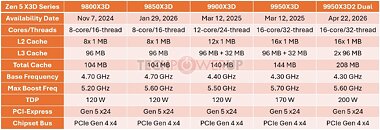
AMD today launched the Ryzen 9 9950X3D2 Dual Edition Socket AM5 desktop processor. This processor is positioned above the Ryzen 9 9950X3D, and is the much awaited implementation of 3D V-Cache memory on both CCDs (CPU complex dies) of the processor. The 16-core/32-thread processor is based on the Zen 5 microarchitecture, and features a total of 192 MB of shared L3 cache—that's 32 MB of on-die L3 cache plus 64 MB of 3D V-Cache that's contiguous with it, across both CCDs. This enables the maximum possible gaming performance, as worker threads of the game can be located on either of the two CCDs and benefit from large last-level cache. The base clock is 4.30 GHz, with a boost clock of 5.60 GHz—100 MHz lower boost than the 9950X3D, and the same clocks as the 9850X3D—no word if these are the same for each CCD.
The AMD Ryzen 9 9950X3D2 Dual Edition is positioned to be a 16-core Zen 5 Flagship part, and to ensure the chip has not just the most cache, but also the highest possible clock speeds in the series, and retain its overclocking capabilities, AMD expanded the TDP of the processor to 200 W—the highest ever for an AMD Ryzen part. AMD is offering gaming performance rivaling its latest Ryzen 7 9850X3D part, but with significantly improved productivity performance in applications with large cached data-sets, such as software development, AI training and inferencing, and video production. The company's first-party productivity benchmarks show the 9950X3D2 post significant single-digit percentage gains over the 9950X3D. AMD did not announce price, but said that the 9950X3D2 Dual Edition will be available from April 22, 2026.


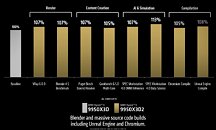 Known specifications of the Ryzen 9 9950X3D2 Dual Edition follow.
The AMD Ryzen 9 9950X3D2 Dual Edition is positioned to be a 16-core Zen 5 Flagship part, and to ensure the chip has not just the most cache, but also the highest possible clock speeds in the series, and retain its overclocking capabilities, AMD expanded the TDP of the processor to 200 W—the highest ever for an AMD Ryzen part. AMD is offering gaming performance rivaling its latest Ryzen 7 9850X3D part, but with significantly improved productivity performance in applications with large cached data-sets, such as software development, AI training and inferencing, and video production. The company's first-party productivity benchmarks show the 9950X3D2 post significant single-digit percentage gains over the 9950X3D. AMD did not announce price, but said that the 9950X3D2 Dual Edition will be available from April 22, 2026.


149 Comments on AMD Announces Ryzen 9 9950X3D2 Dual Edition Desktop Processor with 192 MB L3 Cache
While I get the product proposition, the naming of this model is awful.
They mentioned this with the 5900X prototype that was out with Dual caches many years ago.
So the gains with this chip will be small.It won't be that long both intel and AMD i believe will announce both new Gen CPU's at CES 2027 and availability shouldn't be much longer after that not going to be anywhere close to a two year wait.Why not you can air cool a 14900K and that uses more power than this.
The higher score in Geekbench
I don't like the Intel CPU tech much, even now I have games that don't like running on the E-Cores, but from what I've read AMD has its own gaming issues, with the chiplets.
What a sucky time to be a PC enthusiast :(
Just for info:
I don't think it will. Game bar was there to make sure that the gaming threads prioritised the X3D equipped CCD and not the non X3D ccd.
Normal scheduler should make sure that relevant data stays within the same ccd as that is the default behaviour for all of Zen since Zen 2 IIRC.
Either way, we're likely looking at a launch in the next ~5-10 months, and with Zen 6 probably bringing a meaningful performance uplift across the board vs. a product which is basically a benchmarking gimmick outside of very specific loads. This product will also have very limited availability.
Always wait until there is a meaningful difference.
Wait for Zen 6
Talking through CCX to CCX is still a lot faster than current Die die to talk on Zen 5 since ti's die to technically i/o to die talk on Zen 5. Inter CCX to CCX talkr is right below going out to Ram in latency (80to 90ns). Since infinity fabrics are much longer distances on substrates & you have Go out through to the I/o & back out to even do it.
Zen 3 also wasn't able to connect that cache together because of their placement over the die
All that matters is what the cache slices size are & how they're linked even L3 cache talk is still faster than current models linkages.