Thursday, March 26th 2026

AMD Announces Ryzen 9 9950X3D2 Dual Edition Desktop Processor with 192 MB L3 Cache
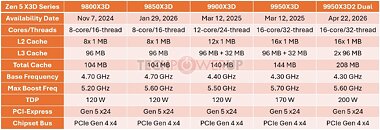
AMD today launched the Ryzen 9 9950X3D2 Dual Edition Socket AM5 desktop processor. This processor is positioned above the Ryzen 9 9950X3D, and is the much awaited implementation of 3D V-Cache memory on both CCDs (CPU complex dies) of the processor. The 16-core/32-thread processor is based on the Zen 5 microarchitecture, and features a total of 192 MB of shared L3 cache—that's 32 MB of on-die L3 cache plus 64 MB of 3D V-Cache that's contiguous with it, across both CCDs. This enables the maximum possible gaming performance, as worker threads of the game can be located on either of the two CCDs and benefit from large last-level cache. The base clock is 4.30 GHz, with a boost clock of 5.60 GHz—100 MHz lower boost than the 9950X3D, and the same clocks as the 9850X3D—no word if these are the same for each CCD.
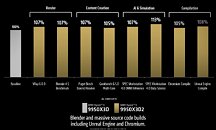
The AMD Ryzen 9 9950X3D2 Dual Edition is positioned to be a 16-core Zen 5 Flagship part, and to ensure the chip has not just the most cache, but also the highest possible clock speeds in the series, and retain its overclocking capabilities, AMD expanded the TDP of the processor to 200 W—the highest ever for an AMD Ryzen part. AMD is offering gaming performance rivaling its latest Ryzen 7 9850X3D part, but with significantly improved productivity performance in applications with large cached data-sets, such as software development, AI training and inferencing, and video production. The company's first-party productivity benchmarks show the 9950X3D2 post significant single-digit percentage gains over the 9950X3D. AMD did not announce price, but said that the 9950X3D2 Dual Edition will be available from April 22, 2026.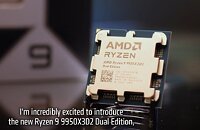

 Known specifications of the Ryzen 9 9950X3D2 Dual Edition follow.
The AMD Ryzen 9 9950X3D2 Dual Edition is positioned to be a 16-core Zen 5 Flagship part, and to ensure the chip has not just the most cache, but also the highest possible clock speeds in the series, and retain its overclocking capabilities, AMD expanded the TDP of the processor to 200 W—the highest ever for an AMD Ryzen part. AMD is offering gaming performance rivaling its latest Ryzen 7 9850X3D part, but with significantly improved productivity performance in applications with large cached data-sets, such as software development, AI training and inferencing, and video production. The company's first-party productivity benchmarks show the 9950X3D2 post significant single-digit percentage gains over the 9950X3D. AMD did not announce price, but said that the 9950X3D2 Dual Edition will be available from April 22, 2026.


149 Comments on AMD Announces Ryzen 9 9950X3D2 Dual Edition Desktop Processor with 192 MB L3 Cache
Half the price of the 9950X3D2? Lol. It will likely keep the 9950X MSRP which was $650 before the $50 price cut a few days ahead of the Arrow Lake launch.
There is no dilemma here, everyone should wait for the new gens, as they can buy older gens then too. But that's after they see the uplift and how the Intel vs AMD variable turns out, then the older gens will get adjusted in price, just like Zen4 was relative to Zen5.
We can only speculate about performance gains, and especially since it never translates directly to CPU performance anyways. For gaming, you'll probably see some that scale better with more computational power and some which are more bloated and cache sensitive. (Applications will scale much more linearly.)
None of us knows the performance characteristics of either Zen 6 or Nova Lake yet. But one thing of note is that Zen 5 added a lot on the execution side without a substantial performance gain as a result, which leads to the deduction that optimizing this might lead to a larger performance gain this time around. So I'm hoping for more than 10% this time, but then again AMD has said more about Zen 7 than Zen 6 if that's an indication...It's not about using it or not, it's about where the point of diminishing returns is. Any cache line of instruction or data will be pushed to L3 when discarded from L2. Having two cache dies just means you have twice the amount of cache banks to spread the data across.
If we first assume you could add extra cache at the exact same latency, you'll get diminishing returns and some point where the gains just get negligible, depending on each workload.
Now, let's assume you have a 9950X3D and 9950X3D2 which managed to achieve the exact same clocks under any kind of load (they don't, but bear with me), the only real disadvantage I can think of with the second cache die having higher latency from the other CCD. I assume that all cache lines will be distributed by address like cache banks normally are, so it means that 50% of your L3 cache hits will be slightly slower while you get a slightly higher chance of a hit in L3 (not twice as large!), so you may get an intersection point where the benefits of the second cache die is outweighed by the disadvantage. (And probably a few where it doesn't matter either way.) Now consider that 9950X3D2 will actually be running at slightly lower clocks, which means many workloads will likely lose a little performance due to that too.
www.techpowerup.com/img/cOCQFUiRPWKnangg.jpg
Obviously the workload itself is essential as not every action in a certain program will produce the same difference between various CPUs.
I suppose AMD cherry-picked some tests where the gains are slide worthy so to speak.
But they still seem very optimistic with pretty much equal gains as those from 9950X to 9950X3D.
We'll see, but bang per buck is shaping up to be horrible now that the MSRP is known.
True but it still feels like AMD is exaggerating here with the MSRP.
9950X3D was $700, up $100 from 9950X's revised MSRP of $600 (down from $650 two months prior).
So this should've been $800 tops.
It's like they're putting an extra Zen5 flagship tax on top.
That flagship tax could've been (partially) justified somewhere in July-August 2025, but now it's so late (with Zen6 probably less than a year away) that it actually feels like an IQ test instead.
But whatever, not my problem.
Remember, Zen7 won’t be with us until at least Q3-Q4 2028.
It’s admirable AMD even launched this, but essentially it’s an engineering proof of concept and it meant for the real world. Nova Lake is the elephant in the room, especially now that the lower end chip is 44 cores overall and the high end one 52c.
It’s good to see competition again, but while Zen5 is indeed a good place to be, even Intel got it right cancelling the Core Ultra 9 Plus 290K. It would have been the same weirdness. A new flagship right before a whole new generation? Like seriously, who’s buying that?? No one. Hence cancelled. AMD should have skipped this chip entirely. It’s very likely the 12 core single CCD Ryzen 9 10900X will have similar performance for half the price.
And indeed, it does feel like a last push before the Zen 6 launch to milk the current architecture as much as they can, not unlike Nvidia's Super cards.
This could've changed with 50 Supers though.
Intel also did some hardcore charity with Arrow Lake Refresh (Jacketman is paying so why not?).
But AMD wants to play the "high roller strong milker not one step back" card.
Understandable as they probably won't get another such opportunity in the near future.Lol @ goddamn typo, I've corrected the post, Zen 6 that's what I meant.
Of course.
The best spin was with the 4080 which had a candid camera $1200 MSRP which then could be reduced to all sorts of degrees and appear like charity while still creating a new overpriced baseline for the future. :roll:
Granted one year later the 5070 Ti managed to offer 4080 Super level of performance ($1000) for 3/4 of the price.
So yeah not awesome but not horrible either.
Two years later the 6070 will do the same for probably $550 (fingers crossed). And that's without adjusting for inflation.
But from what I've seen, it performs better than I expected, likely due to its higher clock speed.
The issue with games is that the threads in a game loop require lots of communication with one another, so that's where the inter-CCD latency kills the performance for those and won't allow them to scale properly. Think of a physics thread trying to relay data to the thread that cares care of audio.
Other kinds or parallel workloads that can go by with no or close to no communication across threads tend to scale really well without facing such issues.
But nonetheless, this CPU shows that the extra CCD doesn't really help with games in a superficial manner and that the extra clocks are what brought most of the benefits for that scenario. From Phoronix's review, it had some really nice uplifts to HPC and other memory intensive tasks, but those were expected already.
Ofc if you have the money this is faster than the other models, has no downsides (other than the extra power consumption), and makes it so one doesn't need to care about the whole CCD/no-CCD scheduling.
www.phoronix.com/review/amd-ryzen-9950x3d2-linux