Thursday, March 26th 2026

AMD Announces Ryzen 9 9950X3D2 Dual Edition Desktop Processor with 192 MB L3 Cache
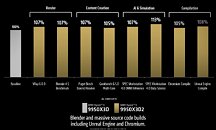
AMD today launched the Ryzen 9 9950X3D2 Dual Edition Socket AM5 desktop processor. This processor is positioned above the Ryzen 9 9950X3D, and is the much awaited implementation of 3D V-Cache memory on both CCDs (CPU complex dies) of the processor. The 16-core/32-thread processor is based on the Zen 5 microarchitecture, and features a total of 192 MB of shared L3 cache—that's 32 MB of on-die L3 cache plus 64 MB of 3D V-Cache that's contiguous with it, across both CCDs. This enables the maximum possible gaming performance, as worker threads of the game can be located on either of the two CCDs and benefit from large last-level cache. The base clock is 4.30 GHz, with a boost clock of 5.60 GHz—100 MHz lower boost than the 9950X3D, and the same clocks as the 9850X3D—no word if these are the same for each CCD.
The AMD Ryzen 9 9950X3D2 Dual Edition is positioned to be a 16-core Zen 5 Flagship part, and to ensure the chip has not just the most cache, but also the highest possible clock speeds in the series, and retain its overclocking capabilities, AMD expanded the TDP of the processor to 200 W—the highest ever for an AMD Ryzen part. AMD is offering gaming performance rivaling its latest Ryzen 7 9850X3D part, but with significantly improved productivity performance in applications with large cached data-sets, such as software development, AI training and inferencing, and video production. The company's first-party productivity benchmarks show the 9950X3D2 post significant single-digit percentage gains over the 9950X3D. AMD did not announce price, but said that the 9950X3D2 Dual Edition will be available from April 22, 2026.


 Known specifications of the Ryzen 9 9950X3D2 Dual Edition follow.

The AMD Ryzen 9 9950X3D2 Dual Edition is positioned to be a 16-core Zen 5 Flagship part, and to ensure the chip has not just the most cache, but also the highest possible clock speeds in the series, and retain its overclocking capabilities, AMD expanded the TDP of the processor to 200 W—the highest ever for an AMD Ryzen part. AMD is offering gaming performance rivaling its latest Ryzen 7 9850X3D part, but with significantly improved productivity performance in applications with large cached data-sets, such as software development, AI training and inferencing, and video production. The company's first-party productivity benchmarks show the 9950X3D2 post significant single-digit percentage gains over the 9950X3D. AMD did not announce price, but said that the 9950X3D2 Dual Edition will be available from April 22, 2026.


149 Comments on AMD Announces Ryzen 9 9950X3D2 Dual Edition Desktop Processor with 192 MB L3 Cache
CCD2 operates with higher latency, and the additional frequency sometimes helps maintain synchronization with CCD1. It remains to be seen whether the cache and the lower frequency will work well.
We’re looking forward to seeing how the additional secondary cache will help when moving low-priority threads from one CCD core to the next CCD. For now, we just have to wait for the data to be copied.
Since you are targeting "workstation" use, generic or synthetic performance is pretty irrelevant, you should seek benchmarks as close to your workflow as possible. If your current performance is unsatisfiable, you should try to find out what's bottlenecking you. If it happens to be either core count or memory bandwidth then the solution is something like Threadripper. If on the other hand it's very sensitive to peak core speed, then perhaps the other team is faster, which will be especially interesting once Nova Lake and Zen 6 arrives. Or it may not be the CPU at all.Only if the cache makes a meaningful difference for his particular workload, which is generally rare for "workstation" tasks. If not, then even regular Zen 6 should be on the table.
The article isn't stating it matches regular X3D parts but the newer OC'd X3D parts.
It is EXACTLY what people who were pushing for 2 X3D cache dies wanted. It completely erases the disadvantage of having that second CCD.
- First things first, How many games currently out there take advantage of more than 8 cores/16 threads in the first place.
- How many games perform better on a 9950x than a 9700x currently and for that advantage to NOT be due to the increased clock speed of the CCD.
- Are developers going to spend the extra time to specifically optimise for the 1% of the 1% who will be using these processrors most likely? I suspect it will be a lot of extra work for very little benefit beyond this small base of users in the short/mid term.
- How is the extra cache going to be treated by developers?
Here is a good going over Zen 5 and how gaming works. He even goes through a simulated scenario where he forces cross CCD communication by forcing different threads across the CPU and there was a ~7% drop in performance in doing so.Individual cache setups that take full advantage of the extra capcity but may introduce cross CCD communication latency due to poor implementation/cache optimisation.
Exact copies across the two CCDs to prevent cross CCD transactions? May help those gmaes that utlise more than 8 cores but your limiting the cache effectiveness overall.
chipsandcheese.com/p/running-gaming-workloads-through
According to his reporting currently there is very few "natural" scenarios in gaming where cross CCD communication will happen with current Zen 5 parts and here is a really big thing people need to take into consideration
"Cross-CCX transfers account for a negligible portion of L3 miss traffic: sampled latency events at the L3 indicate cross-CCX latency is similar to or slightly better than DRAM latency"
So as it has been suggested in previous posts/articles the main bottleneck for Zens architecture in terms of gaming performance beyond the single CCD is mainly the Infinity fabric bandwidth and latency. X3D minimises this limitation by lowering the need to go out on the IF to Memory etc leading to higher framerates. The ONLY situation currently where a Dual X3D part will benefit vs a single one now is when you have a need for >8 core/16 threads OR and this is a REALLY big OR your game has multiple threads that could take advantage of a larger cache without the need for large interactions between the two, I am thinking of things like world generation and AI NPC logic etc.
This is the reason why in EPYC there are specific parts that utilise 2 IF links between each CCD and the IO Die to maximise the throughput for the CCD in certain use cases.
Developers generally speaking don't "optimize" to use more cache, at least not in the way you expect. There are mainly two types of cache, instruction(code) and data, and the way we optimize for them is a bit different. One key difference between L2 and L3 is that L2 is the cache the CPU front-end is interfacing with, while L3 is just discarded L2 (from all the cores). And while we don't have direct control of any of the caches**, cache optimizing have a primary effect on L2, while the only real way L3 is positively affected is by having L2 fetch less unnecessary data.
Cache optimization for code is primarily in making the code computationally denser and therefore the same code takes up fewer cache lines, this includes avoiding/removing unnecessary function calls results in cache misses. Meanwhile data optimization is mostly about making the data "denser", meaning it's either more compact or you traverse the data in the optimal way, so you need fewer cache lines to read the same amount of data. So in layman's terms, both types of optimization can be viewed as trying to use as little as possible to do a set amount of work. It's not like most people think that the programmer controls what is cached and what is not.
One thing of note is that the chances of a cache hit in L3 is significantly higher for instruction cache vs. data cache, because a instruction cache hit in L3 usually means the code is a little too large and the code is the same when churning through lots of data, while most of the data is switched out. So when we see some games and a few applications very sensitive to L3 cache size, that's actually a sign of the application being badly coded, not a sign of quality. This is the opposite of what those who are not experienced low-level programmers expect.
**) There are prefetch and flush instructions as hints to the CPU frontend, but this is very low-level stuff you'll probably never see in a game engine.
--
So addressing your first question(1), are developers going to "address" this? No, not in the way you think, it's the opposite, meaning they will see less of a need to actually optimize it, since all the "hard core" gamers will be having lots of L3 and will be "suffering" less from unoptimized code. This is actually sometimes the downside of some unbalanced "improvements", especially the ones which "favors" bad design. Don't get me wrong, more L3 is a good thing, but there's a "sweet spot" where going beyond that only helps "bad code", and therefore incentivizes developers to write more bad code.
Let me take a similar situation, this time in software, but it's an underlying API so it affects games. Some years back, there was all this hype about DirectX 12 and Vulkan (and Mantle) lowering overhead, which is a good thing by itself. But then we even got benchmarks to measure draw calls, and developers realized that the reduced cost of bloat means we don't have to prioritize optimizations as much. And we see the results now; many games in the last ~5-8 years are incredibly demanding for both CPU and GPU, while only offering a small step above the previous generation of games in terms of visual fidelity.The cache doesn't really work that way, it's transparent to the code.
So I assume in your scenario you're expecting one or more threads in each CCD to access the same cache line, and that one or more of them will at some point write data to it, then any mechanism (in software or hardware) will have too do some kind of synchronization to keep those up to date. The CPU already have a mechanism to synchronize L1, L2 and L3 on various cores, but I don't see how hardware can duplicate those automatically and still keep them in sync, at least not without creating a penalty for everything.
But if the data isn't changing, or only changing at very specific times (and probably only by one thread), then you can easily do this in software by letting each thread have their own copy of the data.
And while a lot of people are very focused on this problem, I don't think it's that much of a deal as people make it out to be. I believe the proper solution is not to solve this problem, but to avoid it. Any software where you need this level of fine-grained synchronization between cores is never going to scale well. This basically comes down to Amdahl's law; the more synchronization you have, the less scaling you'll have. So if you can't scale it's either you're doing it wrong, or the problem can't scale further.I agree.
And if there is a game which is an edge case, then customers should petition that developer to fix their game.Probably more like games which are incredibly bloated. And contrary to some, I think there will be a few games where the addition of the L3 offsets the disadvantage of the dual X3D dies, but that doesn't make it sensible.
It's very relevant for some server loads, especially heavy enterprise Java code, which is in nature incredibly bloated.
has this chanced since 1996? a cpu can fetch faster it needed "data" for computation when the cache is bigger. l1 is faster than l2 than l3 and so on. than DRAM than storage. what is done in the cpu itself does not matter. i doubt it has changed. when it is not in l1, it is searched in slower l2 cache, if not than it is searched in slower l3 cache and so on.
note: data is up to discussion, feel free to provide an example with assembler with full explanation whatever. it does not change how the other caches are slower and how the chain of "data" handling is.that is the point. one is hardware, the other is the compiler generated "machine" code.
i appreciate your efforts in explaining things to the publicmaybe i am wrong. what i learnt in 1996, yes 1996, the cpu itself has various mechanics.
that is the reason i mentioned assembler. that is a nice topic to waste time on. at the end of the day i hope those gcc developers or windows equvialent, freebsd equivalent, apple hardware equivalent, ucontroller equivlanent and so on bother with those task and provide a decent compiler and decent programming language. those pdfs were for the 8 bit and one 16 bit ucontroller i bothered with usually sometimes up to 600 pages and it were multiple pdf files for a single controller.
The more "important" stuff don't stay in cache, the CPU is constantly churning through lots of data every few thousand clock cycles, so if one particular piece of code or data isn't nearly constantly used, it will be pushed out of cache very quickly. We don't control this directly in code, but we can indirectly affect this by how we traverse data, how many jumps we do, and how dense our logic is. If we do this in patterns which the prefetcher can keep up with, then performance will generally be good, if not, performance will suffer, not just by a few percent, it can be like 50x. This also means we don't want the prefetcher to fetch data we don't need, because everything cached will discard something else which may be useful too.
I don't know how old you textbooks were back in 1996, but something which have changed are the performance characteristics of the CPUs when optimizing code. Like back in the early 90s (typically a 386, 486 or early Pentium) the relative cost of a cache miss was only a few clock cycles, today it's like 500+ clock cycles and our superscalar CPUs can execute ~8 calculations per clock, and math operations which used to be super costly are often very quick, so the relative cost of design choices changes over time. You'll see this if you watch videos of people optimizing their game for e.g. SNES, old DOS PCs or even N64, they do prioritization which wouldn't make sense today. Microcontrollers may be very different from a typical PC too. And this will likely change a lot in the coming years too. The current push from Intel is APX, primarily motivated by the fact that performance scaling is increasingly dominated by branch mispredictions and cache misses.Sorry, I didn't get your point. Can you elaborate how the compilers play into this in regards of caches? (other than gcc and llvm is much better at optimizing than msvc of course)
Just thinking of how things from the BF3/4 days to now and how you used to be able to run them on 1-2Gb of VRAM cards with everything maxed with no issue.
As much as people think inter-CCD communication is a "problem" I think it's not such a big deal outside of cases where it proves to be detrimental. In other words I wouldn't use potential inter-CCD communication chance as a factor in a general purchasing decision. There seems to be a lot of concern around inter-CCD communication when it's mostly a non-issue in my opinion.
The exceptional case is with gaming and hybrid dual CCD X3D CPU's but there is also a difference such as click speed between CCD's also working toward lower or inconsistent performance if you cross CCD's. My expectation is with 9950X3D2 is basically normalization of performance across the chip as a whole due to both CCD's having the X3D cache but also being closer to the same clock speed with each other as with normal dual CCD chips.
But this problem has very little, if anything, to do with your point about "optimizing" for one userbase. Efficiency is the key to allow scalability, whether the priority is "good enough" for most people or maximum fidelity for a high-end systems.
Some of these engines seem to be more "content creation platforms" rather than fine-tuned game engines, engines like Unreal and Unity are probably among the "worst", and all the escalating problems we see in current games are mostly symthoms of this underlying inefficiency. Problems like terrible resource management(VRAM management, resource streaming and "duplicated" resources), bad LoD scaling, endless game bugs, slow shader compilation and the aforementioned crappy performance. I'm not going to elaborate on shaders in this thread, but it's probably them generating bloated "duplicated" shaders instead of tailoring them, and it's baffling to me that this has even become an issue. And it's not like what I'm wanting is impossible today, but engineering needs to be a priority, not just mass-producing garbage.What you're describing are symptoms of what I'm referring to, it's not primarily because of 4K. We had high resolutions a decade ago, and back then we generally used more heavy MSAA or even super sampling, but today gamers with pretty high specced systems "needs" to resort to fake frames and/or fake resolutions because the games are so bad.