Thursday, March 26th 2026

AMD Announces Ryzen 9 9950X3D2 Dual Edition Desktop Processor with 192 MB L3 Cache
AMD today launched the Ryzen 9 9950X3D2 Dual Edition Socket AM5 desktop processor. This processor is positioned above the Ryzen 9 9950X3D, and is the much awaited implementation of 3D V-Cache memory on both CCDs (CPU complex dies) of the processor. The 16-core/32-thread processor is based on the Zen 5 microarchitecture, and features a total of 192 MB of shared L3 cache—that's 32 MB of on-die L3 cache plus 64 MB of 3D V-Cache that's contiguous with it, across both CCDs. This enables the maximum possible gaming performance, as worker threads of the game can be located on either of the two CCDs and benefit from large last-level cache. The base clock is 4.30 GHz, with a boost clock of 5.60 GHz—100 MHz lower boost than the 9950X3D, and the same clocks as the 9850X3D—no word if these are the same for each CCD.
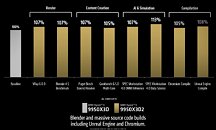
The AMD Ryzen 9 9950X3D2 Dual Edition is positioned to be a 16-core Zen 5 Flagship part, and to ensure the chip has not just the most cache, but also the highest possible clock speeds in the series, and retain its overclocking capabilities, AMD expanded the TDP of the processor to 200 W—the highest ever for an AMD Ryzen part. AMD is offering gaming performance rivaling its latest Ryzen 7 9850X3D part, but with significantly improved productivity performance in applications with large cached data-sets, such as software development, AI training and inferencing, and video production. The company's first-party productivity benchmarks show the 9950X3D2 post significant single-digit percentage gains over the 9950X3D. AMD did not announce price, but said that the 9950X3D2 Dual Edition will be available from April 22, 2026.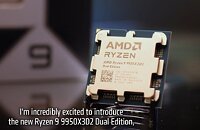
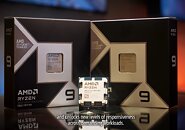

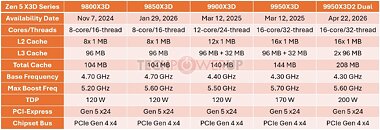
 Known specifications of the Ryzen 9 9950X3D2 Dual Edition follow.
The AMD Ryzen 9 9950X3D2 Dual Edition is positioned to be a 16-core Zen 5 Flagship part, and to ensure the chip has not just the most cache, but also the highest possible clock speeds in the series, and retain its overclocking capabilities, AMD expanded the TDP of the processor to 200 W—the highest ever for an AMD Ryzen part. AMD is offering gaming performance rivaling its latest Ryzen 7 9850X3D part, but with significantly improved productivity performance in applications with large cached data-sets, such as software development, AI training and inferencing, and video production. The company's first-party productivity benchmarks show the 9950X3D2 post significant single-digit percentage gains over the 9950X3D. AMD did not announce price, but said that the 9950X3D2 Dual Edition will be available from April 22, 2026.


149 Comments on AMD Announces Ryzen 9 9950X3D2 Dual Edition Desktop Processor with 192 MB L3 Cache
tpucdn.com/review/amd-ryzen-9-9950x/images/power-applications-compare-vs-14900k.png
tpucdn.com/review/amd-ryzen-9-9950x/images/power-applications-compare-vs-pbo.png
Direct comparison as the scale is the same.
PBO max for 9950X is more than 200 W, so the 9950X3D2 will not go as high but it will be halfway, I think it will tango with the 14900K in many cases.If it can draw the heat quick enough perhaps, but if the thermal density is high coupled with a thick IHS that can be problematic.I would say that this RAM crisis hurts AMD less than Intel.
Why?
Well the AM5 people have DDR5 already so for them it's just a CPU swap. Because they're not going to change sides even if Nova Lake wins, Zen6 will still be a significant upgrade over Zen5.
The people on other platforms however will choose the arch that wins, and they have to buy everything (except RAM for the ones that have DDR5), basically Raptor Lake (not all as some have DDR4) and Arrow Lake people.
And that's the thing, Intel will be pushing CUDIMM for Nova Lake in order to get the best results and maximize stability for high capacity and speed (the whole semi-HEDT, productivity angle).
Expensive shit that isn't really needed for Zen6, unless of course AMD is optimizing for that as well, but the ones already on AM5 don't have CUDIMM and they're not going to go after it in these market conditions.
So without super fast CUDIMM Nova Lake will likely be held back, some Arrow Lake owners have CUDIMM kits that can be repurposed but Raptor Lake owners don't.
That's the vibe I'm getting, if Nova Lake wins CUDIMM will play a part in the outcome, so those who want a beast of a platform will have to pay crazy money, if not they're getting only 90%.
In this regard I believe Zen6 might have a slight advantage because it doesn't need all of the stars to align in order to prevail.
For this aspect above AMD is not as pressured to delay, however the older MLID rumors were that AMD would delay in order to make sure it can reach the crazy clocks it wants for Zen6 (if not with N2P then with N2X).
It'll suck building a new rig and having my Alder Lake-era kit in that build, but RAM is just like power supply... probably the most boring money you can spend on a build. The consolation prize is that RAM was cheap. Well, was. At least it's Hynix A and I know it can run at least 7600 ;)
AMD handles boost behaviour in a different and somewhat more agressive way, but in values what AMD uses are TDP and PPT, PPT being higher than TDP. In AMD the setted up PPT is the actual allowed maximun power to draw to the CPU socket, how much of it is used will vary in some other settings like TDC, EDC and the workload itself. But unlike Intel I think there's not a Tau Boost time window equivalent so as long as there's headroom for what the boost algorythm seeks and the workload requires and other settings and temperatures allow for the headroom, it may be able to sustain higher without an specified time window maximum limit to go back to the base power setting different like how Intel does by default.
The 9950X3D in specific is TDP: 170W and PPT: 230W. www.techpowerup.com/cpu-specs/ryzen-9-9950x3d.c3993
For most AM5 CPUs AMD uses the calculation of PPT being x1.35 of the TDP value. So if AMD keeps consistent with it on this 9950X3D2 Dual Edition that lists TDP as 200W, PPT will be 270W unless AMD specifically decides PPT to be a slightly lower calculation in this case.Nova Lake compared to Arrow Lake will have FRED, AVX10.2 and APX. Zen 6 seems like only will have FRED, but even if APX can be good in general for the future just with recompiled binaries, I expect it to take some time to get widespread adoption at firsst.
With AVX10.2 full backwards compatibility with AVX-512 with all the umbral instructions included in AVX10.1 is possible though, so that's a part in which AMD won't have an advantage in anymore. In both cases I think they actually can be interesting and will be a far more interesting showing than Arrow Lake and Zen 5 against their predecessors.
Intel isn't held back by the lack of CUDIMM (see the 270K matching the 9950X with equal DDR5-6000 RAM), but CUDIMM is a definite advantage they have over AMD. So of course they're be pushing it.
For ordinary users without CUDIMMs, Zen 6 and Nova Lake will probably be roughly equal, unless one side really screwed up the architecture. Both will have models with super-sized cache (X3D vs bLLC). But CUDIMMs will be a definite advantage for enthusiasts.
If its anything like the 9950X3D, it should have a total PPT of up to 250W (sensor reading from HWiNFO) if the default TDP is 200W. A 9950X (170W TDP) that I've tested in late 2024 goes up to 230W.
But Nova Lake still has tiles like Arrow Lake, and worse the flagship has two compute tiles so now the P-cores are separated, there is probably a way to fix the inter-tile latency without throwing super speed CUDIMM at it but the RAM will definitely play a crucial (pun intended) part.
My guess as to why it took so long is 4 fold:
"AMD is offering gaming performance rivaling its latest Ryzen 7 9850X3D part,"
The 9850X3D is 7.1% faster than the 9950X3D, thus it's a 7.1% gain.
www.techpowerup.com/review/amd-ryzen-7-9850x3d/26.html
This new CPU could be amazing manually capping it at a lower PPT from 270W.
It may be interesting to see how to scales. I'm a bit tired of the newer more efficient CPU's being more power hungry in the race for minimal gains.
With Intel using TSMC now I think they are gong to leverage that and bring back some healthy competition but with AI industry knock on effects limiting the supply chain it may be a rough few years with both AMD and Intel bringing new CPU's to market potentially with PC sales slowing down while costs are so high. The fact AMD has at least one more CPU generation for AM5 is pretty favorable to AMD at this time as people might be more reluctant to upgrade their entire system.
Its not the miracle the people expected, it was obvious that adding cache to the second CCD, won't make it faster than the single CCD, just like 9700X and 9950X are within 1-2% difference. Now will be the same with 3D cache on the both CCDs vs single one.
Edit: That's why I swapped back to my trusty little 7800X3D after playing with a 7950X3D for a couple of months (which is also a great CPU, but it dies when a game uses more than 8 cores to load something...).
Translating the colors:
Magenta is 17% increase to match the % difference between 170/230 W and 200/270 W.
Purple is halfway between stock and max PBO because increasing by 17% would have exceeded max PBO.
These will not be 100% accurate to real life but it's at least ballpark.
In reality stuff like 7Zip, AI NLP and Web Hosting might be less than my estimate.
Also some stuff like Blender, Chess, V-Ray could be slightly higher than my estimate.
Keep in mind this is using late 2024 data. Also the 285K is a stand-in for the 270K.
Regarding app avg:
www.techpowerup.com/review/amd-ryzen-7-9800x3d/23.html
If we have:
285K - 132 W
9950X - 135 W
7950X - 149 W
14900K - 180 W
Then 9850X3D2 would be 147 W based on my estimate above. So 8.9% higher than 9950X.
www.techpowerup.com/review/intel-core-ultra-7-270k-plus/23.html
If I use that percentage for the latest data, relative to the 9950X the 9950X3D2 would be 149 W in that chart.
/////
Now for performance.
First assumption is that going from 9950X3D to 9950X3D2 yields half the increase as when going from 9950X to 9950X3D.
But there is extra TDP involved:
www.techpowerup.com/review/amd-ryzen-9-9950x/27.html
Max PBO is 3% better than stock, however 200/270 W is sort of halfway between stock and max PBO therefore only 1.5% increase due to only increased TDP.
In games 720p only 1.2% better therefore only 0.6% increase.
Now using 2026 data:
www.techpowerup.com/review/intel-core-ultra-7-270k-plus/28.html
First app avg:
9950X3D - 105 %
9950X - 101.5 %
270K (without 200S Boost) - 100 %
Thus 3.45% better.
But only half of this when going from 9950X3D to 9950X3D2. Multiplied by 1.015 to account for increased TDP gives:
9950X3D2 - 106.8 %
Games:
720p:
9800X3D - 119.9 %
9950X3D - 113.1 %
9950X - 101.8 %
270K (without 200S Boost) - 100 %
This is 11.1 % better. Half of this multiplied by 1.006 gives:
9950X3D2 - 119.4 %
Enjoy!
Not gonna lie though: I really want this. Whether I can justify it is another matter.