Thursday, March 26th 2026

AMD Announces Ryzen 9 9950X3D2 Dual Edition Desktop Processor with 192 MB L3 Cache
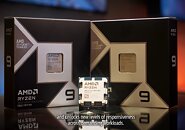
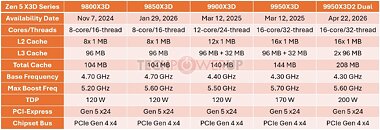
AMD today launched the Ryzen 9 9950X3D2 Dual Edition Socket AM5 desktop processor. This processor is positioned above the Ryzen 9 9950X3D, and is the much awaited implementation of 3D V-Cache memory on both CCDs (CPU complex dies) of the processor. The 16-core/32-thread processor is based on the Zen 5 microarchitecture, and features a total of 192 MB of shared L3 cache—that's 32 MB of on-die L3 cache plus 64 MB of 3D V-Cache that's contiguous with it, across both CCDs. This enables the maximum possible gaming performance, as worker threads of the game can be located on either of the two CCDs and benefit from large last-level cache. The base clock is 4.30 GHz, with a boost clock of 5.60 GHz—100 MHz lower boost than the 9950X3D, and the same clocks as the 9850X3D—no word if these are the same for each CCD.
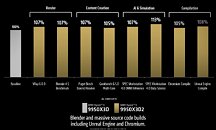
The AMD Ryzen 9 9950X3D2 Dual Edition is positioned to be a 16-core Zen 5 Flagship part, and to ensure the chip has not just the most cache, but also the highest possible clock speeds in the series, and retain its overclocking capabilities, AMD expanded the TDP of the processor to 200 W—the highest ever for an AMD Ryzen part. AMD is offering gaming performance rivaling its latest Ryzen 7 9850X3D part, but with significantly improved productivity performance in applications with large cached data-sets, such as software development, AI training and inferencing, and video production. The company's first-party productivity benchmarks show the 9950X3D2 post significant single-digit percentage gains over the 9950X3D. AMD did not announce price, but said that the 9950X3D2 Dual Edition will be available from April 22, 2026.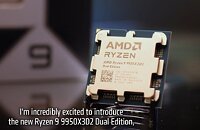

 Known specifications of the Ryzen 9 9950X3D2 Dual Edition follow.
The AMD Ryzen 9 9950X3D2 Dual Edition is positioned to be a 16-core Zen 5 Flagship part, and to ensure the chip has not just the most cache, but also the highest possible clock speeds in the series, and retain its overclocking capabilities, AMD expanded the TDP of the processor to 200 W—the highest ever for an AMD Ryzen part. AMD is offering gaming performance rivaling its latest Ryzen 7 9850X3D part, but with significantly improved productivity performance in applications with large cached data-sets, such as software development, AI training and inferencing, and video production. The company's first-party productivity benchmarks show the 9950X3D2 post significant single-digit percentage gains over the 9950X3D. AMD did not announce price, but said that the 9950X3D2 Dual Edition will be available from April 22, 2026.


149 Comments on AMD Announces Ryzen 9 9950X3D2 Dual Edition Desktop Processor with 192 MB L3 Cache
tpucdn.com/review/amd-ryzen-9-9950x/images/power-applications-compare-vs-pbo.png
^If the new one is like halfway between these two it's still bad for efficiency.
amd less marketing, more driver support, more open source hardware, specs, datasheet, firmware, etc. and more consumer friendly behaviour and longer support of existing purchased amd hardware. longer support of amd instructions and not dropping cpu instructions like XOP.
I'm waiting to see if that "dual Edition" fail mode line appears on the real silicon or not.
good edition, 16 core on one die, bad stuff = dual edition, two dies with 8 cores.This *may* enable possible better performance in various tasks.
not every task utilise cache. more low end cpu cores with reduced cpu instructions are sometimes better for older applications in *microsoft windows (TM)*.
I will just call it "R2D2" CPU, because it sounds better :D
AMD marketing team strikes again !
But their manufacturing strategy is based solely on manufacturing as few things as possible and piece together stuff around that.
200Watt TDP - one can fry eggs on that cpu :D
if you're using it in your profession i doubt 200w is too much power for you to handle
on top of that, it's a halo product, i don't really think buyers are expecting maximum efficiency
Your now packing 12 cores into the same physical space as 8 core were previously. Moving the heatfrom there to the cooler is becoming the main bottleneck in extra performance/efficiency without going into stupid methodologies.
Now i got 7800X3D, im good until 2035 i think. That will also make the next Zen stuff cheaper to buy. Honestly, your CPU is soo good, i dunno why you would even wanna upgrade it. People with 200% worse CPUs are still fine, game and even work. Do you wanna know a stupid fact? I edit over 2500 YouTube videos on i5-2500k. Yeah, dumb but also i did that. It works, slow or not. Gets the job done eventually. If i can game and upload videos often enough, that means its not that bad. Honestly, anyone with a CPU from 2023+ is fine until 2030. I get what you are saying about tech progressing and all... but again, im coming from 2010 and i didnt even feel the need to upgrade. I did cus my motherboard died. I could have used it until 2028 and the final Zen CPU on this current DDR5 platform. Then again upgrading to a dead platform is no fun. I might have delayed it till DDR6 RAM/CPUs are out, cus they will also support 2-3 more generations. So make it 2030 even? A few VERY MODERN games had micro stutters but thats all. Just put a new video card, DLSS on balance/performance and even "4K" gaming looks better than 1440p and the CPU aint too important.
Anyways, the market is going into a funny direction. Soon you wont even have a chance to buy a PC.
P.s. I think the same way about people buying a new phone or a new car every 2-4 years. LOL. Your money of course but yeah, still funny.
I don't care for phones and cars, they're on the same level as a refrigerator for me. But there is a reason people like me are called "PC enthusiasts" or "bike enthusiasts" and you're clearly not one. This is a hobby which you clearly don't understand, which is fine. I don't think that's funny, nothing wrong with keeping a 10+ computer working if it serves a purpose the way I kept my car for 12 years. I have few old machines too. I don't just throw away my hardware, I keep it for other uses or give it away.
AMD TDP Formula
TDP (Watts) = (tCase°C - tAmbient°C)/(HSF θca)
AMD defines tCase°C as: Maximum case(IHS) temperature. The maximum temperature when measured at the package location specified by the appropriate thermal design guide.AMD defines tAmbient°C as: Maximum temperature at the HSF fan inlet to achieve rated performance.
AMD defines HSF θca (°C/W) as: The minimum °C per Watt rating of the heatsink to achieve rated performance.
Rumours are just rumours, but we're expecting 12C/24T clocked at ~6GHz for similar power consumption as the current Zen5 8C/16T at ~5.4GHz. Unfortunately the same rumours suggest CES 2027 as the launch for desktop Zen6 and that means probably a whole year to wait for the 10800X3D or whatever they decide to call it. AMD don't like going from 9000 to 10000, so they'll probably do what they've done with the mobile Ryzens and call it the AI series or some other dumb shit like the Ryzen AI MAX+ 580 X3D with Copilot™ (oops, sorry, couldn't resist a little dig at Microsoft, there....)
I mean this does technically mean you can be within spec with a standard 39x39mm chipset heat sink, provided tAmbient is low enough. But how useful is that when determining what kind of heat sink you actually need which is what the TDP spec traditionally is meant for?
Also watts is watts is watts is watts. TDP will at least provide a ballpark measurement of how much electrical power it uses on average.
But 9850X3D is even more pointless.
Instead, AMD should be focusing on CPU with single Zen6 core complex with extra cache below.
I personally recommend AIO for 16 cores but a highend cooler with good air flow should still be doable.
If you are only focusing on TDP's the 14900K has a TDP of 125 watts lol
Obviously everyone is sensitive to fan noise at different levels depending on both their personal preference and their environment, but realistically a 125W PPT or PL2 (choose your brand) is going to be 100% fine on air.
If you're one of those many weirdos who doesn't care how loud their fans are, you can ignore this entire comment. I'm not judging because almost 30 years ago, that was me; Exotic cooling on Slot-1 and Socket-A nonsense using all the nerdy spare time my access to the university engineering department could provide. Back then, all we really had was 6K RPM 80x38mm Delta fans and it's a miracle I am I still blessed with the ability to hear.
Great to know about your feelings towards AIOs and cores.
A 14900K does not have a TDP of 125W. That is steady state after boost. When boosted it goes to 253W. Which enforces my inquiry towards that if 125W goes to 253W for intel, then 200W goes to what for AMD.
If it helps for arguments sake, lets say the air cooler would be a NHD15G2. I would hope that is sufficient to cool it at load and keep it sub 90, but I don't know.