Monday, April 6th 2026

Intel "Nova Lake" to Use Xe3 Graphics and Xe3P Display/Media Engine
Intel's upcoming "Nova Lake" CPU generation, part of the Core Ultra 400 series, will be a major refresh of the company's P and E-core hybrid design. While many specifications have been largely leaked, the exact integrated GPU configuration remained a mystery until now. One of the most reliable Intel leakers, Jaykihn, has revealed that Intel plans to use the Xe3 generation of graphics, which is found in the current "Panther Lake" Arc B300 series of integrated GPUs. The display and media engine will come from the Xe3P "Crescent Island." Previously, we reported the source's claim that the "Nova Lake" display and media engine would incorporate some IP elements from the Xe4 "Druid" generation of graphics. However, the actual underlying hardware is not related to Xe4 and instead borrows IP from Xe3P.
Intel's plans for "Nova Lake" are focused on late 2026, with the entire lineup expected to roll out in early 2027. The platform will support DDR5 memory at 8,000 MT/s out of the box, without any overclocking. This indicates an improved integrated memory controller on the Nova Lake platform, which seems ready to handle those speeds even before XMP or factory-overclocked modules are considered. It also suggests that Intel is pushing memory support further than its current controller, which reaches DDR5-7200 on the current "Arrow Lake Refresh," alongside the new core IP and updated configuration.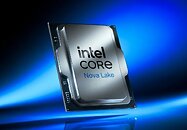 The 52-core flagship Nova Lake chip is expected to have a 175 W TDP, with 65 W variants also included in the lineup. This marks a significant increase from the current "Arrow Lake" flagship, the Core Ultra 9 285K, and its refreshes, which have a 125 W base TDP. For a 52-core chip, this higher rating is reasonable, as boost behavior under heavy workloads will likely drive power consumption much higher in practice. For AI workloads, "Nova Lake" is also expected to deliver more than 100 TOPS at INT8 precision, combining the onboard NPU with the Xe3 graphics engine. Local AI processing is looking to be much more accessible for many as Intel rolls out this platform later this year.
Source:
Jaykihn on X
Intel's plans for "Nova Lake" are focused on late 2026, with the entire lineup expected to roll out in early 2027. The platform will support DDR5 memory at 8,000 MT/s out of the box, without any overclocking. This indicates an improved integrated memory controller on the Nova Lake platform, which seems ready to handle those speeds even before XMP or factory-overclocked modules are considered. It also suggests that Intel is pushing memory support further than its current controller, which reaches DDR5-7200 on the current "Arrow Lake Refresh," alongside the new core IP and updated configuration.

20 Comments on Intel "Nova Lake" to Use Xe3 Graphics and Xe3P Display/Media Engine
And the iGPU should be used as a co-processor (GPGPU) even when using a dedicated graphics card, to relieve the x86 cores of workload for other operations. AMD engineers had this idea about 30 years ago, but never put it into practice.
-------------------------
Returning to the topic at hand, AMD needs to significantly improve the iGPU in its CPUs and APUs, both in terms of raw performance (always with the latest GPU architectures) and image quality of its video encoder, which is the worst of all currently.
I will only upgrade my PC when the Zen7 CPUs are released, and at that time I will see if it's worth buying Intel or AMD. If I buy a Zen7 CPU or APU and the quality of the videos generated by the integrated video encoder of the AMD iGPU is still very poor, I will buy a dedicated graphics card from Intel or Nvidia, which have much better video encoders, not a dedicated graphics card from AMD.
This thread is about Intel latest Nova Lake CPU and its iGPU, what does that have any relation to do with AMD upcoming Zen 7 CPU? If you are not happy with AMD, feel free to make your own thread. This has nothing to do with the discussion at hand.
apu model?
nVidia iGPUs could come sooner though if Titan Lake still gets desktop release.
Either way I don't think AMD will match let alone surpass the Celestial iGPUs in Nova and Razer.
Those that buy Nova Lake DIY are enthusiasts who have a dGPU (or several).
Those that will eventually get Nova Lake via prebuilt/OEM dont even know what an iGPU is, much less care about it's performance in 2D tasks.
I can understand the interest in iGPU in laptops as there it's much more impactful in terms of battery life, heat etc.
Not to mention handhelds where it can make or break a handheld.
It's not to rely solely on the iGPU but it could be a way (I'm referring to the nVidia iGPUs) for some users to get access to the nVidia feature set/ecosystem (albeit something more basic/less capable than a dGPU but still useful nevertheless) that way they're free to get a Radeon dGPU for gaming if they'll prefer that and/or if future Radeons will have better bang per buck.
Let's hope so, for the sake of competition.
Still, that might only be a comeback vs AMD, the real target should be Apple if they want to save x86.
2. A powerful iGPU would actually do quite well in the prebuilt/OEM market. The 3050 and 5050 fill an oft-forgotten but very large market for low-cost esports PCs. An APU with equivalent performance would do very well for OEMs.
I think you mean NVENC.