Thursday, April 9th 2026
Global PC Shipments Grew 3% in 1Q26 as Supply Chain Impacts Emerged
According to the latest research from Omdia, total shipments of desktops, notebooks, and workstations in 1Q26 increased by 3.2% year-over-year to 64.8 million units. Notebooks (including mobile workstations) saw a modest year-over-year increase of 2.6% in Q1 to 50.8 million units. Meanwhile, desktops (including desktop workstations) performed slightly better, up 5.4% to 14.0 million units. Growth was supported by vendors and channel partners pulling orders forward ahead of a widely anticipated increase in component costs, the continuation of the Windows 10 replacement cycle that is still driving commercial refresh budgets, and by a heavier than usual slate of spring product launches across both Windows OEMs and Apple.
"With supply-chain pressures still building, Q1's modest growth is likely to mark the high point for the year," said Ben Yeh, Principal Analyst at Omdia. "Memory and storage costs are expected to rise further and more steeply than previously assumed from Q2, squeezing PC vendor gross margins and forcing them to pass costs through to channel partners and end-customers. AI data center build-outs are crowding consumer categories out of memory and storage supply, which have already seen roughly five-fold and three-fold cost increases respectively since Q1 2025. CPU prices are a smaller but compounding pressure, with Intel and AMD projecting increases of 10-25% into Q2."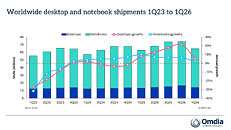
 With costs set to rise across the bill of materials, vendors have every incentive to protect shipments, revenue and gross margin by pulling deliveries forward, and Omdia's regional analysis is consistent with that behavior across most of Q1. Preliminary regional data suggest that channel partners in North America have already absorbed as much as they can before end-user prices rise. In Japan, the market has begun to show a more pronounced downturn, weighed down by the high shipment volume base in 1Q25 and by more severe cost and component supply pressures in the education segment. Given the education-driven surge throughout 2025, fading policy momentum could also become one of the main drivers of contraction in 2026.
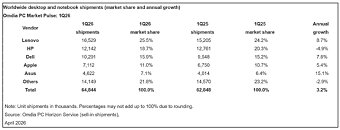 Lenovo remained firmly in the top spot in 1Q26, further expanding its market share with year-over-year growth of 8.7%. Shipments reached 16.5 million units, and its share surpassed 25%. HP remained in second place, but weak performance in Europe and the United States resulted in a 4.9% decline, with shipments falling to 12.1 million units. Dell continued its strong momentum from 4Q25, posting 7.8% year-over-year growth as shipments reached 10.3 million units. Apple reached a market share of 11% with shipments growing 5.4% due to solid MacBook Air sales performance and the initial sell-in of the MacBook Neo. ASUS maintained its double-digit shipment growth, with shipments climbing to 4.6 million units and market share reaching 7.1%.
Source:
Omdia
"With supply-chain pressures still building, Q1's modest growth is likely to mark the high point for the year," said Ben Yeh, Principal Analyst at Omdia. "Memory and storage costs are expected to rise further and more steeply than previously assumed from Q2, squeezing PC vendor gross margins and forcing them to pass costs through to channel partners and end-customers. AI data center build-outs are crowding consumer categories out of memory and storage supply, which have already seen roughly five-fold and three-fold cost increases respectively since Q1 2025. CPU prices are a smaller but compounding pressure, with Intel and AMD projecting increases of 10-25% into Q2."


1 Comment on Global PC Shipments Grew 3% in 1Q26 as Supply Chain Impacts Emerged
The title reads: "Global PC Shipments Grew 3% in 1Q26 as Supply Chain Impacts Emerged"
The data shows: Due to the production shift from distributed areas of consumption of ICs, to mainly products aimed at AI-focused datacenters, the already dwindling component availability resulted in a shipments drop of 23% in desktops and 3% drop in laptops in a single quarter, meaning that manufacturers moved as much material as possible to respond to demand in 4Q25, already itself in a panic to buy before true scarcity hits, where we can expect shipments to drop below the post-confinement period (after everybody and their pet had their home office gear bought). What comes after a mostly constant growth from 1Q24, as companies and consumers resumed renewals of their IT equipment with an economic recovery in 2023 and highly coerced by the discontinuation of support for devices without TPM 2.0, due to the transition from Windows 10 to 11, we are now reporting on the last events of growth in this sector as the component shortage hits its greatest extent, by severely limit the production of desktop and laptop devices, while prices are still within the reach of the majority. It is expected, as reported by numerous sources, that the price increases will remain until 2030, by which then most devices will require upgrading or replacement again, prompting the inability to predict how will the market actually approach the need vs. cost of these products.
In sum, the results of 1Q26 are a result of panic last-breath attempts at maintaining a market and defiantly not the following of a trend that was observed for 2024 and 2025, that continuing would actually have this report showing even higher growth numbers, instead of comparing them with 1Q25 (because 1Q24 and 1Q23 are too far away, despite making for a more sensationalistic headline).