Thursday, April 16th 2026

AMD to Re-launch Ryzen 7 5800X3D as "AM4 10th Anniversary Edition"
AMD is planning to re-introduce the Ryzen 7 5800X3D desktop processor with 3D V-Cache memory as the new Ryzen 7 5800X3D AM4 10th Anniversary Edition. The processor will have the same OPN as the original 5800X3D, but the retail PIB package will have some special artwork commemorating 10 years of AMD Ryzen and the Socket AM4 platform. AMD will have supported the platform with 10 years of new processor launches and continued availability of compatible processors.
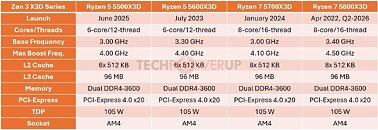
The 8-core/16-thread processor is based on the "Zen 3" microarchitecture, and features stacked 3D V-Cache memory. Each of the 8 cores has 512 KB of L2 cache, and the eight share 96 MB of L3 cache. The processor comes with a base frequency of 3.40 GHz, with a 4.50 GHz maximum boost frequency, with its TDP rated at 105 W. As a Socket AM4 processor, the 5800X3D features a dual-channel DDR4 memory interface, and comes with 20 usable PCI-Express 4.0 lanes, which AMD B550 and X570 chipset motherboards wire out as PCI-Express 4.0 x16, and a CPU-attached M.2 NVMe Gen 4 slot.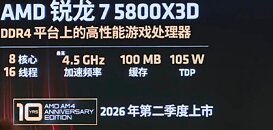
Source:
HXL (Twitter)
The 8-core/16-thread processor is based on the "Zen 3" microarchitecture, and features stacked 3D V-Cache memory. Each of the 8 cores has 512 KB of L2 cache, and the eight share 96 MB of L3 cache. The processor comes with a base frequency of 3.40 GHz, with a 4.50 GHz maximum boost frequency, with its TDP rated at 105 W. As a Socket AM4 processor, the 5800X3D features a dual-channel DDR4 memory interface, and comes with 20 usable PCI-Express 4.0 lanes, which AMD B550 and X570 chipset motherboards wire out as PCI-Express 4.0 x16, and a CPU-attached M.2 NVMe Gen 4 slot.


198 Comments on AMD to Re-launch Ryzen 7 5800X3D as "AM4 10th Anniversary Edition"
RX 7600, the 9060 XT 8GB or the Arc B580 shouldn't be a problem I guess. So, that's more NVIDIA's fault rather than PCIe 3.0 being obsolete I would say.edit: I didn't know the RX 7600 had this problem too, shame on AMD. The B580 has 12GB so it's not as much of a problem as @Rulumi said.
/s for those who need it.
But yeah, I'm not saying it's a bad thing, it's just that they could have been more honest instead of coming up with insane excuses like the BIOS ROM size. While you can get Coffee to work on Z170, you do need to isolate/bridge a pin - an insignificant, but real hardware level change (that did not need to occur). AMD's Zen 3 limitations were purely AGESA level.
It is not that we favor or hate any company. I try to be objective to both.
I respect your purchase decision, but you will overpay for obsolete tech, to a company instead of a particular, that is all. Not expecting this to be cheap at all. I do critizise intel on the same basis, of course.
Your last sentence misses the point as well, its not the cost of DDR4 vs DDR5, its the cost of buying DDR5 vs reusing existing DDR4.
How much does it cost to use 32 gig DDR4 you already own and how much does it cost for 32 gigs of 6000mhz DDR5 at today prices?
Ironically I see used DDR4 is selling for a ton, so an option for me to go DDR5, is to sell the 32 gigs currently used on my 9900k or even my b-die as I dont care for b-die just for encoding machine, that heavily subsidises 32 gigs of DDR5, upgrade main rig, then pass down my current DDR4 to the 9900k. Currently have 128 gigs of DDR4, 64 gigs on AMD hypervisor, 32 gigs on main rig, 32 gigs on 9900k.
This is similar to how I mitigated Ampere pricing, I sold my 1080ti for a premium so my net cost was low.
I would love to buy a Ryzen 9700X AM4, for example. And I would even recommend it to many people.
Zen 5 dies are more dense and thus have higher thermal density and will thus run hotter.
That is why a sub 100W CPU can run hotter than a 300W CPU.
Besides AM4 and AM5 are very different sockets. AM4 is PGA, while AM5 is LGA.
AM4 also lacks the necessary pin count and power delivery. AM5 has 387 more pins (1718 vs 1331).
There is no way to substitute these on AM4.
Overall it would be a pretty pointless Frankenstein exercise that would take years to reach market and by the time it does DDR5 prices have fallen enough to make it pointless anyway. AMD using chiplets does not mean it's just Lego's that you can pick and place across different sockets, memory types etc.
There's also historical precedent for this happening. Intel did it with 11th gen models. Their 10nm was severely delayed, but they had already squeezed out all they could from their 14nm Skylake derivatives. Thus they decided to backport 10nm Sunny Cove (mobile) architecture to 14nm and renamed it Cypress Cove.
By forcing a dense new architecture onto an older, less efficient node, the power draw skyrocketed and 11th gen was and still is mocked as one of Intel's worst generations in recent memory. And that was with the backported architecture supporting the same memory topology.That's untrue. AI is a tool that may help do some legwork, but even Nvidia who designs new chips with AI still takes 12-24 months to release a new architecture. AI is not reliable enough. Humans have to re-check everything it has created and proposed.And did game developers make a huge blunder by making PS5 only games despite the massive PS4 install base?
Should game developers scale back their games that they can also run on PS4 by intentionally crippling them?
What you're asking is essentially to curb the development of current products in order to Frankenstein them into an old platform.
Let's take situation of used cars market. My old car has started to fail here, there and this and that. The repair costs are nearly comparable to getting OTHER car. Why the heck to throw SUCH amount to old car repairing when "generic maintenance" costs of a new car will be a miserable and the "other" (technically "new" for it's owner) car "value" in "its new owner's eyes" will be always preferable? Same here, why the hell to throw $$$ for "old" CPU vs cost of "newer" CPU, yeah adding extra for RAM and mobo, but still it's completely stupid in my opinion to pay same price for older tech vs new tech. Why then people "cried out loud" about Apple iPhone SE 2022? It was good enough phone for its public. And price was really lower vs that time "newer" models. But, todays "Apple cheap comeback" with iPhone 17e looks really clownish when price for technically better "older basic model" is same as "new budget one" with budget having major cutoffs lmfaoEU same I bet;):D:roll:something is off with my math here... or I've got too much of meth...:laugh:
AM5/DDR5 CPU+MB+RAM is ~$630
AM4/DDR4 MB+RAM is ~$290+~$300= $590
$630-$590=$40 it's starbucks small tweens company coffee price, so it's dumb & dumber who will pay $300 for "retro" CPU.:rolleyes::kookoo: Intel i7-8086K comeback?:) I knew one idiot who got it and was proud of it. The prices in EU for 8086K were crazy higher then than "not so exclusive" 8700K lolthe "i7s" "held its value" only for idiots same as fans of 20 y.o. BMWs and MBs who pay crazy for such AGEd stuff. I was always like "picking new i3" rather than same price ~5 y.o. i7.
If someone buys a US$400 Ryzen AM5 CPU, US$450 DDR5 RAM, and a US$350 AM5 motherboard, of that total US$1200 spent by the buyer, AMD will only receive the value of the CPU and chipset. The chipset may be the most expensive component of the motherboard, but it's only a fraction of motherboard's price. Thus, only about half of the $1200 would be a sale for AMD; the rest (approximately US$600), which is still a very high amount, would go to other companies (Foxconn, Samsung, Micron, Texas Instruments, ASMedia, etc.), not to AMD.
Furthermore, if AMD were to sell ZEN5 and ZEN6 CPUs for the AM4 socket, it would be
chainingguaranteeing that home consumers who already own AM4 motherboards would buy AMD CPUs and not Intel ones.Maybe AMD could consider AM4 versions of a few AM5 CPUs if they can work out an updated I/O die that works with AM4. They don't even have to go all-in, just make 2 or 3 AM4+ hybrids that bring the updated X3D layout (extra memory on the bottom) and allowing some OC'ing and better cooling and bring that to market, and it'd be an instant seller. Just give it a weird name suffix; such as 5605X3D (6c), 5805X3D (8c), and 5955X3D (16c).
Yeah, it'll eat into the AM5 market a bit, but by also limiting it to just 2 or 3 hybrid chips, it still results in a net positive for them as they'll get fresh sales on those, and AM5 still would have faster memory speeds and the latest features not present in AM4 mobos. Besides, for many where processing time doesn't = money made per second saved, sticking to AM4 until AM6 has been the plan (myself included), and upgrading CPUs one more time would be an easy sell to them (and myself).
At the same time, you'll blow the 5800X3D out of the water on productivity and general use performance.
And you have significantly faster chips (14900K) you can upgrade to.
1080P gaming with a 3080 :
Applications performance:
And here's the price to beat given that a 12600K is faster than a 5800X3D :
In my case, the trade isn't worth it. As you say, the 5800x3d would be an enormous downgrade in multicore workloads. It also doesn't have an IGP, which isn't a big deal to most "gamers," but it's become a significant value add for me, helpful when troubleshooting, or when repurposing old hardware later on. Idle power consumption on most Zen processors is a minor disadvantage too. And I don't much care for newer AAA games anyway.
But, if you're sitting on some DDR4 already, and your main concern is gaming, then a 5800x3d might be the best available option. If they can price this thing below say $250, then it'll be a no brainer. The 5800x3d may be old tech, but it's easily the best DDR4 gaming CPU, trading blows with most CPUs on DDR5 platforms.
However nobody should be building a new system with a 5800X3D as it's a dead end for AM4. Instead this CPU is for drop-in upgrades for anyone on Zen thru Zen3 and nothing will be able to compete with that on price thanks to 400+% inflated DDR4/5 prices.
The results are not much different than they were when DDR5 came out. There are some specific productivity use cases where DDR5 eats DDR4 rigs for lunch, clearly where they rely heavily on bandwidth and don't care much about latency.
Gaming really isn't such an use case.
This particular test, done in 2025, used a 12900K.
As long as you are running DDR4-3200 or higher, the difference is under 1%, which I would say is definitely within the margin of error. Even with repeated runs etc. etc. Other choices like which particular motherboard you use, and more detailed XMP settings will will have an outsized effect vs RAM type on games.
Today at TechSpot with a selection of new to ~6yr old games on a 5090 (~2.5x FPS @1080p vs the 2080 Ti):
12900K with DDR5 ends up with 20% faster 1% lows compared to DDR4. 17% faster averages.