Thursday, April 16th 2026

AMD to Re-launch Ryzen 7 5800X3D as "AM4 10th Anniversary Edition"
AMD is planning to re-introduce the Ryzen 7 5800X3D desktop processor with 3D V-Cache memory as the new Ryzen 7 5800X3D AM4 10th Anniversary Edition. The processor will have the same OPN as the original 5800X3D, but the retail PIB package will have some special artwork commemorating 10 years of AMD Ryzen and the Socket AM4 platform. AMD will have supported the platform with 10 years of new processor launches and continued availability of compatible processors.
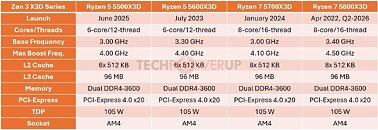
The 8-core/16-thread processor is based on the "Zen 3" microarchitecture, and features stacked 3D V-Cache memory. Each of the 8 cores has 512 KB of L2 cache, and the eight share 96 MB of L3 cache. The processor comes with a base frequency of 3.40 GHz, with a 4.50 GHz maximum boost frequency, with its TDP rated at 105 W. As a Socket AM4 processor, the 5800X3D features a dual-channel DDR4 memory interface, and comes with 20 usable PCI-Express 4.0 lanes, which AMD B550 and X570 chipset motherboards wire out as PCI-Express 4.0 x16, and a CPU-attached M.2 NVMe Gen 4 slot.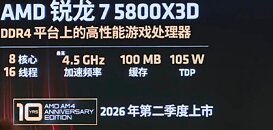
Source:
HXL (Twitter)
The 8-core/16-thread processor is based on the "Zen 3" microarchitecture, and features stacked 3D V-Cache memory. Each of the 8 cores has 512 KB of L2 cache, and the eight share 96 MB of L3 cache. The processor comes with a base frequency of 3.40 GHz, with a 4.50 GHz maximum boost frequency, with its TDP rated at 105 W. As a Socket AM4 processor, the 5800X3D features a dual-channel DDR4 memory interface, and comes with 20 usable PCI-Express 4.0 lanes, which AMD B550 and X570 chipset motherboards wire out as PCI-Express 4.0 x16, and a CPU-attached M.2 NVMe Gen 4 slot.


198 Comments on AMD to Re-launch Ryzen 7 5800X3D as "AM4 10th Anniversary Edition"
32GB of DDR5-7200 is also an $600 item right now, vs DDR5-6000 being ~$360
From the same site, here's a comparison of 14900K gaming performance using DDR4-3600 vs DDR5-6000. This is a far more normal setup for most people.
I don't find +4% real convincing.
Alder Lake, IIRC, is more sensitive to memory in newer games than Raptor. But as always, it depends on the selection of games. With newer games, it's pretty safe to assume that DDR5 will play a big role.
EDIT: I'll add the summary image from the article.
(And ... edited a second time to resize the image, sheesh.)
www.tomshardware.com/features/ddr5-vs-ddr4-is-it-time-to-upgrade-your-ram [Tom's, Nov 2025]
www.techspot.com/review/3059-ddr5-vs-ddr4-gaming/ [TechSpot, Dec 2025]
www.techspot.com/review/2862-ddr5-vs-ddr4-gaming/ [TechSpot, Jul 2024]
www.techspot.com/review/2777-ddr5-vs-ddr4-gaming/ [TechSpot, Dec 2023]
[Tom's, Nov 2025] used a 12900K + 2080 Ti combo, so we can't compare Raptor Lake v Alder Lake very well, and the GPU might be a bottleneck. They also tried multiple RAM speeds, which I appreciate. Their game selection is weird too: AC Valhalla, Far Cry 6, Ghost Recon Breakpoint, Watch Dogs Legion, Borderlands 3, Shadow of the Tomb Raider and Wolfenstein: Youngblood. Somewhat old titles and not that CPU heavy I would say. Barely any difference among all RAM configs.
[TechSpot, Dec 2025] used a 12400F + RTX 5090 combo, so we can't compare Raptor Lake v Alder Lake once again. They only used DDR5-6000 and DDR4-3600 for the whole comparison, reasonable choices but I wish they tried other CPUs too. Their game selection is better in my opinion: Rainbow Six Siege X, Marvel Rivals, AC Shadows, HZD Remastered, Cyberpunk Phantom Liberty, CS2, Space Marine 2, TLoU 2 Remastered, Spider-Man 2, Mafia The Old Country, Assetto Corsa Competizione and Baldur's Gate 3. They saw a 20% difference.
[TechSpot, Jul 2024] Tested many CPUs with an RTX 4090: 14900K, 14600K, 12900K and 12600K at DDR5-7200 (for Raptor Lake), DDR5-6400 (for Alder Lake) and DDR4-3600 (for both). I wish they used DDR5-6000 like they did in 2025, the CPU selection was good though. The games were BG3, TLoU 1, CP2077 PL, Hogwarts Legacy, ACC, Spider-Man Remastered, Homeworld 3, A Plague Tale Requiem, CS2, Starfield, Horizon Forbidden West, Hitman 3 and Watch Dogs Legion. Watch Dogs Legion is the most interesting case, because [Tom's, Nov 2025] saw no difference, but TechSpot saw a 28% difference on the same 12900K. TechSpot had way higher FPS because of the 4090, so there must be a bottleneck in Tom's Hardware review indeed. TechSpot saw a 20% gain for Alder Lake and 15% gain for Raptor Lake on DDR5, even though Raptor Lake used a faster DDR5 kit.
[TechSpot, Dec 2023] used only the 14900K with DDR5-7200 and DDR4-4000 speeds, I don't know the GPU, I guess it's the 4090. They used AC Mirage, CP2077 PL, HZD, Far Cry 6, F1 23, ACC, Watch Dogs Legion, A Plague Tale Requiem, Jedi Survivor, BG3, CoD: MW3, RE4, Shadow of the Tomb Raider, The Callisto Protocol, Total War Warhammer III, Hogwarts Legacy, Starfield, TLoU 1, Halo Infinite, Hitman 3 and Spider Man Remastered. They saw a 10% difference.
The benchmark @RandallFlagg posted is from December 2021, it's the one with most games tested but it's the oldest, and it was done in the 12900K actually (the chart was in the 2023 review too, it confused me for a second). Anyway, I think [TechSpot, Jul 2024] is the one that better shows the current state of DDR4 vs DDR5. Alder Lake seems to be pretty sensitive (20%), Raptor Lake not so much (15%). I wonder if DDR5-6000 would shrink the difference even further for Raptor Lake. I hope that, with this 5800X3D revival and the Raptor Lake refresh, we get more direct comparisons between these platforms on DDR4.
However, while AMD's only concern is making money from CPUs, chipsets, and whatever other deals are in place, it would create a lot of confusion from a business point of view and, if the performance of the backported architectures was not much slower, weaken the point of AM5's existence. It would take engineering time and cost, even if feasible, and then there's the AGESA situation, which would lead to fragmentation, where some supported Zen 1–3 and some Zen 4–6.
Sending the 5800X3D schematics for a quick manufacturing run will make money and has none of these problems: it won't affect AM5 or cost much, and AGESA support has been in place for years. They win the PR campaign: AM5 is still their premier platform; they show (feigned) goodwill towards AM4 customers (by tossing four-year-old crumbs to the mob).
(Why I always laugh and speculate about this case?
1. many hate Intel for "socket change" - but, this is exact same situation but with marketing magic put into other, "shinier" package. only blind won't see parallel.
2. this case is such stupid for some who changes parts frequently and not fully at once. I have had such use-case example, when I have had Ryzen1+MB1, then I got Ryzen2, but wanted it to use on MB1, saving still Ryzen1 in the drawer, and then when I could change MB for "better" MB2, I then better to sell Ryzen1 with MB1 as a combo, so I need to mess with MB1 BIOS again, downgrade it (and pray it won't break lol) to support Ryzen1 back. This is and was such a mess, yes it's 1 of 1000 use-cases but they f...n EXIST.;))depends of SIZE my friend... one could use 16 GB, another wants "only 32" (as me), and some will go crazy and put 64 and only gaming lol.
I very doubt one with 16 GB of 6000+ RAM and some Z-chipset "bling-bling" "pricey" motherboard won't get it stable.;)going 3600 was ALWAYS overprice vs 3200. And some unique persons always wanted lower CL than "cheap" 3600.18, this always was insanely overprice vs "mainstream" 3200.16 or "cheap" 3600.18. Going DDR4 past 3200 nowadays only make sense when you get used higher than 3200 speed suitable size kit for you for REASONABLE price. (so not price of some "mid-tier" same size DDR4 kit in shop NEW today lol)
Either you dont understand CPU testing or you simply dont want to understand.
But sure. Let's test everything at 4K and then wrongly conclude that all tested CPU's are as fast as each other with zero differences...forever, with newer and faster GPU's.AMD didn't decide to throw some out willy-nilly like you claim. This came as a result of a real limitation of the first gen 16MB BIOS chips that could not hold the microcode for all models. Hence some earlier models had to be removed if you were running the latest model.That's on you for buying a board with a 16MB BIOS when boards with 32MB chips existed. Most AM4 users didn't have this problem.
I myself bought high end X570 board in 2019 and i haven't had to change anything on that board aside from regular BIOS updates to run 3800X initially. The 4750G intermediately and 5800X3D as the final form.
On a socket where longevity is the key the motherboard choice matters alot. If you end up buying a cheap crappy board you will regret this one way or another when upgrading the CPU. Best to spend a bit more and get a decent board from the get go. Saves you from the troubles in the future.
So I haven't seen any REASON to waste $$$ for AMD motherboards other than "okay-ish", nor also paying 12-core CPU price for 8-core with some "cache".:rolleyes::oops::kookoo::Dmy friend ran perfectly fine "cheap crap" H110 chipset mobo with "highest end for that socket" i7-7700K without ANY "regrets". Another client used Ryzen 5 1600 initially on "cheap crappy" A320 board and later replaced it with 3600 or 5600, again, without any "problems" lol.
The reason there is a dearth of 4 vs 5th gen ram testing is if you were building a gen 5 capable system it was a no brainer to use it. Then the rampocalypse happen. Aussie Steve at least tested it on the 12400 without the laughably huge GPU bottleneck Tom's tested with.
Also, the performance difference tends to grow with less total cache on the lower end raptor parts like the i5 series. Cache matters for gaming.
PBO is on all boards. Curve Optimizer is amazing for performance and temps regardless of what CPU you use.A series motherboards are pure OEM garbage. I have never recommended them and never will.
Were they at least super cheap then i could see some point, but they're not and that's the problem.
A620 starts at ~70€, but B650 also starts from the same range. Granted B850 is more expensive starting at near 100€, but B850 was never a good deal anyway.
But even comparing 70 vs 100 that's still not cheap enough. A series needs to be 30-60 to make sense.
In every other case it's better to get B650 instead.RAM has always been dependent on chips it uses more than the platform it's running.
I was running 3600 CL16 with my non-Samsung B-Die kit (I think it used Hynix chips) with 3800X.
I had no problems overclocking.That's because back then Intel CPU's were not ovens. Later testing showed that even Z series motherboards struggled with their high end chips.
My thinking was that motherboard makers will not invest much into the first boards as AMD had been in the gutter for roughly a decade at that point.
This is what i said back in 24.05.2016. Ten months before Zen 1 release while i was on 2500K:
So until Ryzens they offered scam crap, not something "good performance and price" (the FX was pretty $$$ these time but I like to test random hw lol)
Yet, not all was bad. Zen used a perceptron branch predictor, similar to Piledriver; and Sandy Bridge borrowed inspiration from Netburst: its micro-op cache simplified and generalised the P4's trace cache, and there was the register file.
The Hades Canyon Nuc's were pretty awesome at the time
I didn't jump into AM4 until 500 series boards and Zen 2 (3800X).
There were decent 400 series boards, but the CPU performance was not quite where i wanted to be yet.
Not until Zen 2. Obviously at the time i didn't know that Zen 3 would be another massive jump, but thanks to a solid board i was able to upgrade with ease.
w11 also have some latency issues definitely slower than w10 on desktop.
That's the problem with modern Windows for a power user. If i already have to debloat, configure and use the terminal then Windows loses it's appeal as a "plug and play" operating system. In the past it's main advantage over others was it's ease of use and setup along with legacy support.
Now the actual weird part is that with a Ryzen AI 7 450G you get fewer usable PCIe lanes (12) and a worse iGPU (Radeon 860M) against the Ryzen 7 8700G 16 usable PCIe lanes and the Radeon 780M iGPU, it's a weird release.
Currently being stuck with RDNA 3.5 is also going to cause them some problems in the mobile segment, apparently they are preparing RDNA 4m (GFX117x), despite the name it seems to be RDNA 3.5 with some added instructions and modules from RDNA4, even if not completely ideal that would still be a much better situation than being stuck with RDNA 3.5 integrated graphics until 2029 when Apple, Intel and others are already keeping advancing over RDNA 3.5 capabilities and performance in current and new releases.