Monday, April 20th 2026

NVIDIA Develops 2-3x Faster Real-Time Path Tracing with Better Image Quality
NVIDIA has developed a new algorithm for path tracing that will make it 2-3 times faster, deliver better visual quality, and improve the robustness of real-time path tracing. Scheduled for a technology demo at the ACM conference on Computer Graphics and Interactive Techniques in May, NVIDIA has found a way to make real-time path tracing a fully realistic rendering process, moving beyond the usual emulation, software denoising, upscaling, and other techniques we use today. Since real-time path tracing is extremely compute-intensive, modern GPUs are still not powerful enough to execute the full path tracing technology in all its potential. Instead, we currently rely on emulations in modern games, implemented across many titles to address this computational demand. Below is the abstract described on NVIDIA's paper page, though the paper itself is not yet available as its publication is scheduled for May. However, note that the technology is still in development, and we have to wait more for it to hit commercial games.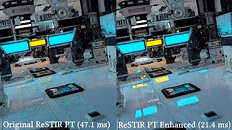
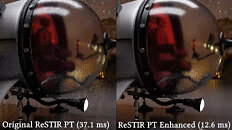 Users can check out the NVIDIA video demonstration through the link provided here. As one Redditor noted, Dynamic Diffuse Global Illumination (DDGI) in 2019 helped bring real-time global illumination to more games and even current consoles by making dynamic lighting much more affordable. Reservoir-based Spatiotemporal Importance Resampling (ReSTIR) in 2020 was a significant advancement because it made real-time path tracing much more practical by reusing effective light samples instead of recalculating everything from scratch. Now, Reservoir-based Spatiotemporal Importance Resampling for Path Tracing Enhanced (ReSTIR PT Enhanced) in 2026 is expected to push things even further by making path-traced direct lighting and global illumination more accessible to developers. This could enable future games to achieve higher visual quality without requiring extremely powerful hardware.
Sources:
NVIDIAResearch, via Reddit
NVIDAAlgorithms leveraging ReSTIR-style spatiotemporal reuse have recently proliferated, hugely increasing effective sample count for light transport in real-time ray and path tracers. Many papers have explored novel theoretical improvements, but algorithmic improvements and engineering insights toward optimal implementation have largely been neglected. We demonstrate enhancements to ReSTIR PT that make it 2-3x faster, decrease both visual and numerical error, and improve its robustness, making it closer to production-ready. We halve the spatial reuse cost by reciprocal neighbor selection, robustify shift mappings with new footprint-based reconnection criteria, and reduce spatiotemporal correlation with duplication maps. We further improve both performance and quality by extensive optimization, unifying direct and global illumination into the same reservoirs, and utilizing existing techniques for color noise and disocclusion noise reduction.


58 Comments on NVIDIA Develops 2-3x Faster Real-Time Path Tracing with Better Image Quality
I'm glad somebody is trying to push lighting forward. Having seen a few games using path tracing, the lighting really does look better.
With that said the problem with those new features is that, they are trying to show that You can't live without it, but You can, if it is good and works fine let it work in games, but don't disregard people that don't like it, let people have options to use it or not.
So I hope they don't make it standard and make games that can't be played by People who don't have money to buy new gpu every 2 years.
But in other hand I hope they could improve even more, that even older hardware could try new features :), but just please don't require them to run every new game.
Now all that remains, is to fix the FPS and denoise it using DLSS 5 *.
* original lighting may be completely ignored.
The rising tide lifts all boats.
Some places in CB2077 look better to me ambience wise, than PT.
*Edit*
On another note; if it's improved algorithms, why can't this performance be done via driver for backward compatibility? I very much doubt many developers will update their old games/engines.
But, I really would like to see what they would say if this tech came from AMD, was open source, or some such - ie did not carry the baggage of coming from that disgusting, greedy, evil Nvidia, (as explained to us by a myriad of self reinforcing posts, videos, and the like). Bias is a helluva thing :)
I don't care whether you are pro or con, at least comment on the actual article.
Obviously we'll have to see what it looks like hands-on, but still, I'd rather encourage this kind of development than that DLSS 5 "innovation" (not everyone wants their characters to look like generic chatbots!).
It's literally "This is worthless" meme IRL. If it's not yet it soon will be if they continue with this trajectory. It's why I'm mad and salty. Because the state of the industry is in the ass.