Monday, April 20th 2026

NVIDIA Develops 2-3x Faster Real-Time Path Tracing with Better Image Quality
NVIDIA has developed a new algorithm for path tracing that will make it 2-3 times faster, deliver better visual quality, and improve the robustness of real-time path tracing. Scheduled for a technology demo at the ACM conference on Computer Graphics and Interactive Techniques in May, NVIDIA has found a way to make real-time path tracing a fully realistic rendering process, moving beyond the usual emulation, software denoising, upscaling, and other techniques we use today. Since real-time path tracing is extremely compute-intensive, modern GPUs are still not powerful enough to execute the full path tracing technology in all its potential. Instead, we currently rely on emulations in modern games, implemented across many titles to address this computational demand. Below is the abstract described on NVIDIA's paper page, though the paper itself is not yet available as its publication is scheduled for May. However, note that the technology is still in development, and we have to wait more for it to hit commercial games.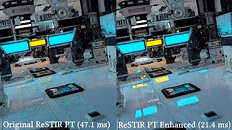
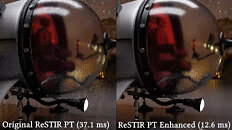 Users can check out the NVIDIA video demonstration through the link provided here. As one Redditor noted, Dynamic Diffuse Global Illumination (DDGI) in 2019 helped bring real-time global illumination to more games and even current consoles by making dynamic lighting much more affordable. Reservoir-based Spatiotemporal Importance Resampling (ReSTIR) in 2020 was a significant advancement because it made real-time path tracing much more practical by reusing effective light samples instead of recalculating everything from scratch. Now, Reservoir-based Spatiotemporal Importance Resampling for Path Tracing Enhanced (ReSTIR PT Enhanced) in 2026 is expected to push things even further by making path-traced direct lighting and global illumination more accessible to developers. This could enable future games to achieve higher visual quality without requiring extremely powerful hardware.
Sources:
NVIDIAResearch, via Reddit
NVIDAAlgorithms leveraging ReSTIR-style spatiotemporal reuse have recently proliferated, hugely increasing effective sample count for light transport in real-time ray and path tracers. Many papers have explored novel theoretical improvements, but algorithmic improvements and engineering insights toward optimal implementation have largely been neglected. We demonstrate enhancements to ReSTIR PT that make it 2-3x faster, decrease both visual and numerical error, and improve its robustness, making it closer to production-ready. We halve the spatial reuse cost by reciprocal neighbor selection, robustify shift mappings with new footprint-based reconnection criteria, and reduce spatiotemporal correlation with duplication maps. We further improve both performance and quality by extensive optimization, unifying direct and global illumination into the same reservoirs, and utilizing existing techniques for color noise and disocclusion noise reduction.


58 Comments on NVIDIA Develops 2-3x Faster Real-Time Path Tracing with Better Image Quality
Do GPUs cost more these days? Sure, but pretending it has zilch to do with global situation is disingenuous at best.I'm sorry that's how things are in the parallel universe you inhabit but here the story’s quite different: see above. This narrative sounds like somebody who has never tried to run Doom on a 386 :), or many subsequent AAA releases on average hardware maxed out.
Also, it always puzzles me that somehow it's ok to uglify a game by dropping all kinds of settings, but having a bit of fuzz via DLSS is a crime against artistry, or something.Gun to your head? I get it that you're trying to get out of a jam by using extreme hyperboles, but that really is getting things in a rather comical direction.
Second: the 5850 you used to run Crysis cannot run it at full settings at 1080p. According to reviews from years after the game came out, the HD 7970 was as low as you could go at 1080p max settings and still hit an average of 60 FPS. not minimum, just average. Despite that, the tech the game introduces, like volumetric lighting or ambient occlusion, were not derided as being useless performance hogs.
Sure, some games run poorly today, but theres plenty of games that run great. And if you're not running at full settings, games are easily playable on low end hardware. Even the 5060 can run modern games.
If you really, truly needed a 4090 or 5090 to make games playable, do you really think the PC would be outstripping all consoles combined in software sales? Those two GPUs combined are a whopping 0.5% of the steam market.
A little more kindness from you might get you a better discussion that you might actually enjoy. I don't expect any of my opinions to matter to others, including you.
If the VRAM + bandwidth requirements are indeed bigger they could be mitigated by this:
www.techpowerup.com/348003/nvidias-neural-texture-compression-cuts-vram-use-from-6-5-gb-to-970-mb
But that could eventually lead to nVidia consumer cards being optimized for gaming, that is increasingly meager VRAM uplifts going forward, those who want cards that can do other things (very well) besides gaming will have to pay dearly for the Pro cards.
The problem with this scenario is prices will still be high, so it's not like people would get a "discounted MSRP" each gen because they're only getting compute uplifts but not necessarily VRAM ones too.The whole 2x, 3x could be a spin, like the "4090 performance for $549".
So not literally 2x, 3x the fps obtained with OG PT but lower performance penalty instead.
There's also the question as to how much this technology and other AI technologies will increase VRAM usage as well.
Most likely Nvidia will still be forced to put a reasonable amount of VRAM on their cards. If not just for the fact that the cards being multi-use and their non-gaming performance heavily drive their pricing. It's a huge chunk of why Nvidia has been able to increase prices so much start way back with the 700 series. Having those features is a massive draw.
I'm looking forward to seeing where this takes us (with a little apprehension).
There has to be monetary advantage for NVidia or progression will stall. It remains to be seen if the response from AMD and Intel will keep the product stack and pricing in check.
How much this benefits us in real terms remains to be seen.
Not forgetting, Moores law is no longer realistic without a huge price increase. So some performance and quality improvements need to come from elsewhere.
As its not easy to extract as high hardware performance per gen now, software optimisation has become key, and not just for our benefit.
Plus the years between generations will probably need extending, otherwise the differences between gens will be small and the backlash big.
Then theres our economic situ...
I'm glad to see progression and that ReSTIR is an open standard.
/waffle