Monday, April 20th 2026

NVIDIA Develops 2-3x Faster Real-Time Path Tracing with Better Image Quality
NVIDIA has developed a new algorithm for path tracing that will make it 2-3 times faster, deliver better visual quality, and improve the robustness of real-time path tracing. Scheduled for a technology demo at the ACM conference on Computer Graphics and Interactive Techniques in May, NVIDIA has found a way to make real-time path tracing a fully realistic rendering process, moving beyond the usual emulation, software denoising, upscaling, and other techniques we use today. Since real-time path tracing is extremely compute-intensive, modern GPUs are still not powerful enough to execute the full path tracing technology in all its potential. Instead, we currently rely on emulations in modern games, implemented across many titles to address this computational demand. Below is the abstract described on NVIDIA's paper page, though the paper itself is not yet available as its publication is scheduled for May. However, note that the technology is still in development, and we have to wait more for it to hit commercial games.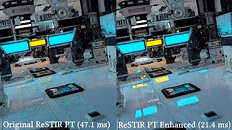
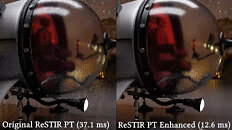 Users can check out the NVIDIA video demonstration through the link provided here. As one Redditor noted, Dynamic Diffuse Global Illumination (DDGI) in 2019 helped bring real-time global illumination to more games and even current consoles by making dynamic lighting much more affordable. Reservoir-based Spatiotemporal Importance Resampling (ReSTIR) in 2020 was a significant advancement because it made real-time path tracing much more practical by reusing effective light samples instead of recalculating everything from scratch. Now, Reservoir-based Spatiotemporal Importance Resampling for Path Tracing Enhanced (ReSTIR PT Enhanced) in 2026 is expected to push things even further by making path-traced direct lighting and global illumination more accessible to developers. This could enable future games to achieve higher visual quality without requiring extremely powerful hardware.
Sources:
NVIDIAResearch, via Reddit
NVIDAAlgorithms leveraging ReSTIR-style spatiotemporal reuse have recently proliferated, hugely increasing effective sample count for light transport in real-time ray and path tracers. Many papers have explored novel theoretical improvements, but algorithmic improvements and engineering insights toward optimal implementation have largely been neglected. We demonstrate enhancements to ReSTIR PT that make it 2-3x faster, decrease both visual and numerical error, and improve its robustness, making it closer to production-ready. We halve the spatial reuse cost by reciprocal neighbor selection, robustify shift mappings with new footprint-based reconnection criteria, and reduce spatiotemporal correlation with duplication maps. We further improve both performance and quality by extensive optimization, unifying direct and global illumination into the same reservoirs, and utilizing existing techniques for color noise and disocclusion noise reduction.


58 Comments on NVIDIA Develops 2-3x Faster Real-Time Path Tracing with Better Image Quality
I remember the days of 8-bit gaming (Commodore 64, Atari, Amiga, IBM Clone PCs, etc.), when the gameplay, not the graphics was the thing most gamers really enjoyed. To me, gameplay is always more important than the new feature in graphics. Maybe you are too young to understand what has changed over the years and not for the benefit of humanity or the consumer.Yeah. That is exactly right. It's like they are trolling people because they have their own opinions. Why do they think they are the gatekeepers of the community? Kind of sad, really...
🙄Or devs will try to apply 3x more effects ...
It probably could run on rtx 3090 (rtx 3090Ti)
rtx 4090 definitely has enough computing power to run it.
But you will get it enabled on rtx 6060 laptop which wont have enough power to use it for real.
They had it but they give it slowly, new generation, next generation, all that bullshit.
Now with Pragmata and Resident Evil Requiem, Nvidia insists on full precision or higher precision path tracing, they could do it much cheaper but if it runs on RTX 5070 then what would be the point of RTX 5080 and 5090.
Bought tech media like Digital Foundry will advertise this like they invented the light bulb, Nvidia is getting close to Apple in terms of marketing.
Greetings
Like I said, PT offers a huge visual upgrade, and I'm glad that at least one company in the space is working hard to push the tech forward. If you dont like new technology you are welcome to disable PT and keep using pre baked renders, just like nobody forces you to use RT, upscaling, or FG.Playing a game like Metro, the RT make sit look a whole gen newer.Pretty sure you mistook nVidia for AMD here.
Regardless, technology WILL advance, and at some point you will need new hardware to do new effects. Thats how things work.
I feel like people just want the industry to completely stagnate so the never have to accept any kind of change (and then they can complain we're still stuck on 4 cores and why cant we get something better.....)Oh yes, the pinnacle of gameplay: run to the right and press the jump button. if you get REALLY advanced, maybe you run LEFT too!
Gamers still enjoy good gameplay today. IDK why you think that changed, games with good gameplay are consistently outselling and out living graphical showcases with no meat to them.Ive been around more than long enough to tell you people today have become insanely cynical and depressed, angry over every little thing. when Crysis came out, people didnt wail and gnash their teeth over this unoptimized fairly mediocre FPS game with some neat effects. When Hardware T&L released, people didnt cringe and demand developers keep doing things the old fashioned way because it was good enough before.
Even now, people mald over GPU prices because they always compare them to prices during the GFC and conveniently forget the market from 2000-2007, because the top end 8800 series being in the 4 digit range with inflation doesnt fit the worldview they try to paint. A high end rig in 2008 was utterly unobtainable to the average joe unless they were REALLY dedicated, yet nobody was sobbing over how nGREEDia and SINtel were ruining the hobby with their $1000 processors. We drooled over E8600s and 8800 ultras, built our budget rigs with whatever we could get, and played our games and had fun!
Most people just want to be absolutely miserable all the time. Despite games being so "horrible" and the hardware so "terrible", ece ece they still come here and crap all over everything that comes out. Why? You have literal decades of software available to purchase, a whole lifetime's worth of games available, all of which run on the equivalent of a toaster, and if you run out somehow, you also have literal decades of consoles you can emulate! Just playing the whole PS2 library would take you decades.
I always have to ask, when someone who has been around for awhile says this stuff: "why are you here complaining about the new things you dont like instead of enjoying the literal decades of greatness available to you right now?"
When you pay for higher class than you have now.
it's just like trying to render down to microscopic levels with rasterization & tessellation.
If I can't can't see it why are you rendering it ??? I don't have a in game microscope? ?? ( Crysis 2)
the current ray tracing design factors are poorly done, to the point where no hardware will have enough compute to staify it
What's need it cut off points for ray & dynamic ray count total that can change on the fly. Games don't need 1,024 ray pre-pixel if the screen if the scene is full of fog! or the light intensity isn't the high. ( that 1024 ray's- per-pixel's what developers claimed they needed for no noise in ray tracing games. While a RTX 5090 can only 4.5 ray pre-pixel even in 4K rendering while rendering rasterization.) by the way that's 256x more compute performance for rays. Not ever going to hit that untill 20 years later
What's need isn't compute it's link the rays to correctly done physics for waves, frequency's & intensity.
The current design is compute heavy because it's sort of just "Dumb rays" that don't do very much except from Point A to point B & sometime reflect from point B to C, then tell the texture units to shader x,y,z. There's literally a ton of things the light ray isn't doing or isn't doing properly. That Ray tracing cores can't do without proper physics calculations applied to it or reapplied while in motion.
This is just a ploy to get you accept more A.I software that isn't actually helping, or just hallucinating details that weren't originally there, but look aesthetically please to people.
I was looking at some DLSS 4 transformer model on Horizion Zero dawn Forbiddin west & I'm fairly certain that it was adding details that was never part of the original games models or rendering even on 16k native.
DLSS 5 took that to the extreme, since they were getting away with it on DLSS 4.
The paper details new ways of handling PT on the software side (i.e. in the game engine). It improves PT performance by being smarter about what is included in the process and de-duplicating work. Nothing about this signals any new hardware requirements beyond what already exists.
I am also glad to see that intelligent approaches are taken now. Brute force usually only is chosen in the beginning of a new tech.
5090 - 140 fps @ 1080p DLSS Quality (aka 720p) with PT
Three times that is 420, oh that was yesterday, lol. :laugh: :pimp:
www.techpowerup.com/review/pragmata-performance-benchmark/5.html
^That's 55% more than 1080p native without RT.
At 1440p it would be 315 vs 220 fps, 43% more.
At 2160p it would be 186 vs 138 fps, 35% more.
So this "new PT" wouldn't give a performance penalty like expected (compared to native) but a performance boost instead. :eek:
tpucdn.com/review/pragmata-performance-benchmark/images/upscaling-performance.png
^Since the comparison uses native vs DLSS Quality there is a performance boost when switching but still reasonable percentages.
tpucdn.com/review/pragmata-performance-benchmark/images/vram.png
^There's also the question of VRAM impact of PT, does it remain the same with this new one and only the framerate increases or is the VRAM impact lower as well?
2x would seem plausible, fps for DLSS Quality would be very close to native, that would mean small performance penalty compensated by upscaling.
1080p - 271.4 vs 280 fps ("new PT" +3.2% faster)
1440p - 219.6 vs 210 fps (native +4.6% faster)
2160p - 138 vs 124 fps (native +11.3% faster)
* Higher VRAM usage for the reservoirs and VRAM bandwidth requirements
* Deep engine integration required (notably beyond what is required for current RT)
* Higher register pressure (capacity, bandwidth, throughput)
* Longer shader compilation times (more complex shaders)
* Over / under estimation of light sources (might be why we see the difference in floor reflection in the last clip of the video.
Basically everything next gen GPUs would solve. Increasing register and cache would improve RT performance in general.
I do wish they moved away from this being temporal.Saying other people's opinions are valid is wrong?
You are just wholesale attempting to dismiss everyone else's opinions and you don't even bother giving a reason why, let alone an actual argument.Not sure if you actually read my comment, I did say this could be a good thing (after nothing the visual differences). Not that I've ever used any PT / RT feature. I don't dislike the feature but I do prefer performance and a clean presentation. Art style always trumps graphical fidelity.
If everyone was racing towards realism, games would homogenize visually and a big part of the charm of games has always been the visual style.This isn't true and we all know it. AAA games are increasingly being designed with upscaling in mind and in some cases being an outright requirement. It's absolutely at least a soft requirement in an increasing number of titles.This is really a false equivalent on many levels.
Crysis (the first) is 1 game, not an industry trend. Games of the time didn't suddenly require a $2,000 GPU in order to run. One game being hard to run is not the same as every AAA title running like doo-doo unless you have a 4090 / 5090 and still having messy artifacts. Heck I remember running Crysis on my $280 5850 right before I upgraded to something better. The presentation was also a lot cleaner as well. There was no temporal artifacts, smearing, ect. Nevermind that Crysis 1 has a more interactive environment than your average AAA title to this day.
People were excited about graphical features back then because most folks could actually afford to buy a GPU that'll run them reasonably, new features would generally run well across the entire GPU stack, you didn't have a gun held to your head basically forcing you to use features required to get decent performance, and they didn't come with image quality degradation drawbacks (remember the crap FXAA took?).
People used to get notably more performance per dollar gen over gen. That's exciting, that's advancement. It's not advancement when everything gets significantly more expensive every gen.I did some math using the 5090's Alan Wake 2 PT on vs off, cutting the PT performance hit of PT in half would place the card at 173.9 FPS at 1080p, up from 132.
How far are we realistically away from them renting us their GPUs exclusively - not just as an option via their cloud service? Their encoding is highly advanced, streaming latency is becoming almost nothing sans HAGs (even with HAGs, frame generation makes it fill almost non-existent), and fiber is rolling out nationwide.
that pragma game, seems another nvidia exclusive tech demo, nvidia exclusive features, is also something i do not really see what other people appreciate.
when people like it, why not. some consumers will see nvidia this and that and will keep on buying the market leader in graphic cards. which is of course good for the market. one graphic card maker means microsoft needs to test and support less hardware.
They say they're making Path Tracing easier to run, and you somehow take that as a sign that they want to do away with discrete GPUs. It's like talking to a flat-earther.
I have a 5090, PT at 4k max setting is quite taxing.